
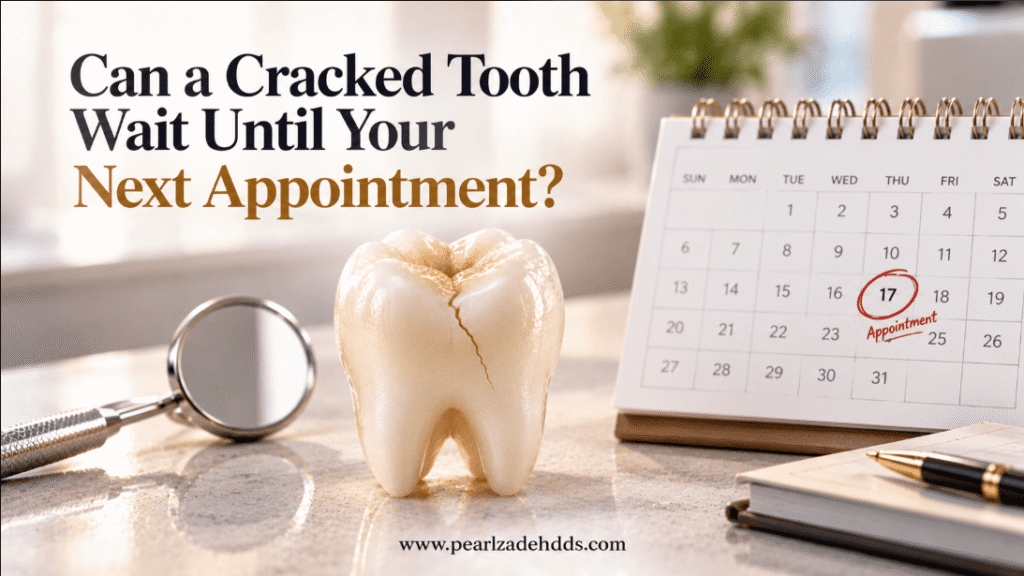
A cracked tooth does not always require emergency care, but it should not automatically wait until your next routine appointment. The right timing depends on the symptoms and the condition of the tooth.
Severe symptoms, such as facial swelling or fever, need prompt attention. If you suspect a crack, contact a dentist for advice rather than assuming it is safe to wait.
Can a Cracked Tooth Wait for a Dental Appointment?
No single waiting period is safe for every cracked tooth. The answer depends on the symptoms, the extent and location of the crack, and the tooth’s condition.
A tooth that causes little pain may still have a significant crack. Severe pain can also have other causes, so discomfort alone cannot show how serious the problem is.
Cleveland Clinic addresses chips or cracks that do not cause pain. It says it may be OK to wait until your dentist can see you. However, you cannot judge a crack’s depth at home, so call the dental office for advice.
When you call, explain when the symptoms started, what triggers the pain, whether a piece of tooth has broken off, and whether you have swelling. These details can help the office advise how soon you should be seen.
A suspected crack generally warrants a call to the dentist for guidance. Severe symptoms may require emergency care, as discussed below.
Signs You Should Not Ignore
These symptoms warrant a dental assessment:
- Pain when chewing or releasing a bite.
- Persistent or worsening sensitivity to temperature or sweets.
- Pain that comes and goes without a clear cause.
- A visible crack or a broken piece of tooth.
- Swelling or severe pain.
The American Association of Endodontists (AAE) describes erratic pain when chewing, possibly with the release of biting pressure. It adds that the pain may come and go.
These symptoms can have other causes. They do not confirm a crack on their own.
Some cracks cause little or no pain. Cleveland Clinic says cracked teeth do not always cause symptoms. A lack of symptoms does not show that the tooth is intact or that delaying assessment is safe. Only an examination can show which situation applies.
When Should You Seek Urgent or Emergency Care?
Not every suspected crack is an emergency. Some symptoms, however, call for prompt attention.
Severe or rapidly worsening pain, facial or gum swelling, or fever with dental symptoms warrants prompt assessment. Call your dentist right away. MouthHealthy, the American Dental Association’s (ADA) consumer site, advises providing as much detail as possible about your condition. Cleveland Clinic notes that a badly cracked tooth may be a dental emergency.
Difficulty breathing or swallowing requires emergency medical care. Mayo Clinic’s guidance on tooth abscess says to go to the emergency room for trouble breathing or swallowing. It also advises the emergency room for fever with facial swelling when you cannot reach your dentist.
Do not wait for office hours or a scheduled visit if you have these symptoms.
What Should You Do While Waiting for Your Appointment?
These steps may reduce stress on the tooth. They do not repair the crack or replace a dental examination.
- Avoid chewing on the affected side.
- Choose softer foods.
- Avoid hard, crunchy, sticky, or chewy foods.
- Keep the area clean with gentle brushing.
- Contact the dental office if symptoms worsen or new symptoms develop.
MouthHealthy advises rinsing the mouth with warm water to clean the area after a crack. Do not test the tooth by biting hard objects or applying extreme heat or cold.
If a sharp edge irritates your tongue or cheek, Cleveland Clinic suggests covering the area with orthodontic wax.
Over-the-counter pain relievers may help some people. Follow the product label, and ask a pharmacist or clinician if you are unsure what is appropriate. Do not place aspirin on the tooth or gums. Mayo Clinic says a painkiller placed directly against the gums may burn the tissue.
Our article on what to do if you have a cracked tooth covers immediate steps in more detail.
What Happens When a Dentist Examines a Cracked Tooth?
The dentist reviews your symptoms and dental history, then examines the tooth. A bite assessment may help identify the affected tooth. Further tests or imaging may follow when appropriate.
Imaging has limits. StatPearls is a clinical reference hosted by the National Institutes of Health. It says a radiograph may reveal a thin line in some cracks. Usefulness depends on how the crack runs. A normal X-ray therefore does not always rule one out.
Our article on how dentists diagnose a cracked tooth when an X-ray looks normal covers the methods they may use.
Treatment depends on the extent of the damage. Cleveland Clinic explains that the right approach depends on how much of the tooth is affected. The crack’s location and depth also matter. Not every crack can be repaired, and a crown is not always necessary. Our article on cracked tooth treatment with bonding, an onlay, or a crown compares the options.
Can a Cracked Tooth Get Worse If You Wait?
Some cracks can. Cleveland Clinic says that even with treatment, tooth cracks sometimes continue to get bigger or split. Continued chewing and pressure may worsen some cracks, but the risk depends on the tooth and the crack. Symptoms alone cannot predict a timeline.
Pain that fades does not mean the crack has healed. Read more about whether a cracked tooth can heal on its own.
Symptoms cannot reliably show how deep a crack is. A dentist can advise how quickly the tooth should be assessed. Dr. Pearl Zadeh can examine the tooth and discuss what care may be appropriate. You can also read about dental crown treatment at Pearl Zadeh DDS. Crowns are one option dentists may discuss for some cracked teeth.
Call (818) 716-6722 or click the button below to schedule your consultation online.
Frequently Asked Questions
No universal waiting period is safe. Some cracks cause little or no pain, so a lack of pain does not show the tooth is intact. Call your dentist, describe what you notice, and ask how soon to be seen.
Yes. Pain when biting warrants a dental assessment. It can have several causes, including a crack, and only an examination can identify which one applies.
Avoid hard, crunchy, sticky, and chewy foods, and avoid chewing on the affected side. Softer foods place less pressure on the tooth. These steps do not repair the crack.
Symptoms can change, and some cracks worsen over time. Timing varies and cannot be predicted from symptoms alone. Contact your dentist if symptoms worsen or new ones appear.
Severe or rapidly worsening pain, facial or gum swelling, or fever with dental symptoms warrants prompt assessment. Difficulty breathing or swallowing requires emergency medical care.
The information above is for informational purposes only and is not a substitute for professional dental advice. Please schedule a consultation with Pearl Zadeh DDS to discuss your specific situation.