
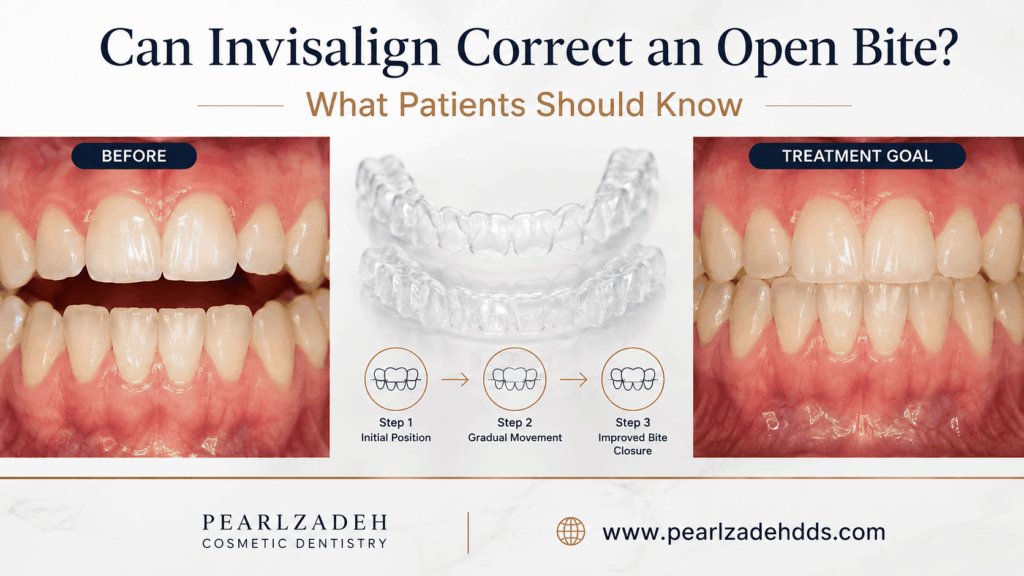
You close your teeth together, but your front teeth still leave a visible space. This is what many patients with an open bite experience, and it can affect more than just the appearance of their smile. An open bite may change how you bite into food, speak, or feel about your teeth.
Many people know Invisalign can straighten crowded teeth or close gaps, but they are less sure whether clear aligners can correct bite problems. The answer depends on several factors, including the type of open bite, its severity, and what is causing the teeth not to meet properly.
A proper evaluation can help determine whether Invisalign is a suitable option or whether another approach may better fit your smile goals.
What Is an Open Bite?
An open bite happens when some of your teeth don’t make contact when you bite down fully. Invisalign’s own patient resources describe two main types. An anterior open bite affects the front teeth, leaving a visible gap between your upper and lower teeth even when you close your back teeth together. A posterior open bite is less common and affects the back teeth instead, where the molars and premolars don’t meet even though the front teeth do. This is different from an overbite, underbite, or crowded teeth, which involve teeth overlapping, misaligning, or sitting too close together rather than failing to meet at all.
Beyond how it looks, an open bite can affect everyday function. Some patients notice difficulty biting into certain foods, changes in how certain sounds are pronounced, or a tendency for the tongue to rest between the front teeth. Left unaddressed for years, an open bite can also place uneven strain on the jaw joint for some patients. This isn’t true for everyone with an open bite, and severity plays a large role, but it’s part of why correction can matter beyond appearance alone.
What Causes an Open Bite?
Open bites usually come from one of a few sources. Childhood habits like prolonged thumb sucking or pacifier use can gradually push teeth out of position over years of repeated pressure. Tongue thrusting, where the tongue pushes against the front teeth during swallowing or speech, can have a similar effect. In other cases, the cause is skeletal rather than habitual, meaning the jaw itself grew in a way that creates the gap, sometimes described as a long-face or vertical growth pattern. Knowing which of these is behind your specific open bite matters, since it shapes what treatment approach actually makes sense.
Can Invisalign Correct an Open Bite?
In many mild to moderate cases, yes. Invisalign has shown reasonable success treating open bites caused primarily by tooth position rather than significant jaw structure issues. That said, not every open bite responds to Invisalign alone, and results vary considerably based on severity and cause. This isn’t a treatment that works identically for every patient with an open bite, which is exactly why an evaluation matters more than a general yes or no answer found online.
How Invisalign Works to Improve Bite Alignment
For many anterior open bite cases, Invisalign aligners are designed to act somewhat like bite blocks, applying gentle, sustained pressure that can help the back teeth settle slightly while allowing the front teeth to extrude, or move down, into contact. One study looking at anterior open bite predictability with clear aligners found that treatment achieved roughly two-thirds of what the software’s initial prediction had projected, a reminder that digital previews give a general direction rather than a guaranteed outcome. This is part of why regular monitoring throughout treatment matters, so your dentist can adjust the plan if your bite isn’t closing as expected. The general tooth-movement mechanics involved are similar to how Invisalign closes gaps between teeth, just applied to vertical movement rather than horizontal spacing.
What Determines Whether You’re a Good Candidate
Several factors shape whether Invisalign is a reasonable option for your specific open bite. Severity matters most: a small gap involving one or two teeth responds differently than an open bite spanning several teeth. How much tooth movement is actually needed factors in too, since more significant repositioning can push past what aligners alone reliably achieve. Whether the open bite is primarily dental, meaning it’s about tooth position, or skeletal, meaning it involves how the jaw itself developed, makes a substantial difference, since aligners work on tooth position and have real limits when it comes to jaw structure. Your overall oral health, including gum condition and any existing dental work, also factors into whether your teeth are ready for aligner treatment at all.
Mild cases, often limited to a few teeth with a primarily dental cause, tend to respond most predictably to Invisalign alone. Moderate cases may still be treatable but often need closer monitoring and sometimes additional tools, like small attachments that give aligners more precise grip on specific teeth. More complex cases, particularly those with a significant skeletal component, may need a combination of approaches or a different treatment path altogether. Open bite correction also tends to take longer than treatment focused mainly on crowding or spacing, since vertical tooth movement generally progresses more slowly than horizontal movement.
When Invisalign May Not Be the Ideal Option
Severe skeletal open bites, especially those linked to significant jaw growth patterns, may require more than Invisalign alone. In these cases, your dentist or orthodontist may recommend traditional braces for more controlled tooth movement. Some severe cases may also require a combination of orthodontic treatment and jaw surgery. This does not mean Invisalign is the wrong choice for everyone. It means a proper evaluation helps you choose the right treatment path. Starting with Invisalign when another approach fits better can delay progress and prevent you from reaching your desired outcome.
What to Expect During Evaluation and Treatment Planning
Your evaluation begins with photos, digital scans, and a close examination of your bite. Your dentist determines whether your open bite is dental or skeletal. They also assess how many teeth are involved and estimate a realistic treatment timeline. This is a good time to ask how treatment may affect your bite and smile line. Our discussion of Invisalign and facial changes explores that topic in more detail. A clear treatment plan makes it easier to track your progress throughout treatment.
Why Dentist Supervision Matters Throughout Treatment
Open bite correction requires ongoing monitoring throughout treatment. Regular check-ins help your dentist confirm your bite is closing as planned. If progress slows or changes unexpectedly, your dentist can adjust your aligner sequence or attachments. Catching these issues early helps keep treatment on track. Wearing your aligners as directed also plays a major role. Inconsistent wear is one of the most common reasons treatment takes longer or fails to fully correct an open bite.
How Retainers Help Maintain Results
Once your active treatment ends, wearing a retainer becomes part of your routine. Skipping it is one of the most common reasons an open bite can begin to return. Teeth naturally drift over time, including those moved with Invisalign. Wearing your retainer as directed helps keep your teeth in their new position and protects the results you achieved during treatment.
Getting an Open Bite Evaluation With Dr. Pearl Zadeh in Woodland Hills
Dr. Pearl Zadeh, an Invisalign Premier Provider, carefully evaluates your open bite before recommending Invisalign or another treatment. She determines whether your case is dental or skeletal. She also assesses how many teeth are involved and what outcome is realistic for your bite. Her goal is to give you an honest understanding of your options, so you know what to expect before committing to treatment.
Schedule a Consultation With Dr. Pearl Zadeh
Whether Invisalign can correct your open bite depends on your specific bite. No single answer applies to everyone. A professional evaluation is the only reliable way to determine what is realistic for your situation.
Dr. Pearl Zadeh and her Woodland Hills team can evaluate your open bite and explain your treatment options. They will help you decide whether Invisalign or another approach best fits your needs.
Call (818) 716-6722 or click the button below to schedule a consultation online.
Schedule a ConsultationFrequently Asked Questions
1. Can Invisalign fix an open bite completely?In many mild to moderate cases, Invisalign can meaningfully improve or close an open bite, though results vary by severity and cause. Severe skeletal cases may need a different or combined approach.
2. How long does Invisalign take to correct an open bite?Timelines vary widely based on severity and how many teeth are involved. Your dentist can give you a more specific estimate after evaluating your bite directly.
3. Can clear aligners correct a posterior open bite?Posterior open bites are less common and can be more challenging to treat with aligners alone, depending on the cause. A dentist can evaluate whether your specific case is a good fit.
4. What happens if Invisalign doesn’t fully close my open bite?Your dentist may recommend additional aligners, attachments, or, in some cases, a different treatment approach if progress isn’t matching the original plan. Regular monitoring is what catches this early.
5. Is an open bite always caused by childhood habits?No. While habits like thumb sucking are common causes, some open bites are primarily skeletal, related to how the jaw developed, rather than habit-related.
This article is for informational purposes only and is not a substitute for professional dental advice. Please schedule a consultation with Dr. Pearl Zadeh to discuss your specific situation.