
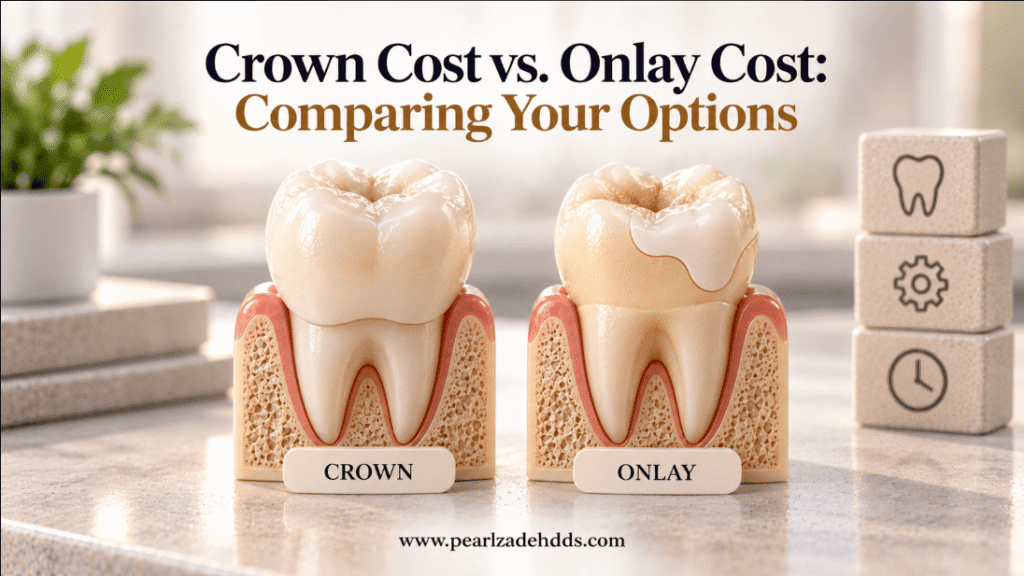
A dental crown covers the entire visible part of a tooth, while an onlay covers only the damaged area and may extend over one or more cusps. The cost of each depends on the restoration needed and the tooth’s condition.
Neither option is always cheaper or more suitable. A dental examination helps determine which restoration may work for the tooth and what the treatment may cost.
The differences between crowns and onlays, the factors that affect their cost, and the questions to ask before choosing can help you prepare for a discussion with your dentist. Exact prices vary based on your clinical needs and treatment plan.
What Is the Difference Between a Dental Crown and an Onlay?
A crown covers the visible portion of a tooth. It restores shape, strength, and function when a tooth has substantial damage or needs added protection. Cleveland Clinic says a crown fits over your entire tooth.
An onlay restores a damaged part of a tooth. Cleveland Clinic says an inlay fills the area between the cusps. An onlay also covers at least one cusp. A cusp is a raised point on the chewing surface.
Picture a crown as a cap over the whole tooth. An onlay, by contrast, is a custom piece. It replaces a damaged section and covers part of the chewing surface.
The amount of tooth structure involved also differs. Cleveland Clinic says the dentist will need to remove some of your natural enamel for a crown. An onlay covers less of the tooth, so it may preserve more natural structure in suitable cases.
Neither restoration is automatically better. Preserving structure does not make an onlay right for every tooth. A crown is not automatically the stronger or more suitable choice either.
When Might a Dentist Recommend an Onlay?
Cleveland Clinic says a cavity can be too big for a filling, but too small for a crown. The dentist might recommend an inlay or onlay in that case.
An onlay may be considered when damage affects part of the tooth, such as a cusp. The tooth must still have enough healthy structure to support the restoration.
Not every damaged tooth qualifies. The dentist assesses how much healthy tooth remains, where the damage sits, and how the tooth functions.
Our article on cracked tooth treatment with bonding, an onlay, or a crown compares these treatment options.
When Might a Dental Crown Be More Appropriate?
A crown may suit a tooth with more extensive damage or one that needs broader coverage. Cleveland Clinic says dentists use crowns to repair large cavities or restore broken teeth. MouthHealthy is the American Dental Association’s (ADA) consumer site. It says a crown can strengthen a tooth with a large filling when not enough tooth remains.
That does not mean every cracked, weakened, or heavily restored tooth needs a crown. The right restoration depends on the tooth’s condition. Learn more about when a cracked tooth may need a dental crown.
Crown Cost vs. Onlay Cost: What Affects the Price?
Several factors can influence the cost of either restoration:
- The extent and location of the tooth damage.
- The complexity of the restoration.
- The material selected.
- Laboratory fabrication requirements.
- Additional treatment that may be needed.
- Insurance benefits and coverage limitations.
Material is one factor. Cleveland Clinic notes that crowns can be made from metal, resin, porcelain, and other materials. Zirconia and porcelain are two common ceramic options, with differences in strength and appearance.
Laboratory work matters too, since both restorations are custom made. Some teeth also need other treatment before a restoration is placed. The dentist can explain what applies after an examination.
No option is always cheaper than the other. Cost depends on the individual case and the treatment recommended.
Insurance adds another variable. Cleveland Clinic’s overview of dental insurance places crowns under major care. It says dental benefit plans vary widely. Deductibles, annual maximums, and waiting periods can also affect what you pay.
Which Option Offers Better Value?
Value depends on more than price. It reflects the tooth’s condition, how suitable the restoration is, and how much healthy tooth structure it preserves. Expected function and durability matter as well.
The lowest-cost option may not fit the tooth. Cleveland Clinic notes that resin crowns are generally less expensive than other crown types. It also says they are fragile and more likely to break than porcelain-fused-to-metal crowns.
The choice should reflect the tooth’s condition, its functional needs, and its long-term prognosis, not cost alone.
No restoration is guaranteed to last a set time. Neither option is always the more economical choice over the long term.
Already have a crown with a problem? Learn more about when a crown can be repaired instead of replaced.
Questions to Ask Before Choosing a Restoration
Consider bringing these questions to your consultation:
- Why is this restoration recommended for my tooth?
- Could an onlay or another option be appropriate?
- How much healthy tooth structure remains?
- What are the benefits and limitations of each suitable option?
- Will I need any additional treatment?
- What will my treatment plan include?
- What will my estimated out-of-pocket cost be?
- What should I confirm with my dental insurance provider?
Ask for clear answers. You can request clarification at any point before you decide.
How Can You Find Out What Your Crown or Onlay Will Cost?
An individualized assessment lets the dentist determine the appropriate restoration and prepare a treatment estimate. Ask for the estimate for your tooth, and ask what it includes.
Confirm your benefits with your insurer as well. Cleveland Clinic suggests finding out specifically what services your plan covers and excludes. It also notes that a pre-treatment estimate is not a guarantee of payment.
Schedule a consultation with Dr. Pearl Zadeh DDS to discuss your tooth, suitable restorative options, and the expected cost. A consultation does not guarantee a particular treatment or price.
The right restoration depends on the condition of the tooth, not cost alone. Discuss the appropriate options and pricing with the dentist before you decide. You can also read about dental crowns at Pearl Zadeh DDS.
Call (818) 716-6722 or click the button below to schedule your consultation online.
Frequently Asked Questions
Not necessarily. Relative costs vary by case, material, laboratory work, and treatment needs. Ask for an individualized estimate for your tooth.
In suitable cases, it can, because it covers less of the tooth than a crown. Cleveland Clinic says a crown requires removing some natural enamel. Not every tooth qualifies for an onlay, and preservation is only one factor.
The dentist examines the tooth. Key factors include how much healthy structure remains, where the damage sits, and how the tooth functions. Clinical findings drive the decision, not cost alone.
It depends on your plan. Coverage and out-of-pocket costs vary with benefits, deductibles, annual maximums, waiting periods, and treatment details. Confirm your benefits with your insurer and request an estimate.
Schedule a consultation to discuss your tooth, your treatment options, and the expected cost. The dentist can assess the tooth and prepare an estimate for the recommended treatment. A consultation does not guarantee a particular treatment or price.
The information above is for informational purposes only and is not a substitute for professional dental advice. Please schedule a consultation with Pearl Zadeh DDS to discuss your specific situation.