
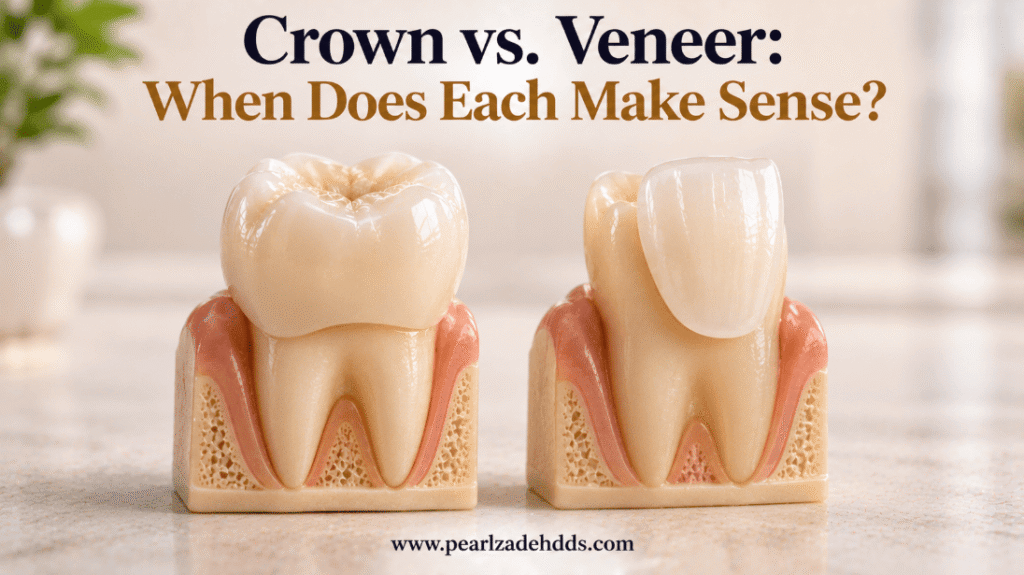
A chipped, stained, or worn tooth may be treated with either a crown or a veneer. Although both can improve a tooth’s appearance, they are not interchangeable.
A veneer covers only the front surface of a tooth, while a crown covers the entire visible portion. A crown may be recommended when a tooth needs more coverage or support, while a veneer may be suitable when the main concern is the front surface and enough healthy tooth structure remains.
The choice depends on how much damage the tooth has, its overall condition, and what needs to be corrected. Some cases may be suitable for either option, so a dental examination is needed before deciding.
What Is a Dental Crown?
A dental crown is a tooth-shaped cap. It covers the entire visible portion of a tooth above the gumline. Crowns can restore a tooth’s shape, function, and appearance.
Porcelain crowns and veneers both use tooth-colored ceramic, but a crown wraps the whole tooth. Cleveland Clinic notes that crowns come in several materials, including metal, resin, and porcelain.
When Do You Need a Dental Crown?
A dentist may recommend a crown for situations such as:
- A tooth with significant structural damage.
- A weakened tooth following certain dental procedures.
- A tooth with a large existing filling.
- A cracked tooth, when a crown is clinically appropriate.
- A tooth that needs substantial restoration.
The American Dental Association’s (ADA) MouthHealthy site explains that a crown may be needed when too little natural tooth remains to support a filling. It also notes that crowns can improve the appearance of teeth that are discolored or poorly shaped.
Not every damaged or discolored tooth needs a crown. The dentist weighs the tooth’s condition first. Learn more about dental crowns at Pearl Zadeh DDS.
What Is a Porcelain Veneer?
A porcelain veneer is a thin restoration bonded to the front surface of a tooth. Cleveland Clinic describes veneers as custom-made shells that fit over the front surfaces of your teeth. Dr. Pearl’s cosmetic dentistry services include veneers for patients who qualify.
When Are Veneers Recommended?
Veneers may address cosmetic concerns such as:
- Persistent discoloration.
- Minor chips.
- Small gaps.
- Uneven tooth shapes.
- Other minor cosmetic imperfections.
Veneers generally require some removal of natural enamel. Cleveland Clinic says the dentist must remove some enamel before placement. The ADA adds that the treatment is not reversible because enamel is removed.
Not every tooth is suitable. Cleveland Clinic says veneers are an option only for patients free of extensive cavities and gum disease. The ADA says that if you clench or grind your teeth, veneers may not be a good choice.
Crown vs. Veneer: What Are the Main Differences?
The difference between crowns and veneers comes down to coverage, purpose, and preparation. Tooth condition matters too. This table compares a dental crown vs porcelain veneer.
| Feature | Dental crown | Porcelain veneer |
| Coverage | Covers the entire visible tooth above the gumline | Covers the front surface of the tooth |
| Purpose | Can restore and protect a weakened tooth, and can improve appearance | Primarily addresses cosmetic concerns, with some overlap for minor damage |
| Tooth preparation | The tooth is reshaped all around, with enamel removed so the crown fits | A small amount of enamel is removed, mainly from the front and sides |
| Tooth condition | Can suit teeth that need substantial structural support | Suits generally healthy teeth with enough healthy enamel |
| Appearance | Can look natural when properly planned and fitted | Can look natural when properly planned and fitted |
| Maintenance | Brushing, flossing, and regular dental visits | Brushing, flossing, and regular dental visits |
Preparation differs in scope, but neither option skips it. Veneer preparation removes enamel, as noted above. Cleveland Clinic says crown preparation also removes enamel for a proper fit. A crown surrounds the whole tooth, so the reshaping goes all around it.
The amount of damage and the remaining healthy tooth structure matter most. Cleveland Clinic says a crown, unlike a veneer, covers the entire tooth to add strength and protection.
Both restorations need good oral hygiene and regular dental care. Neither is permanent in the sense of lasting forever.
When Does a Dental Crown Make More Sense?
A crown may be more appropriate when a tooth needs substantial structural support or coverage. Veneers vs crowns for damaged teeth often comes down to how much of the tooth is affected.
The dentist evaluates cracks, large fillings, and weakened tooth structure. Some cracks are minor, while others threaten the tooth’s integrity. A large filling may leave thin walls of tooth that need protection.
A crown is not automatic for every cracked or discolored tooth. Other treatments may fit better, depending on the findings.
When Does a Porcelain Veneer Make More Sense?
A veneer may suit a tooth that is generally healthy and structurally sound. The concern should mainly affect the front surface, such as staining, a small gap, or an uneven shape.
Enough healthy enamel matters, because a veneer bonds to enamel. Realistic expectations matter too. Veneers can improve appearance, but they cannot correct every problem.
The dentist can explain what a veneer may and may not change for your teeth.
Can a Chipped Tooth Be Treated With a Crown or Veneer?
It depends on the chip. The size, location, and depth of the damage matter, along with the remaining tooth structure. A crown or veneer for a chipped tooth is one possibility among several.
Bonding may also suit some minor chips. Not every chipped tooth needs a crown or a veneer. A dentist can recommend a treatment after examining the tooth.
Can You Replace a Crown With a Veneer or a Veneer With a Crown?
Switching between restorations is not always possible. The decision depends on how much tooth structure remains and the condition of the existing restoration. Why the original treatment was needed also plays a role.
One restoration cannot always replace the other. The dentist needs to examine the tooth before suggesting a change.
How Does a Dentist Decide Between a Crown and a Veneer?
Several factors guide the choice:
- The amount of healthy tooth structure remaining.
- Existing cracks, decay, or previous restorations.
- The location of the tooth.
- Bite forces and grinding habits.
- Cosmetic goals.
- Long-term maintenance needs.
An examination and appropriate diagnostic imaging can help determine which option may work for the tooth. X-rays, for example, can reveal problems that are not visible during a visual examination.
Neither restoration is suitable for every situation. Dr. Pearl Zadeh DDS in Woodland Hills can assess the tooth and discuss whether a crown or veneer may be appropriate.
Call (818) 716-6722 or click the button below to schedule your consultation online.
Frequently Asked Questions
A crown covers the whole tooth. Cleveland Clinic says it adds strength and protection. That does not make a crown the better choice for every tooth. Strength also depends on the material, the remaining tooth, and the bite.
Generally, yes. Cleveland Clinic says the dentist must remove some enamel before placement. The ADA says the treatment is not reversible for that reason.
Sometimes. Cleveland Clinic says veneers can conceal aesthetic imperfections, including cracks. A deeper crack can affect the tooth’s structure. The dentist checks the crack’s depth before suggesting a veneer or a crown.
Neither always lasts longer. Cleveland Clinic reports that veneers last 10 to 15 years with proper care. It reports that crowns last five to 15 years. Results vary with materials, hygiene, and grinding habits.
Yes, in some cases. Cleveland Clinic lists covering a severely stained or discolored tooth among crown uses. A crown reshapes the whole tooth, so the dentist weighs that against other options.
The information above is for informational purposes only and is not a substitute for professional dental advice. Please schedule a consultation with Pearl Zadeh DDS to discuss your specific situation.