
You’re comparing veneer options online and the prices swing wildly. One listing says custom porcelain veneers. Another advertises pre-made or prefabricated veneers at a fraction of the cost. Both cover your teeth. Both are described as porcelain. So why would one be so different from the other?
Veneers aren’t simply pieces placed over teeth. How they’re planned, shaped, fitted, colored, and bonded can make a real difference in the result. That doesn’t automatically make one option the right answer for everyone reading this.
What Are Custom Porcelain Veneers?
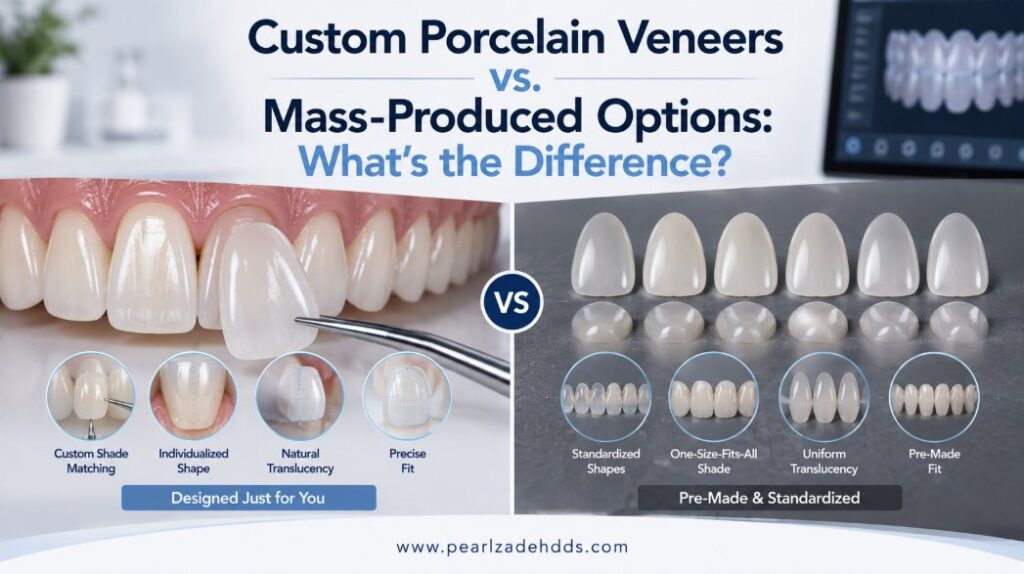
A custom porcelain veneer is a thin shell of ceramic material designed and fabricated around one specific tooth, not selected from an existing catalog of shapes. The American College of Prosthodontists describes veneers generally as a thin, custom layer of material used to improve the appearance of teeth, often addressing staining, chips, or crooked teeth. Custom doesn’t simply mean more expensive. It describes how the restoration is planned and made, specifically for you rather than for a general category of patient. Customization can factor in:
- Tooth shape
- Tooth size
- Facial proportions
- Smile line
- Shade
- Translucency
- How the veneer relates to neighboring teeth
- Your bite
- The specific cosmetic outcome you’re after
What Are Mass-Produced or Prefabricated Veneers?
Prefabricated or pre-made veneers are manufactured in standard shapes or sizes rather than individually fabricated from scratch for one particular tooth. This isn’t one single product. Options in this category can differ significantly in material, design, manufacturing process, and intended use. A prefabricated veneer meant as a temporary solution is a different thing than one intended for longer-term wear, and lumping every pre-made option together wouldn’t be an accurate way to think about this category.
Custom vs. Mass-Produced: What’s Actually Different?
A few specific areas tend to matter most to patients comparing these approaches.
Shape and Fit
A custom restoration is designed around your specific tooth rather than chosen from a standard shape closest to what you need. Fit affects more than comfort. It influences how the veneer looks against your gumline, how easy it is to keep clean, and how naturally it relates to the teeth next to it.
Shade and Appearance
Custom porcelain allows detailed planning of color, translucency, surface texture, and how the restoration reflects light, along with how closely it matches your neighboring teeth. This doesn’t mean every custom veneer looks completely indistinguishable from a natural tooth in every lighting condition. It means there’s considerably more room to fine-tune these details than a standard shape typically allows.
Tooth Preparation
How much of your natural tooth structure needs to be adjusted depends on your specific tooth and treatment plan, not on whether the veneer happens to be labeled custom. Custom veneers aren’t automatically “no-prep,” and prefabricated veneers don’t automatically require more reduction either. The real factors are your tooth position, the material being used, your desired result, and the specific restoration involved.
Laboratory Fabrication
Custom porcelain veneers typically involve real communication between your dentist and a dental laboratory technician. The lab fabricates the restoration based on your dentist’s clinical notes, photographs, digital scans or impressions, shade information, and treatment plan. That back-and-forth is part of what allows the level of detail custom work is known for.
Why Does Customization Matter for Smile Design?
Veneers don’t exist in isolation. A dentist planning a smile considers how your teeth relate to each other, your lips, your gums, your smile line, your bite, and your overall facial proportions. A single veneer that looks attractive sitting on its own might not look right once it’s placed next to your other teeth. That’s exactly why smile design involves more than picking a shade off a chart. It’s about how everything works together.
Are Mass-Produced Veneers Always a Bad Choice?
No. Pre-made or prefabricated options can have appropriate uses depending on the specific product and your situation. Where they tend to offer less flexibility is when you need highly specific changes to shape, shade, proportions, or fit that a standard option simply wasn’t designed to accommodate. The real question isn’t whether an option is prefabricated. It’s whether that particular option is actually appropriate for your clinical and cosmetic goals.
Are Custom Porcelain Veneers Always Better?
Not automatically. “Custom” describes how a restoration is designed and fabricated, but the quality of your overall treatment also depends on:
- An accurate diagnosis
- Thoughtful treatment planning
- Your dentist’s experience
- The material selected
- The laboratory’s work
- The bonding technique used
- Your own oral health
- Your bite
- How well you maintain the result afterward
The word custom by itself doesn’t guarantee a better outcome if any of those other pieces fall short.
What Happens Before Custom Veneers Are Made?
The process generally starts with a consultation and examination, followed by a conversation about your cosmetic goals. Your dentist evaluates your tooth and gum health and assesses your bite, then takes photographs or digital scans to guide smile planning. From there, tooth preparation gets discussed, a shade gets selected, and the restoration goes to fabrication. Depending on the case, you may have a try-in or evaluation step before final bonding. The exact sequence shifts somewhat depending on your specific case and the restoration being used.
Can You Get Veneers Without Preparing Your Teeth?
This comes up often, since patients frequently search for “no-prep veneers.” Some patients genuinely qualify for a minimal or no-preparation approach, but it isn’t appropriate for everyone. A nine-year comparative study of conventional and no-prep porcelain veneers notes that no-prep veneers rely on very thin feldspathic porcelain, often 0.2 to 0.3 millimeters, while veneers requiring more reduction typically use thicker ceramic. Whether a no-prep approach works for you depends on your tooth position, tooth size, existing enamel, the changes you’re hoping for, your bite, and any existing restorations. A separate clinical evaluation of a no-prep veneer protocol found genuinely good outcomes for appropriately selected patients, while also noting real controversy in the broader research about predictability. Avoiding tooth preparation isn’t always possible, and it isn’t automatically the preferable choice even when it is possible.
How Does the Material Matter?
Porcelain isn’t one single material with identical properties across every product. Different ceramic materials vary in strength, translucency, thickness, appearance, and how they’re fabricated, and thinner, more delicate materials generally call for a different approach to fit and bonding than thicker, stronger ones. The point isn’t to turn this into a materials science lecture. It’s that the specific material your dentist recommends should connect directly to what your teeth and goals actually need.
What About Durability and Cost?
Veneer longevity depends on several things working together:
- The material
- The quality of bonding
- How much tooth preparation was involved
- Your bite forces
- Your oral hygiene
- Whether you grind or clench your teeth
- Habits like biting hard objects
- How consistently you keep up with dental care
Porcelain itself doesn’t make a restoration immune to chipping, fracture, or coming loose over time. It would be misleading to promise a specific lifespan without qualifying it heavily, since so much depends on your individual situation and habits.
Cost follows a similar logic. Custom treatment often costs more because of individualized planning, the clinical appointments involved, laboratory fabrication, material selection, custom shade and shape work, and the expertise of both your dentist and the lab. A higher price doesn’t automatically mean higher quality, though. It’s worth comparing what’s actually included in a treatment plan rather than looking at the final number alone.
What Should You Ask Before Choosing Veneers?
A few genuinely useful questions to bring to a consultation: What type of veneer are you recommending, and why is it appropriate for my teeth? How much tooth preparation will I actually need? Can the shade and shape be customized to my face and smile? What material will be used, and will a dental laboratory fabricate them? How will these veneers be designed to match my other teeth? What happens if I don’t like the proposed shape or shade before it’s final? How does my bite factor into this? What are the risks, and how should I care for the result? What happens if one chips or comes loose down the line? And what’s actually included in the quoted fee?
Is This the Right Time for Veneers?
Custom porcelain veneers tend to be worth discussing when you want detailed changes to tooth shape, proportions, shade, symmetry, minor spacing, or certain other cosmetic imperfections. That said, veneers aren’t right for every patient at every point in time. A stable, healthy foundation matters. Some patients need other treatment first, whether that’s addressing decay, gum disease, significant tooth damage, an underlying bite problem, active grinding or clenching, or orthodontic movement, before cosmetic work makes sense. None of this is something to self-diagnose. A consultation is what actually determines whether veneers are the right next step or whether something else should come first.
What If You’re Choosing Between Veneers and Invisalign?
Veneers and Invisalign solve genuinely different problems. Invisalign primarily moves teeth into better positions. Veneers change the visible shape, color, and surface appearance of a tooth without moving it. Our comparison of Invisalign and veneers goes further into which fits different smile goals. Neither is universally the better choice. Some patients need orthodontic movement before cosmetic restoration makes sense, while others are reasonable candidates for veneers without any orthodontic treatment at all.
Customization Is More Than Just Choosing a Shade
Custom veneer treatment involves far more than picking a color from a chart. A well-planned restoration accounts for shape, size, proportion, tooth position, bite, smile line, neighboring teeth, material, and optical characteristics like translucency and light reflection together. The question worth asking isn’t simply “are these veneers custom?” It’s “how will these veneers actually be planned and made for my teeth and my goals?” That’s the question that tells you more about what to expect.
Speak With Dr. Pearl Zadeh About Porcelain Veneers
Choosing veneers involves more than picking a material or comparing prices. Dr. Pearl Zadeh, an accredited member of the American Academy of Cosmetic Dentistry, can evaluate your teeth, bite, gums, and smile goals before discussing whether porcelain veneers are appropriate for you. If veneers make sense, that conversation can also cover the type of restoration, the degree of customization involved, expected preparation, the overall process, and how to maintain the result afterward.
Call (818) 716-6722 or click the button below to schedule a consultation online.
Frequently Asked Questions
Are custom porcelain veneers always better than prefabricated ones?
Not automatically. Custom describes how a veneer is designed and made, but outcome quality also depends on diagnosis, planning, material, and bonding technique.
Do custom veneers require less tooth preparation than mass-produced ones?
Not necessarily. Preparation depends on your specific tooth, material, and treatment goals, not simply on whether the veneer is custom or prefabricated.
Can I get veneers without any tooth preparation?
Some patients qualify for a minimal or no-preparation approach, but it depends on tooth position, size, existing enamel, and your specific goals. It isn’t right for everyone.
Why do custom porcelain veneers typically cost more?
Individualized planning, laboratory fabrication, material selection, and the clinical time involved all factor into cost, though a higher price doesn’t automatically mean better quality.
How long do porcelain veneers last?
Longevity varies by patient and depends on the material, bonding, bite forces, oral hygiene, and habits like grinding. No veneer, regardless of material, is immune to chipping or wear over time.
This article is for informational purposes only and is not a substitute for professional dental advice. Please schedule a consultation with Pearl Zadeh DDS to discuss your specific situation.