
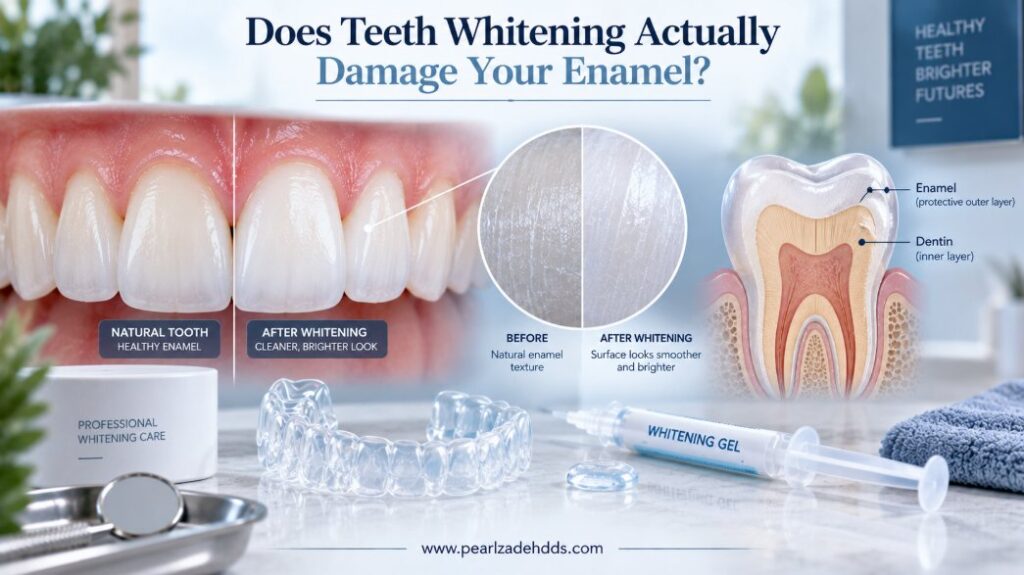
Before whitening their teeth, many people ask the same question: Can whitening actually weaken or damage their teeth? It’s a reasonable concern before applying a bleaching agent. Conflicting claims online can also make the answer confusing. One source may call whitening harmless, while another claims it strips away enamel.
The honest answer isn’t a simple yes or no. Whitening can cause temporary sensitivity. Your teeth may also respond differently based on the product and concentration. How you use the product also matters. Following evidence-based instructions and considering your existing dental health matter more than choosing one specific whitening method.
Does Teeth Whitening Damage Enamel?
Not in the way most people picture it. Whitening agents work by breaking down and altering the stain molecules within your tooth structure, not by physically scraping or dissolving away enamel. A 2026 systematic review and meta-analysis on enamel damage from tooth whitening found that peroxide-based bleaching produced statistically detectable but small reductions in enamel microhardness, without clear evidence that these changes are clinically meaningful.
The review concluded that peroxide bleaching is unlikely to cause clinically meaningful enamel damage when used as recommended. However, that does not mean every whitening product is harmless in every situation. The concentration, contact time, frequency of use, and specific formulation can all affect the outcome.
How Does Teeth Whitening Affect Your Enamel?
Enamel forms the hard, mineral-rich outer layer of your tooth. Dentin sits underneath it and feels more sensitive to temperature and pressure. Microscopic channels connect dentin to the nerve inside your tooth.
Whitening agents pass through the enamel and reach stain compounds that have built up over time. They break these compounds apart through a chemical process. This changes how light reflects off your teeth.
During treatment, whitening can temporarily increase tooth permeability. This helps explain why some people experience sensitivity during or shortly after whitening. More stimuli can reach the channels that lead toward the nerve.
Whitening can also cause minor changes in the tooth surface during treatment. Researchers have observed changes in microhardness and surface texture in laboratory studies. These changes generally do not indicate permanent structural damage to the enamel. The effects can vary based on the whitening agent, concentration, and treatment conditions.
Can Teeth Whitening Cause Permanent Enamel Damage?
Research on this genuinely depends on how closely the study conditions resemble what actually happens in your mouth. A peer-reviewed safety review on tooth whitening points out that studies replicating real intraoral conditions, meaning they included human saliva and normal fluoride exposure, generally found no clinically significant adverse effects on enamel. The same review is candid that this makes laboratory measurements on isolated, extracted teeth difficult to interpret as directly equivalent to what happens during actual clinical use.
A separate narrative review of whitening agents and safety notes that higher-concentration formulations carry more documented concern for enamel surface alteration and microhardness reduction than lower-concentration ones. Excessive exposure time, using products incorrectly, or whitening far more often than recommended can genuinely raise the level of concern here. Normal, appropriately used whitening isn’t shown to inevitably cause permanent enamel damage, and it also isn’t accurate to say enamel is completely unaffected under every possible whitening condition. The honest answer sits between those two extremes.
Why Does Whitening Sometimes Make Teeth Sensitive?
Sensitivity is one of the more common temporary effects associated with whitening, often showing up as increased reaction to cold, heat, air, or sweet foods and drinks. This happens because whitening agents can temporarily affect how your tooth responds to these everyday triggers, not because your enamel has necessarily suffered permanent damage.
People who already deal with sensitivity for unrelated reasons often notice whitening-related sensitivity more strongly, simply because their teeth were already more reactive to begin with. Our discussion of teeth whitening for sensitive teeth goes further into the mechanism and what actually helps.
Does Professional Teeth Whitening Damage Enamel?
Professional whitening isn’t automatically safer in every single circumstance, but dentist supervision offers real advantages worth naming. An evaluation before treatment can catch existing dental problems, a cavity, exposed dentin, or gum recession, that might affect how you respond to whitening before treatment ever starts.
Product selection, treatment concentration, and exposure time can all be adjusted based on your specific teeth rather than a generic instruction sheet meant for a general population, and sensitivity can be actively managed as part of the process rather than discovered partway through with no plan for addressing it. Professional teeth whitening gives your dentist more control over the variables that actually affect enamel-related risk, which is a meaningfully different thing than a guarantee that supervised treatment carries zero risk.
What About Whitening Strips and At-Home Products?
At-home whitening products genuinely vary from one another, sometimes considerably. Results and side effects depend on the specific whitening agent used, its concentration, how long it stays in contact with your teeth, how often you use it, and whether you actually follow the manufacturer’s instructions. A product left on for twice the recommended time, or used daily instead of the intended schedule, isn’t behaving the way it was designed to, and that gap between intended use and actual use is where most problems tend to originate.
It wouldn’t be accurate to label every whitening strip as dangerous, and it also wouldn’t be accurate to assume every over-the-counter product affects enamel identically. Sticking to the recommended usage, and not extending contact time or frequency beyond what the product actually calls for, matters more than which specific brand you choose.
Can Whitening Toothpaste Damage Enamel?
Whitening toothpaste works differently than peroxide-based treatments. Most whitening toothpastes primarily remove surface stains through mild abrasion rather than changing the color deep within your tooth structure, which is a fundamentally different mechanism than chemically breaking down stain molecules.
Abrasivity genuinely matters here, particularly for people who already have some enamel wear or exposed dentin, since a more abrasive formulation can add unnecessary wear on top of an already thinner surface. This doesn’t mean every whitening toothpaste damages enamel. Formulations vary considerably in how abrasive they actually are, and anyone with significant sensitivity or existing enamel concerns is better off discussing the right product with a dental professional than guessing from a store shelf.
Does Whitening Too Often Harm Your Teeth?
Repeated or prolonged whitening genuinely can increase the likelihood of unwanted effects. This includes whitening more frequently than recommended, leaving treatment on longer than instructed, combining multiple whitening products at once, continuing treatment after you’ve already reached the shade you wanted, and pushing through persistent sensitivity instead of stopping. Each of these amounts to giving your teeth more exposure than the studied protocols actually accounted for, which is exactly the scenario where the research base gets thinner and the honest answer becomes more uncertain.
There’s no universal maximum number of whitening sessions that applies to every patient across the board. Following whatever treatment plan or product instructions you were actually given matters far more than hitting some specific number.
What Makes Whitening More Likely to Cause Problems?
A handful of factors can genuinely raise the likelihood of discomfort or complications:
- Existing tooth sensitivity
- Enamel erosion or significant wear
- Gum recession
- Exposed dentin
- Cavities
- Cracked or damaged teeth
- Excessive product use
- Incorrect application
- High-concentration products
- Prolonged exposure time
Several of these share a common thread. When enamel is already thinner or dentin is already exposed for some other reason, whitening agents have an easier path to reach the nerve, which can make sensitivity more pronounced than it would be for someone with fully intact enamel. None of these factors automatically means whitening is impossible for you. They generally mean your teeth are worth having evaluated before you start, rather than assuming your situation is identical to everyone else’s.
Can You Whiten Teeth If Your Enamel Is Already Worn?
This deserves real care rather than a simple yes or no. Worn enamel can change how sensitivity actually feels during whitening, sometimes making it more noticeable than it would be otherwise, since thinner enamel gives whitening agents a shorter distance to travel before reaching more sensitive structures underneath. The cause and severity of that wear genuinely matter here. Wear from years of normal use is a different situation than active, ongoing erosion or a cracked tooth that hasn’t been addressed.
If you’re dealing with significant enamel loss, unexplained sensitivity, cavities, cracks, or other dental problems, whitening probably isn’t the first thing to address. None of this can be diagnosed from symptoms alone, which is exactly why an actual dental evaluation is the right next step rather than guessing at what’s going on.
Does Teeth Whitening Damage Existing Dental Work?
Whitening affects natural teeth differently than it affects restorations like veneers, crowns, or fillings, which generally don’t change shade the same way natural enamel does. Our discussion of whitening before veneers or crowns covers how that timing question actually plays out.
How to Whiten Your Teeth More Safely
1. Have unexplained sensitivity evaluated before you start.
2. Follow the product instructions you were actually given.
3. Avoid whitening more often than recommended.
4. Don’t leave whitening products on longer than instructed.
5. Discuss any existing dental problems before beginning treatment.
6. Follow your dentist’s specific instructions for professional whitening.
7. Stop and seek dental advice if symptoms feel severe or won’t go away.
None of these steps guarantees a specific outcome, since individual response to whitening always varies somewhat. They genuinely reduce unnecessary risk, though, and following them consistently matters more than any single product choice.
When Should You Talk to a Dentist Before Whitening?
A few situations are worth a conversation first: persistent tooth sensitivity, severe sensitivity, sensitivity limited to one tooth, visible enamel wear, gum recession, cavities, cracks, tooth pain, existing veneers or crowns, or a notably strong reaction to whitening in the past. Whitening shouldn’t be used to cover up an unexplained dental problem that actually needs its own attention.
Speak With Dr. Pearl Zadeh About Whitening Safely
Teeth whitening isn’t a simple safe-or-unsafe question. The actual outcome depends on the method, how it’s used, how often it’s repeated, and the condition of your teeth going in. Dr. Pearl Zadeh, a dentist providing cosmetic dentistry and teeth whitening in Woodland Hills, can evaluate your teeth and help you understand whether whitening makes sense for your specific situation.
Call (818) 716-6722 or click the button below to schedule your consultation online.
Frequently Asked Questions
Does teeth whitening damage enamel?
Research shows small, statistically detectable changes in some laboratory studies, but no clear evidence that properly used whitening causes clinically meaningful enamel damage.
Does teeth whitening weaken your teeth?
Normal, appropriately used whitening isn’t shown to permanently weaken teeth, though excessive use or existing dental problems can change that picture.
Can whitening cause permanent enamel damage?
It isn’t shown to inevitably happen with normal use, but excessive exposure, incorrect use, or very frequent whitening can raise genuine concern.
Why do my teeth hurt after whitening?
Temporary sensitivity is common and relates to whitening agents temporarily affecting how your teeth respond to triggers like cold or heat, not necessarily permanent damage.
Does professional teeth whitening damage enamel?
It isn’t automatically risk-free, but professional supervision allows for evaluation, product selection, and sensitivity management tailored to your specific teeth.
Do whitening strips damage enamel?
Not inherently, though effects depend on the concentration, contact time, frequency of use, and whether instructions are followed correctly.
This article is for informational purposes only and is not a substitute for professional dental advice. Please schedule a consultation with Pearl Zadeh DDS to discuss your specific situation.