
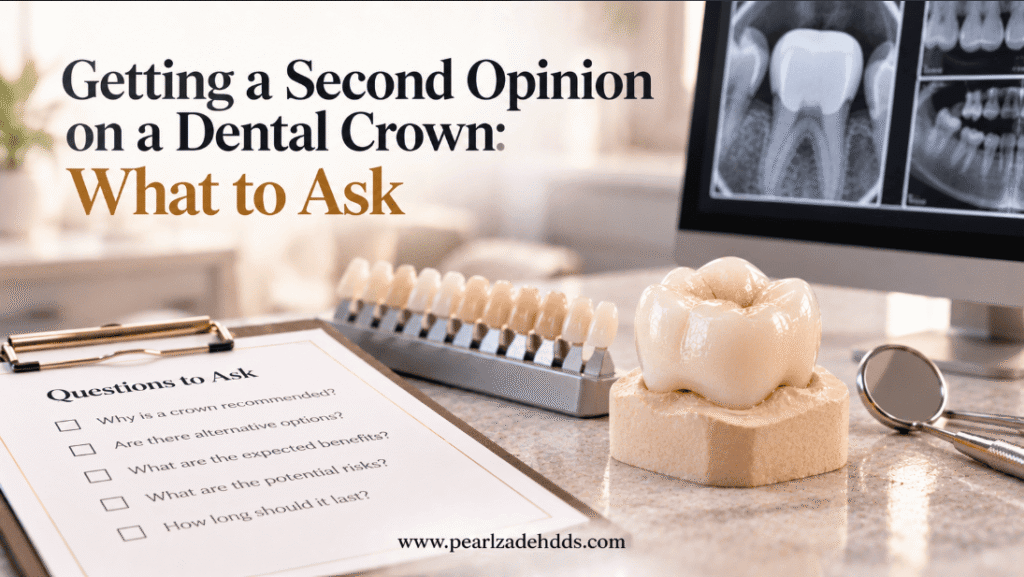
A second opinion can be helpful when a dentist recommends a crown. It gives you another chance to understand why the crown may be needed and whether other treatments are suitable for your tooth.
Getting another opinion does not mean the first dentist was wrong. A crown may be the right choice for a damaged or weakened tooth, but another dentist may identify a different treatment option based on your dental condition.
A second opinion can help you compare recommendations, prepare questions, and decide how to proceed. Bringing your dental X-rays and treatment records can also help the next dentist assess your case.
Why Might a Dentist Recommend a Crown?
A crown covers a tooth to restore its shape and function and to protect it. Cleveland Clinic says dentists use crowns to restore a decayed, broken, weak, or worn-down tooth.
MouthHealthy is the American Dental Association’s (ADA) consumer site. It says a crown can strengthen a tooth with a large filling when not enough tooth remains. A crown can also protect a weak tooth from breaking.
Common reasons include a broken or weak tooth. Another is a large filling with too little tooth left to support it. The recommendation depends on an examination and the specific condition of the tooth.
Cracked teeth are one example. Our article on when a cracked tooth needs a dental crown explains why the extent of the crack matters.
When Should You Consider a Second Opinion?
Patients ask for another assessment for several reasons. Common ones include:
- Uncertainty about what the diagnosis means.
- A wish to compare reasonable treatment options.
- Questions about the expected benefits or costs.
- A need for more information before agreeing to treatment.
The ADA’s Code of Ethics says dentists should inform patients of the proposed treatment and any reasonable alternatives. Dentists should do this in a way that lets patients become involved in treatment decisions. Asking about alternatives fits that standard.
A recommendation to replace an existing crown can raise its own questions. Our article on signs a dental crown needs to be replaced explains common warning signs. We also cover whether a crown can be repaired instead of replaced.
What a Second Opinion Can and Cannot Do
Another dentist may agree with the original recommendation. Or the second dentist may suggest a different approach. A different recommendation does not automatically mean either dentist is wrong.
Dentists can weigh the same findings differently, and an examination may reveal different details. A second opinion adds information. It does not settle the decision for you.
Questions to Ask Before Agreeing to a Crown
These questions can guide the conversation. They are prompts, not a checklist that points to one particular outcome.
- What problem does the crown address?
- What findings support this recommendation?
- How much of the tooth is damaged or weakened?
- Could a filling, bonding, or onlay be appropriate in this case?
- What are the benefits and limitations of each reasonable option?
- What are the risks of each option?
- How long might the restoration be expected to last?
- What could happen if treatment waits?
- What material is being recommended, and why?
- How many appointments will treatment require?
- What costs should be expected, including any additional treatment the tooth may need?
Ask the dentist to explain each answer in plain language. Questions about X-rays and examination findings also belong in the conversation, when they are relevant to the tooth.
Comparing Fillings, Bonding, Onlays, and Crowns
These options are not interchangeable. The right one depends on the amount and location of the damage. Cleveland Clinic says onlays can restore teeth too damaged for a filling but too healthy for a crown. A less extensive treatment is not always preferable, though. Teeth with little remaining structure may need more coverage.
Our article on cracked tooth treatment with bonding, an onlay, or a crown explains how these options differ.
Crown materials also vary. Our article on zirconia versus porcelain crowns compares two common choices.
Appointments and cost deserve direct answers. Cleveland Clinic says crown placement usually requires two appointments and that crowns may be expensive. Individual plans vary, so ask for a written estimate.
What Records Should You Bring?
Existing records help another dentist review the case. Ask the first office for copies of:
- Relevant X-rays.
- Examination findings and notes.
- The treatment plan.
- Cost estimates.
The ADA says HIPAA lets patients ask covered practices to send copies of their records to a designated person. Requests must be written and signed by the patient. Access can vary by state, the ADA adds.
X-rays can often be forwarded. MouthHealthy says a new dentist may ask for copies instead of ordering new ones. It advises asking both dentists for help forwarding the X-rays.
Records support the review, but they do not replace it. The second dentist may need to perform an independent examination. Additional imaging may also be needed, depending on the circumstances.
How Do You Compare Two Different Recommendations?
Recommendations can differ for several reasons. The tooth’s condition may be changing. Each dentist may observe different findings. Clinical approaches also vary, and some situations allow more than one reasonable path.
Ask each dentist to explain the reasoning. Useful points to compare include:
- The expected benefits of the recommended treatment.
- The risks and limitations.
- The alternatives considered.
- The likely consequences of delaying treatment.
Compare the reasoning, not only the price or how extensive the treatment sounds. If questions remain, return to the first dentist with what you learned. A clear explanation from either office helps you decide.
What If the Tooth Needs Treatment Soon?
The risks of waiting depend on the tooth’s condition. Some problems may worsen without treatment. Others may allow time for further assessment.
Cracks show this range. Cleveland Clinic says that even with treatment, tooth cracks sometimes continue to get bigger or split. It also says a cracked tooth that causes no pain or infection may not need treatment.
Taking time for another opinion may be reasonable when the tooth is stable and symptoms are mild. Ask your dentist how long waiting is reasonable for your tooth.
Severe or worsening pain, swelling, fever, or difficulty swallowing warrants prompt dental or medical assessment. Do not delay urgent care while seeking another opinion. Mayo Clinic’s guidance on tooth abscess says to go to the emergency room for trouble breathing or swallowing. It also advises the emergency room for fever with facial swelling when you cannot reach your dentist. Cleveland Clinic notes that a badly cracked tooth may be a dental emergency.
A second opinion works best as a way to understand your options. It is not a test of the first dentist. Dr. Pearl Zadeh can examine the tooth, explain the findings, and discuss the options that fit. You can also read about dental crown treatment at Pearl Zadeh DDS.
Call (818) 716-6722 or click the button below to schedule your consultation online.
Frequently Asked Questions
Yes. Patients may want clearer answers about the diagnosis, the alternatives, or the cost. A second opinion does not mean the first recommendation was wrong, and another dentist may agree with it.
Possibly, depending on the examination findings and the amount and location of the damage. Fillings, onlays, and crowns are not interchangeable, and the less extensive option is not always better.
Yes, if they are available. Ask the first office to send copies or forward them. The second dentist may still examine the tooth and may take new images.
Not necessarily. Whether a tooth hurts is only one part of the picture, and examination findings also matter. A second opinion can help if more information would make the decision clearer.
It depends on the tooth’s condition. Ask the dentist how long waiting is reasonable and what to watch for. Severe pain, swelling, fever, or trouble swallowing should not wait.
The information above is for informational purposes only and is not a substitute for professional dental advice. Please schedule a consultation with Pearl Zadeh DDS to discuss your specific situation.