
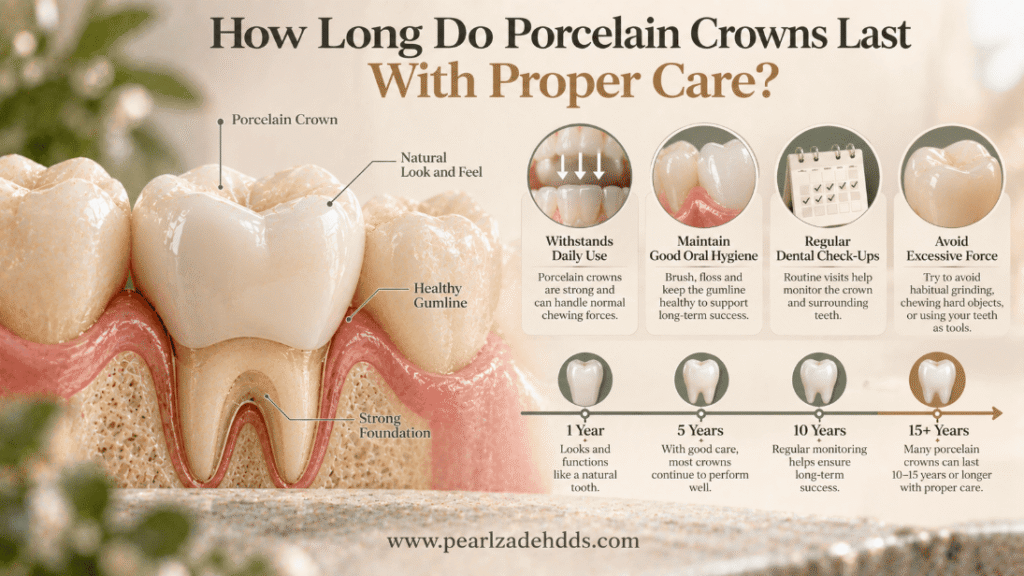
Your porcelain crown is ten years old, or you are considering one for a cracked or heavily filled tooth. Either way, the same question comes up. How long will it last? Dentists design crowns to withstand normal chewing forces, but no crown has a guaranteed lifespan.
Longevity can vary with the crown material, the tooth supporting it, your bite, oral hygiene, and other individual factors. Knowing what affects those factors can help you understand what to expect from an existing crown or a new one.
How Long Do Porcelain Crowns Usually Last?
Porcelain and ceramic crowns can last many years, but no single number applies to every crown. Published survival rates vary by material, tooth, patient, and follow-up period.
One systematic review of 67 studies estimated five-year survival of 96.6% for leucite or lithium disilicate glass-ceramic crowns. Glass-infiltrated alumina had a five-year survival rate of 94.6%, while zirconia reached 92.1%. The authors also reported more fractures of the veneering ceramic with zirconia crowns than with metal-ceramic crowns.
Long-term data are more limited. An overview of 28 systematic reviews reported 95% to 100% survival for lithium disilicate crowns at one to five years. The analysis included both tooth- and implant-supported crowns and noted limited evidence beyond five years.
A retrospective study of 1,037 tooth-supported crowns reported survival rates of 89.9% at five years, 80.9% at ten years, and 61.8% at twenty years. The records covered crowns placed between 1981 and 2018, and only 16.3% of the crowns were all-ceramic.
These figures are useful for showing the range of outcomes, not for predicting exactly how long one crown will last. The studies used different materials, populations, clinical settings, and follow-up periods. The term “porcelain crown” also covers several ceramic systems, and they do not all perform identically.
Good care can support the longevity of a crown, but it cannot guarantee a specific lifespan. Two crowns made from the same material can perform differently depending on the tooth, bite, oral health, and other patient factors. That is why dentists consider the individual crown rather than relying on one expected expiration point.
What Can Affect How Long a Porcelain Crown Lasts?
Longevity depends on more than brushing and flossing. The tooth’s location, the forces it experiences, the crown material, and the amount of healthy tooth structure remaining underneath can all matter. Crown fit, gum health, grinding or clenching, previous dental problems, and daily habits can also affect how a restoration performs over time.
Remaining tooth structure deserves special attention. A crown may cover a tooth that was already cracked, decayed, or heavily filled. When less healthy tooth structure remains, the restoration may have less natural tooth structure available to support and retain it. The condition of the tooth underneath therefore remains important even when the crown itself is intact.
Habits and trauma can affect a crown as well. Biting ice, opening packages with your teeth, or experiencing an injury to the mouth can place excessive force on a restoration. Those forces may contribute to chipping, cracking, or loosening.
The retrospective study above also found differences in survival associated with several patient and tooth factors. In that group, front-tooth placement, teeth without a living nerve, and bruxism were significantly associated with crown survival. Crown material and upper versus lower jaw did not reach statistical significance in that study.
The position of the crown margin is another area where the evidence is less clear. A systematic review of 22 studies found insufficient evidence to determine whether placing margins below the gumline changes the risk of secondary caries. The authors considered the evidence inconclusive.
Does Proper Oral Hygiene Make Porcelain Crowns Last Longer?
Porcelain itself does not decay. The natural tooth around and beneath the crown still can. Plaque control therefore helps protect the tooth supporting the crown. MouthHealthy advises brushing twice a day with fluoride toothpaste and cleaning between your teeth daily. It also recommends regular dental visits for examinations and professional cleanings.
Pay particular attention to the gumline, where the crown meets the natural tooth. Regular examinations allow your dentist to check the crown margins, surrounding gums, and bite. Good oral hygiene supports the health of the tooth and tissues around a crown, but it cannot guarantee that the restoration will last indefinitely.
Gum health matters as well. Inflammation or gum recession can expose areas around the crown and make the margin more difficult to keep clean. Your dentist can assess the tissues around the crown and let you know whether they need additional attention.
Can You Get Cavities Under a Porcelain Crown?
Yes. The crown material and the natural tooth underneath it are two different things. Ceramic itself cannot develop tooth decay, but the natural tooth can. Decay may develop at the crown margin or in exposed tooth structure that remains around the restoration. The same conditions that contribute to cavities elsewhere in the mouth can affect these areas too. MouthHealthy explains that bacteria in plaque produce acids that attack tooth enamel.
Recurrent decay appeared in 8.6% of crowns in the retrospective study discussed earlier. That figure came from one study population and should not be treated as a universal risk for every crown.
A crown that develops decay is also not necessarily a sign of poor oral hygiene. Cavity risk varies with factors such as plaque control, diet, saliva flow, previous decay, gum recession, and the condition of the tooth itself.
Does Teeth Grinding Affect Porcelain Crowns?
Clenching and grinding can place additional force on teeth and restorations. MouthHealthy describes chipped or cracked teeth and worn spots as possible signs of grinding. With a crown, repeated excessive force may contribute to chipping, cracking, wear, loosening, or damage to the underlying tooth.
Grinding does not automatically mean a crown will fail. A 2026 systematic review reported favorable short-term performance for zirconia and lithium disilicate crowns in patients with bruxism. However, the review included only three studies. Complications appeared more frequently among patients with bruxism in the observational data, and the authors noted the need for better research.
A night guard may be one option for managing the effects of grinding. MouthHealthy notes that a dentist may recommend one in appropriate cases. Whether a night guard is appropriate depends on your teeth, symptoms, bite, and grinding pattern, so discuss it with your dentist.
Does the Location of the Crown Matter?
Front and back teeth serve different functions. Front teeth help cut food and have important esthetic demands. Back teeth handle more of the forces involved in chewing. These differences can influence which materials and crown designs a dentist considers.
Location does not determine lifespan on its own, though. In the retrospective study, front-tooth placement was significantly associated with survival, while upper versus lower jaw did not reach statistical significance. Individual bite forces, habits, and other patient factors still matter.
Can a Porcelain Crown Chip or Crack?
Yes. Porcelain and ceramic restorations can chip, crack, or fracture. The systematic review of 67 studies documented fractures of veneering ceramic, including more such fractures with zirconia crowns than with metal-ceramic crowns in the studies analyzed. Ceramic restorations can also experience wear or changes in appearance over time.
A damaged crown does not automatically need replacement. The appropriate response depends on the location and extent of the damage, your symptoms, and the condition of the tooth underneath. In some cases, a small chip may be polished or monitored. Larger fractures may require repair or replacement. Your dentist can examine the damage and explain which options are appropriate.
What Happens If a Porcelain Crown Becomes Loose?
A loose crown deserves dental evaluation. Loss of retention affected 9.9% of crowns in the retrospective study. Causes can involve the cement, the crown, the underlying tooth, or the surrounding structures.
Avoid trying to recement a crown yourself. A loose restoration can expose areas of the underlying tooth and make the area harder to keep clean. It can also affect how your teeth come together.
Even a painless loose crown should be evaluated. The absence of pain does not necessarily mean that the tooth or restoration is healthy.
What Are the Signs a Porcelain Crown May Need Attention?
Pain when biting or new sensitivity can be signs that a crown needs evaluation. So can a loose or moving crown, visible cracks or chips, or a rough edge. Food that repeatedly becomes trapped around the crown may also deserve attention. Gum irritation, a change in the way your teeth meet, or a crown that feels different can provide additional clues.
None of these signs identifies the cause by itself. An examination can help determine what is happening.
Some problems may develop without noticeable symptoms. A compromised crown margin, decay around the restoration, or a small crack may not cause pain initially. Regular examinations can help your dentist monitor the crown and the tooth underneath it.
Do Porcelain Crowns Need to Be Replaced on a Schedule?
No. Crowns are not automatically replaced because they reach a certain age. Replacement may become appropriate when the crown or underlying tooth develops a problem. It may also be considered when the restoration no longer functions properly, its fit has changed, or its condition has deteriorated.
Your dentist bases that decision on the condition of the crown and tooth rather than a calendar date. A crown that looks worn may still function well, while a crown that looks intact can still have an underlying problem. Appearance alone does not determine whether a crown needs attention.
Can You Make a Porcelain Crown Last Longer?
Practical habits can support the health of a crown and the tooth underneath it. Brush regularly and clean between your teeth. Keep your gums healthy and attend recommended dental examinations.
Avoid using your teeth to open packages or bite hard objects. You do not need to avoid all hard foods. If you grind or clench your teeth, discuss it with your dentist.
Let your dentist know if you notice changes in sensitivity, your bite, or crown stability. Follow the recommendations that fit your teeth and restoration. These steps can support long-term function, but none can guarantee a specific result.
What If Your Porcelain Crown Is Several Years Old?
An older crown is not necessarily a failing crown. Its clinical condition matters more than its age alone. During an examination, a dentist may evaluate the crown margins, the remaining tooth structure, the surrounding gums, and your bite. Cracks, chips, wear, or decay around the restoration may also affect the assessment.
A small 15-year study of 34 lithium disilicate crowns illustrates how outcomes can vary over longer periods. The study estimated 80.1% survival at 15 years. Five of the six recorded failures were biological, including decay and root fractures. The authors also noted the study’s small sample size and lack of a comparison group.
That result should not be treated as a prediction for every lithium disilicate crown. The material, tooth, patient, clinical circumstances, and follow-up period can all affect outcomes.
Can a Porcelain Crown Be Repaired Instead of Replaced?
Repair may be possible for some types of crown damage. An Operative Dentistry article explains that repairing defective restorations can sometimes extend their service life when a durable bond can be established. It also notes that replacement may be indicated when problems are multiple or severe and repair is not feasible.
The appropriate approach depends on the crown material, location, extent of the damage, and condition of the underlying tooth. Not every chipped crown can be repaired, but replacement is not automatically necessary for every minor defect.
When Should You Have an Older Crown Checked?
Have a crown evaluated if you notice symptoms or visible changes. These can include pain, sensitivity, looseness, chips, cracks, or gum irritation.
Regular dental examinations can also help monitor older restorations when you have no obvious symptoms. Routine visits cannot prevent every crown problem, but they allow your dentist to assess changes in the crown, tooth, gums, and bite over time.
Get a Professional Evaluation for Your Crown
Crown longevity depends on the restoration, the underlying tooth, bite forces, oral hygiene, gum health, and individual habits. An older crown is not automatically a failing crown. A dental evaluation can help assess the condition of the crown, the tooth underneath it, and the surrounding tissues.
Dr. Pearl Zadeh evaluates existing crowns and discusses restorative care based on your individual needs. You can read more about crowns at Pearl Zadeh DDS.
Call (818) 716-6722 or click the button below to schedule your consultation online.
Frequently Asked Questions
It varies. Many last for years, but survival depends on the material, tooth, bite, and patient. Published rates differ by study and follow-up period.
Some can. One retrospective study of mostly metal-ceramic crowns estimated 61.8% survival at twenty years. No crown is guaranteed to reach that mark.
Ceramic can wear, especially under heavy bite forces. The rate varies with the material, the opposing teeth, and habits such as grinding.
It can add force that may chip, wear, or loosen a crown, though failure is not inevitable. Ask your dentist whether a night guard suits you.
Brush twice a day with fluoride toothpaste and clean between your teeth daily. Keep your regular dental visits. Avoid biting hard objects.
This article is for informational purposes only and is not a substitute for professional dental advice. Please schedule a consultation with Pearl Zadeh DDS to discuss your specific situation.