
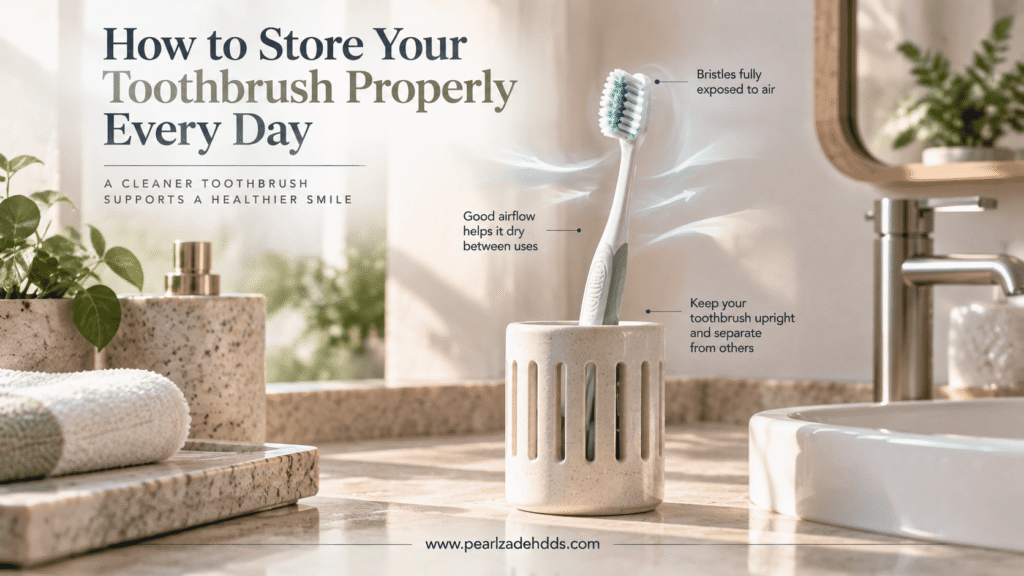
Your toothbrush needs more than a quick rinse after brushing. Where you leave it affects how well it dries between uses. You do not need to keep it sterile, but you should avoid leaving it wet in a closed space.
The basic routine is simple: rinse it, store it upright, and let it air dry. These habits take little effort and give your toothbrush a better chance to dry between uses.
Why Toothbrush Storage Matters
Your mouth naturally hosts hundreds of species of bacteria, and some of them end up on your toothbrush during normal use. Bacteria from the surrounding environment can settle on a stored brush too. This is normal and unavoidable, not a sign something has gone wrong. Toothbrushes are not even sold in sterile packaging to begin with, according to the Journal of the American Dental Association, which notes they can carry bacteria right out of the box.
As Consumer Reports has reported, a toothbrush can harbor bacteria even when it looks perfectly clean, and there is no evidence that this causes adverse health effects for ordinary, healthy adults. That distinction is worth holding onto through the rest of this article. Storage habits are worth getting right because they support a good routine, keep your brush working well, and take almost no extra effort, not because an ordinary bathroom turns your toothbrush into a health hazard that needs correcting.
Where storage genuinely matters is moisture. A wet toothbrush left in a sealed, airless space gives bacteria a far better environment to multiply in than the same brush left out in the open. That single distinction, damp and enclosed versus dry and open, explains most of the specific recommendations below.
How to Store Your Toothbrush Properly
The American Dental Association’s own guidance comes down to a short routine. Rinse the toothbrush thoroughly with tap water after each use to clear off toothpaste and debris. Store it upright rather than lying flat, and let it air dry fully before it gets used again or covered. If more than one brush shares a holder, keep them separated so they are not touching. Avoid a consistently damp, enclosed spot, since moisture is what actually lets bacteria multiply, not the open air of a bathroom.
That is the whole routine. Nothing about it requires special products or extra time, and none of it needs repeating multiple times a day. Do it once, after your last brushing session before the toothbrush sits unused for a while, and you have covered what actually matters.
Should You Use a Toothbrush Cover?
Generally, no, at least not for everyday home use. The ADA is specific here: storing a moist toothbrush in a closed container promotes microbial growth more than leaving it exposed to open air. A cover placed over a still-wet brush traps that moisture right against the bristles, which is the opposite of what you want.
Travel is the one situation where a cover makes practical sense, since you are usually packing a brush that has not fully dried and need to protect it from a bag’s contents. Even then, take the brush out of the case and let it air dry again as soon as you can, rather than leaving it sealed up for the whole trip. A travel case with small ventilation holes handles this better than a fully sealed tube.
How Far Should Your Toothbrush Be From the Toilet?
A toilet flush can send a fine mist of water droplets into the air for a short distance, a phenomenon that has been documented for decades. That is a real, measurable event. It is a much smaller concern than it sounds when repeated online, and there is no evidence connecting it to actual illness for people brushing their teeth normally in a typical home.
Even so, a few practical habits cost nothing and address the concern directly: close the toilet lid before flushing, and keep your toothbrush holder a reasonable distance away, on a separate counter or in a cabinet, rather than propped on the tank. Some public-health guidance suggests a rough distance of a few feet as a practical benchmark, though this is a sensible habit rather than a precisely studied safety threshold. Following it is a low-effort precaution, not a sign that your bathroom is unsafe if you have not been doing it.
Can You Store Multiple Toothbrushes Together?
Yes, with one consistent rule: keep the heads from touching. The ADA recommends separating toothbrushes stored together to prevent cross-contamination between household members. A standard holder with individual slots handles this easily. If your current holder lets bristles lean against each other, angling the brushes differently or spacing out the slots you use solves it.
This matters more in a shared bathroom with several people brushing at similar times than it does for someone living alone, but it is a simple enough habit to keep either way. Families with young children often find that color-coded holders or brushes make it easy to keep everyone’s separated without much thought.
Should You Keep Your Toothbrush in a Cabinet?
A cabinet or drawer works fine, as long as the toothbrush can still dry out before the door closes on it. The problem was never darkness or being out of sight. It is trapped moisture.
If you keep your brush in a cabinet, let it air dry in the open for a while after use, then put it away once it is no longer wet. A cabinet with a bit of airflow, or a holder that keeps the bristles upright and unenclosed even inside the cabinet, works better than tossing a damp brush directly into a closed drawer. A small upright holder placed inside a cabinet with the door left slightly ajar for the first hour or so is an easy middle ground for anyone who prefers their toothbrush out of sight.
What About Electric Toothbrush Heads?
The same basic principles apply. Rinse the head thoroughly after brushing to clear off toothpaste residue, let any water drain off, and store it upright so it can air dry rather than sitting wet against the base or a cover.
Many electric toothbrush bases are designed with this in mind, holding the head upright while charging. If yours does not, standing the handle in a cup or holder the same way you would a manual brush works just as well. If you have more than one head in the household, or swap heads between users, keep them from touching each other for the same reason you would separate manual brushes. A charging base tucked into a closed cabinet has the same moisture problem a covered manual brush does, so the same fix applies: let it dry before closing anything around it.
When Should You Replace Your Toothbrush?
The ADA recommends replacing a toothbrush roughly every three to four months, or sooner if the bristles start to fray or splay outward. This is about effectiveness, not about the brush becoming dangerous on a fixed schedule. Worn, bent bristles simply clean your teeth less thoroughly than fresh ones do, which is the actual reason the recommendation exists.
Children’s toothbrushes often need replacing more often, since kids can wear down bristles faster, and it is worth checking theirs on a similar schedule rather than waiting for an obvious sign. Anyone recovering from an illness that involved a lot of coughing or a sore throat might reasonably swap their brush out afterward too, more as a fresh start than a strict medical necessity. Bristles that look fine at a glance can still be splayed enough at the base to clean less effectively, so a quick check every few months is worth the few seconds it takes.
What If Your Toothbrush Touches a Dirty Surface?
If it briefly touches a clean-ish surface, like a bathroom counter, rinsing it thoroughly under running water is a reasonable response before you use it again. There is no need to treat a minor bump against the sink as an emergency.
If it falls into something clearly contaminated, drops into the toilet, or lands somewhere visibly unclean, replacing it is the simpler and more sensible choice. A new toothbrush costs very little, and there is no need to disinfect your way around a situation like that. Skip the elaborate disinfecting methods generally: the ADA notes that toothbrush sanitizers, including UV devices, have not been shown to provide a meaningful health benefit, and public health guidance similarly discourages running a toothbrush through a dishwasher or microwave. Normal rinsing plus replacement when needed covers what you actually need.
Simple Toothbrush Storage Habits That Actually Matter
Rinse it after every use. Stand it upright. Let it dry fully before covering or packing it away. Keep multiple brushes from touching. Skip the sealed containers and the sanitizing gadgets. Replace it every three to four months, sooner if the bristles wear out. That is the entire list, and none of it takes more than a few extra seconds a day.
Build Habits That Actually Support Your Oral Health
Good toothbrush storage is a small, easy habit, but it is not the foundation of a healthy mouth. Brushing twice daily with fluoride toothpaste, cleaning between your teeth, and keeping up with regular visits do far more for your teeth and gums than anything about where your toothbrush sits overnight.
Dr. Pearl Zadeh’s Woodland Hills practice takes a practical, patient-centered approach to preventive care, focused on habits you can actually keep up with rather than perfection.
Call (818) 716-6722 or click the button below to schedule an appointment and discuss your oral health needs.
Frequently Asked Questions
Yes. Standing it upright lets water drain away from the bristles and helps it air dry fully before the next use, which is what the ADA recommends.
Not for everyday use. Covering a wet brush traps moisture against the bristles, which encourages bacterial growth rather than preventing it. A cover is more useful for travel, once the brush has already dried.
There is no exact required distance, but keeping it on a separate counter or in a cabinet, away from the toilet, and closing the lid before flushing are simple, reasonable habits.
Yes, as long as it has fully air dried first. A closed space is fine; a closed space around a still-wet brush is what actually promotes bacterial growth.
No. Keep multiple toothbrushes separated in their holder to avoid transferring bacteria between household members.
This article is for informational purposes only and is not a substitute for professional dental advice. Please schedule a consultation with Pearl Zadeh DDS to discuss your specific situation