
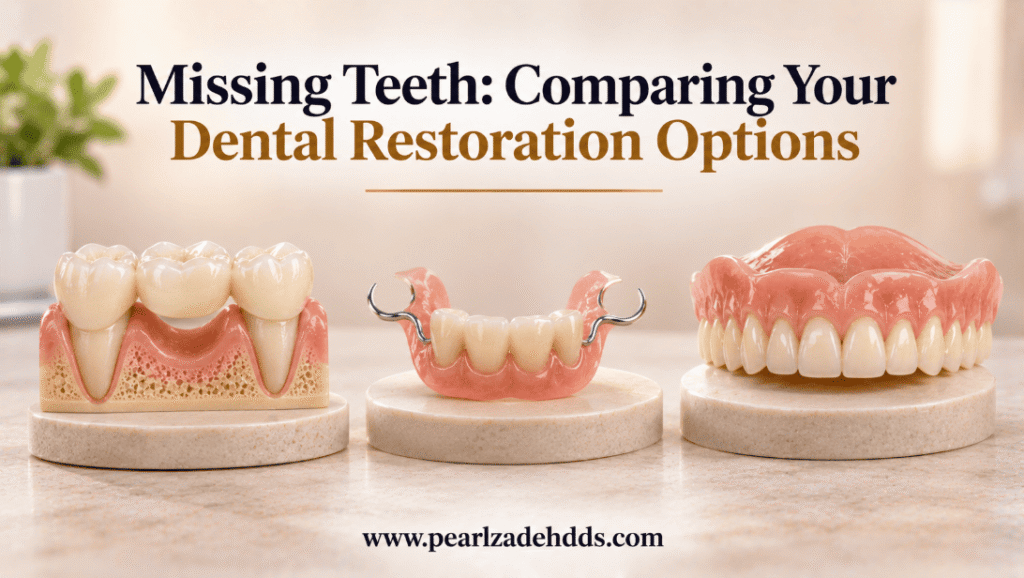
Losing a tooth can affect how you chew, speak, and feel about your smile. A missing tooth can be replaced with a dental bridge, partial denture, full denture, or dental implant. The suitable option depends on how many teeth are missing, the condition of the remaining teeth, your oral health, and your needs.
These restorations work in different ways. Bridges and implants are fixed in place, while dentures can be removed for cleaning. Each also has different requirements for support, maintenance, and placement.
The gap left by a missing tooth can also affect nearby teeth over time, so leaving it untreated is worth discussing with a dentist.
Why Should You Consider Replacing Missing Teeth?
The effects of tooth loss depend on which tooth is missing and how many teeth are affected. Losing a molar, for example, can make chewing more difficult. A larger gap may also affect eating or speech, as the American Dental Association explains.
Other possible effects include:
- Difficulty chewing certain foods.
- Changes in speech, depending on the location of the gap.
- Nearby teeth shifting into the empty space.
- Changes in the bite or added pressure on remaining teeth.
- Changes in appearance and facial support when several teeth are missing.
Cleveland Clinic also notes that untreated tooth loss can contribute to shifting teeth, bite problems, and facial sagging due to reduced support. These effects are not inevitable. A single missing tooth does not necessarily cause all or any of these problems.
What Are the Main Options for Replacing Missing Teeth?
Missing teeth can be replaced in several ways. Dr. Pearl Zadeh DDS offers dental bridges, partial dentures, and full dentures. Although dental implants are another option, Dr. Pearl does not perform implant surgery. Patients interested in implants need to consult a qualified implant provider.
Dental Bridges
A dental bridge fills the space left by one or more missing teeth. The replacement teeth are held in place by supporting structures, which may include neighboring natural teeth or dental implants.
A traditional bridge uses crowns placed over the teeth on either side of the gap to hold the replacement tooth in place. Other designs, such as cantilever and Maryland bridges, use different support methods. Implant-supported bridges rely on dental implants instead of natural teeth.
Porcelain is one material used for dental bridges. It can be matched to the shade of surrounding teeth for a more natural appearance. Dr. Pearl offers porcelain dental bridges.
With a traditional bridge, the supporting teeth usually need to be reshaped to make room for the crowns. This involves removing some enamel, which cannot grow back. The condition of these teeth matters because they must provide enough support for the bridge.
A traditional bridge may be suitable when healthy teeth are present on both sides of the gap. However, the number of missing teeth, the condition of the supporting teeth, and overall gum health also influence whether this option is appropriate.
Partial Dentures
A partial denture replaces several missing teeth while allowing the remaining natural teeth to stay in place. It is removable and may use clasps that attach around nearby teeth to help keep it stable.
Partial dentures may suit people who are missing several teeth but still have enough healthy natural teeth to support the appliance. Dr. Pearl offers partial dentures for patients who need this type of restoration.
Daily cleaning helps keep a partial denture in good condition. Remove it for cleaning and follow the dentist’s instructions for brushing and storage. The natural teeth around the clasps also need regular brushing and flossing to help prevent plaque buildup.
Full Dentures
Full dentures replace all the teeth in an upper or lower arch. Unlike partial dentures, they are used when no natural teeth remain in the arch being restored.
They are removable and rest on the underlying gum tissue. Dr. Pearl offers full dentures for patients who have lost all their teeth in an arch.
Getting used to new dentures can take time. They may initially feel awkward or require adjustments as the mouth adapts. Changes in the gums and supporting tissues can also affect how dentures fit over time, so follow-up visits may be needed for adjustments or relining.
Like partial dentures, full dentures require daily cleaning and proper storage when removed. Follow the dental team’s instructions to care for the appliance.
Dental Implants
Dental implants provide another way to replace missing teeth. They consist of small posts that a qualified provider surgically places in the jawbone. Once healed, an implant can support a crown, bridge, or denture.
Implants are not suitable for everyone. Jawbone condition, general health, healing ability, and other factors influence whether implant treatment is appropriate. A consultation with a qualified implant provider can help determine whether this option is suitable.
Dental Bridges vs. Partial Dentures: What Is the Difference?
Both options replace missing teeth, but they work in different ways. Neither is better for every patient.
| Feature | Dental bridge | Partial denture |
| Basic design | Artificial teeth joined to anchoring crowns or other support | Replacement teeth on a removable appliance with clasps |
| Support | Neighboring teeth, or implants in some designs | Clasps that hook around remaining natural teeth |
| Removable? | Fixed in place. Only a dentist can remove it. | Yes. Taken out for cleaning. |
| Daily care | Brushing and flossing, plus cleaning under the bridge with floss threaders or interproximal brushes | Rinsing, brushing, and water storage for the appliance, plus careful care of the clasped teeth |
| Remaining teeth needed | Healthy supporting teeth beside the gap | Natural teeth healthy enough to anchor the clasps |
Cleveland Clinic’s denture overview says bridges work best for one to three missing teeth in a row. Replacing multiple missing teeth can involve a longer bridge, a partial denture, or an implant-supported design. The examination shows which is realistic.
Both options depend on the health of the remaining teeth and gums. A weak supporting tooth can limit either one. The dentist weighs those details before recommending anything.
Full Dentures vs. Other Replacement Options
Full dentures address a different situation. They replace every tooth in an arch. A bridge needs supporting teeth, and a partial denture needs natural teeth for its clasps.
When an arch has no teeth left, those designs have nothing to anchor to unless implants provide support. That is where full dentures often enter the discussion.
Cleveland Clinic names dental implants and dental bridges as the two main alternatives to dentures. Each has trade-offs in fit, upkeep, and suitability.
Full dentures are removable, while bridges stay fixed. Partial dentures also come out, but they leave some natural teeth in place. Fit may need adjustments over time for any removable appliance.
How Do You Choose Among Missing Teeth Replacement Options?
No single option fits every patient. These factors usually guide the decision:
- Number and location of missing teeth.
- Condition of the remaining natural teeth.
- Gum and jawbone health.
- Chewing and speech needs.
- Comfort and appearance preferences.
- Cleaning and maintenance habits.
- Treatment time and cost.
Treatment time and cost differ by option and by case. Ask for an estimate that fits your mouth, and confirm insurance benefits with your plan.
A dentist must examine the mouth and review your needs before recommending a restoration. The dentist may also use X-rays when they are appropriate. Bring questions about fit, upkeep, and what each option involves.
What Happens If You Leave a Missing Tooth Unreplaced?
What happens if you do not replace a missing tooth depends on several factors. Location, the number of missing teeth, and overall oral health all matter. Some gaps cause few noticeable problems, while others can lead to changes over time.
Shifting teeth and bite changes are possible effects. The American Dental Association (ADA) explains that remaining teeth may shift toward an empty space. Bone loss can also occur around a missing tooth. These are possibilities, not guarantees. A gap at the back, a gap at the front, and several missing teeth can each affect the mouth differently.
A dental examination can help determine whether a missing tooth is affecting nearby teeth, the bite, or the supporting bone. Dr. Pearl Zadeh DDS can assess your oral health and discuss whether replacing the tooth may be appropriate. If replacement is recommended, the available options depend on your dental condition and needs.
Call (818) 716-6722 or click the button below to schedule your consultation online.
Frequently Asked Questions
The answer depends on the case. Cleveland Clinic names dental implants as the most common alternative to dentures. It calls a traditional bridge the most common bridge type. Bridges, partial dentures, and full dentures remain established options, and a dentist can explain which fits your mouth.
Sometimes. The ADA describes a bridge as filling the gap where one or more teeth used to be. Cleveland Clinic says bridges work best for one to three missing teeth in a row. The health of the supporting teeth also matters
A partial denture replaces several teeth and uses clasps on remaining natural teeth. Full dentures replace all teeth in an upper or lower arch. Both types are removable.
Not always. The effects depend on the tooth’s location, the number of missing teeth, and oral health. Some gaps cause little trouble, while others may lead to shifting teeth or chewing changes. A dentist can say whether replacement is advisable in your case.
Cleveland Clinic reports that bridges last five to 15 years on average, and dentures seven to 10 years. Individual results vary with care, fit, and oral health. Regular dental visits help catch problems early.
The information above is for informational purposes only and is not a substitute for professional dental advice. Please schedule a consultation with Pearl Zadeh DDS to discuss your specific situation.