
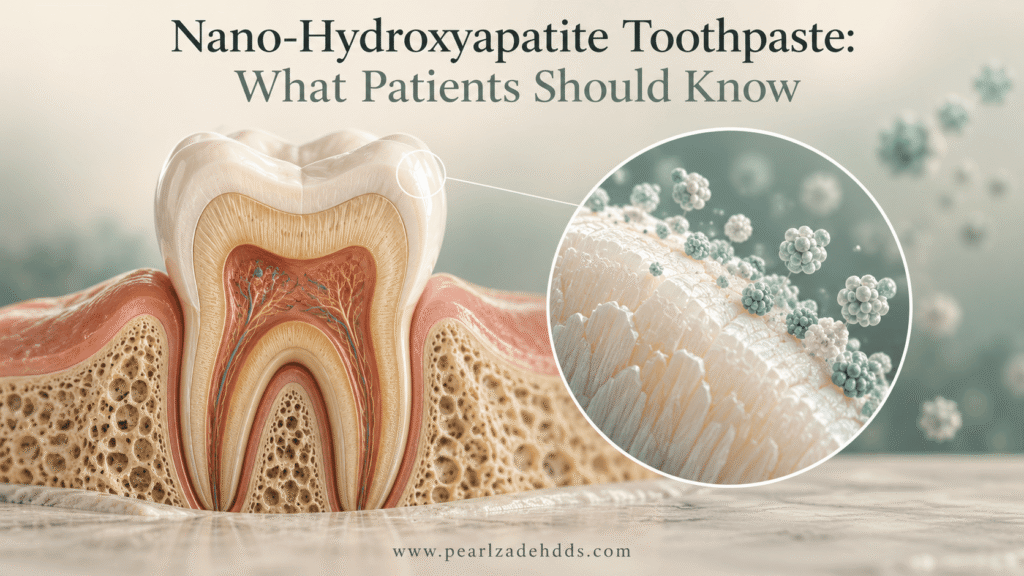
Nano-hydroxyapatite toothpaste has moved from a niche product into mainstream oral care shelves, often marketed as a fluoride-free alternative that repairs enamel. It has genuinely attracted scientific attention, not just marketing attention, because it resembles the mineral your teeth are actually made of.
Nano-hydroxyapatite toothpaste is a promising option with growing clinical evidence. It is not yet established as equivalent to fluoride toothpaste for every adult, and the two evidence bases differ substantially in size and maturity.
What Is Nano-Hydroxyapatite?
Hydroxyapatite is a calcium phosphate mineral that makes up most of your tooth enamel and dentin, quite literally the mineral your teeth are built from. Nano-hydroxyapatite refers to that same mineral engineered into particles at the nanoscale, far smaller than natural crystal structures. The small particle size affects how the material behaves on a tooth surface, including how it settles into microscopic irregularities.
It shows up in some toothpastes, mouth rinses, and other oral-care products, usually as a standalone active ingredient in fluoride-free formulations, though some products combine it with fluoride. Using it does not mean a new layer of natural enamel forms over your teeth. Enamel does not regenerate that way, with any ingredient.
How Does Nano-Hydroxyapatite Work on Teeth?
Researchers have studied several proposed mechanisms, best kept separate rather than treated as one settled fact. Nano-hydroxyapatite may interact with the outer tooth surface, in some studies appearing to settle into small defects or porous areas. It can contribute calcium and phosphate, the same minerals enamel is made of, involved in natural remineralization. Under certain laboratory and clinical conditions, it has been associated with reduced mineral loss and support for remineralizing early enamel changes.
A genuinely important distinction belongs here. Remineralizing an early, non-cavitated lesion is not repairing an established cavity. Once decay has progressed to an actual hole, no toothpaste ingredient reverses that. This research addresses the earlier stage, before a cavity has fully formed.
Can Nano-Hydroxyapatite Remineralize Enamel?
Remineralization is a normal, ongoing process. Enamel constantly loses and regains minerals in small amounts, a balance between acid from oral bacteria pulling minerals out and saliva and mineral sources helping put them back. When that balance tips toward loss, an early lesion can develop. When conditions favor mineral gain, early lesions can sometimes be arrested or partially reversed.
A 2025 systematic review and meta-analysis in the Journal of Dentistry examined fluoride-free hydroxyapatite toothpaste against fluoride toothpaste for preventing and remineralizing initial caries lesions. Out of 68 studies screened, only four in-situ randomized trials met the eligibility criteria, involving children, adolescents, and young adults under 25. On the main measures, lesion development and progression, the meta-analysis found no statistically significant difference between the two. Two secondary measures did differ significantly: lesion size and a fluorescence-based measurement, both at six months.
Four eligible trials in a younger population is a small evidence base. This finding is encouraging for that specific comparison and age group. It is not proof that hydroxyapatite remineralizes enamel equivalently to fluoride across all ages.
Does Nano-Hydroxyapatite Prevent Cavities?
Several different things get treated as interchangeable in this conversation: a laboratory finding, a remineralization measurement, a change in an early lesion, a shift in cavity-related bacteria, and an actual measured reduction in cavities. Only the last one directly answers the patient’s question.
A 2024 updated systematic review and meta-analysis reviewed clinical trials comparing hydroxyapatite oral-care products against placebo, no intervention, or fluoride controls. Of 18 studies retrieved, 5 clinical trials showed higher odds of caries prevention with hydroxyapatite toothpaste versus placebo. The authors concluded that clinical evidence for fluoride-free hydroxyapatite in reducing dental caries has expanded, and that it is effective as an active ingredient without fluoride.
This review deserves a direct disclosure. Two of the six authors are senior scientists employed by a company that manufactures hydroxyapatite toothpaste, and all six authors received travel grants from that company. That does not mean the findings are wrong. It means the favorable framing should be read alongside that relationship, not treated as fully independent.
A separate, earlier 2022 review in Clinical Oral Investigations reached a more cautious conclusion on nano-hydroxyapatite specifically. The authors stated that no conclusive evidence on efficacy could be obtained, citing the low number of clinical studies, relatively short follow-up periods, high risk of bias, and study conditions that do not reflect everyday use.
The honest summary: evidence for hydroxyapatite reducing actual cavities has grown, some of it from researchers with a manufacturer connection, while an earlier review found the same evidence inconclusive. Neither the enthusiastic framing nor blanket dismissal fully represents where the research sits.
Is Nano-Hydroxyapatite as Effective as Fluoride?
Fluoride has decades of clinical evidence behind it. The ADA cites studies finding fluoride toothpaste prevented caries ranging from 16% per tooth to 31% per surface versus placebo. That base spans decades and many independent research groups. Hydroxyapatite’s evidence base is newer, smaller, and concentrated among fewer groups.
Some studies have found comparable outcomes under specific conditions, as the in-situ remineralization comparison above showed. Other research has found differences depending on what was measured, and rigorous head-to-head trials remain far fewer than what exists for fluoride.
It would be inaccurate to say nano-hydroxyapatite is just as effective as fluoride for everyone. It would be equally inaccurate to dismiss it as having no supporting evidence. Some studies have reported comparable results in specific comparisons. That does not establish universal equivalence across every patient, every formulation, and every outcome that matters for caries prevention.
Why Do Some People Choose Fluoride-Free Toothpaste?
Reasons vary and are worth taking seriously without judgment: personal preference for alternative ingredients, concerns about fluoride, sensitivity to certain formulations, or a specific recommendation from a dental professional.
The ADA does not treat fluoride as inherently dangerous at normal toothpaste use. Fluorosis, a cosmetic enamel change in developing teeth, is addressed through recommended amounts by age, not by avoiding fluoride entirely. Choosing fluoride-free for personal reasons differs from avoiding fluoride on the belief it is generally toxic, which current evidence does not support.
Can Nano-Hydroxyapatite Help With Tooth Sensitivity?
Hydroxyapatite has been studied specifically for dentin hypersensitivity, and this is one area where its evidence base is more established than for cavity prevention. The proposed mechanism involves physically occluding the microscopic tubules in exposed dentin, which reduces the fluid movement inside those tubules that triggers pain signals when dentin is exposed to cold, air, or touch.
It does not work for everyone, and it is not a guaranteed treatment. Sensitivity has several possible causes, including exposed dentin, gum recession, enamel wear, acid erosion, cracks, and cavities. A desensitizing toothpaste addresses the symptom rather than diagnosing the cause.
Sensitivity that persists despite a desensitizing product, or appears suddenly, deserves an actual evaluation rather than indefinite continued use.
Can Nano-Hydroxyapatite Whiten Teeth?
Not the way professional whitening does. The ADA distinguishes abrasive agents, which may whiten by physically removing surface stains, from peroxide, used to lighten intrinsic color through actual bleaching. Nano-hydroxyapatite functions more like the former: it may polish the surface and remove some staining.
Research on nano-hydroxyapatite and white spot lesions specifically is informative. A 2024 systematic review and meta-analysis looked at its effect on white spot lesions, including color change. Most of the 14 included studies were laboratory based, with only three in vivo and one in-situ study. On color specifically, the meta-analysis found no significant improvement in appearance.
Surface polishing is a real, modest effect, not the same as bleaching. Anyone hoping for a noticeably whiter smile is describing a cosmetic goal that a professional whitening treatment is actually built to address.
Is Nano-Hydroxyapatite Safe?
Hydroxyapatite has been studied in oral-care applications for decades, and it is chemically similar to what teeth are already made of, part of why it has drawn research interest. Available safety evidence for nano-hydroxyapatite formulations has not raised red flags suggesting it is unsafe for normal brushing use. Laboratory and material-science research on nanoparticles generally should not be extrapolated onto every commercial formulation, since concentration and particle characteristics vary between products.
It is not accurate to claim nano-hydroxyapatite particles routinely enter the bloodstream or accumulate in organs from normal toothpaste use, a claim that circulates online but goes beyond available evidence. It is also inaccurate to claim it is inherently safer than fluoride; both have their own, separately studied safety profiles. Normal brushing, where toothpaste is spit out, differs from intentionally ingesting toothpaste, which is not recommended regardless of active ingredient.
Can Adults Use Nano-Hydroxyapatite Toothpaste?
Adults can and do use fluoride-free nano-hydroxyapatite toothpaste. Whether switching makes sense depends on more than curiosity about the ingredient: your history of cavities, current caries risk, enamel condition, sensitivity, gum health, diet, dry mouth, medications, and the rest of your routine. Not every adult needs to switch, and a fluoride-free product is not automatically appropriate for every risk level without discussion first.
Should You Switch From Fluoride to Nano-Hydroxyapatite?
Do not make this decision based on marketing claims alone. Frequent cavities, high caries risk, dry mouth, exposed root surfaces, or orthodontic appliances can make fluoride particularly relevant. Discuss these factors with your dentist before switching away from fluoride toothpaste. Nobody has to use fluoride toothpaste, but people with higher cavity risk should consider their individual oral health when making that choice.
If your caries risk is low and you strongly prefer a fluoride-free product, a dentist can discuss whether hydroxyapatite toothpaste is reasonable for your situation. The right answer depends on the person asking, not a universal rule.
Can You Use Nano-Hydroxyapatite and Fluoride Together?
The two ingredients are not mutually exclusive, and some commercial products combine them. A systematic review of nano-hydroxyapatite combined with fluoride for remineralizing white spot lesions found only five eligible studies, assessing 151 lesions. The authors called it a promising strategy while noting the evidence has limited quantity and only moderate quality.
Layering extra active ingredients on top of an existing routine does not produce a better result by default. If a combination product interests you, that is a reasonable question for your dentist rather than something to assemble on your own.
What Should You Look for in a Nano-Hydroxyapatite Toothpaste?
Look past the phrase on the box. Check the full ingredient list and whether the product contains fluoride, since some hydroxyapatite products include both. The ADA Seal of Acceptance is useful context: a product earns it by submitting safety and efficacy data, and any toothpaste carrying a cavity-protection claim with the Seal must currently contain fluoride.
A hydroxyapatite toothpaste can have a well-formulated ingredient profile without making that specific seal claim, since the claim relates to fluoride. The word “hydroxyapatite” on the packaging does not, by itself, prove that a product prevents cavities. Marketing claims also do not replace evidence from reliable research.
What Nano-Hydroxyapatite Toothpaste Cannot Do
Remineralization often gets overstated in dental marketing. Toothpaste of any kind cannot rebuild a tooth that has lost substantial structure. It cannot fill an established cavity or repair a broken tooth. It also cannot reverse every type of enamel damage beyond the earliest, non-cavitated stage. Toothpaste does not replace professional treatment or regular dental checkups.
At its most meaningful, remineralization helps very early, non-cavitated enamel changes stabilize or recover before they progress. That makes remineralization a useful benefit for some toothpaste ingredients. However, it is a much smaller claim than repairing damaged teeth, and the two should not be confused.
What Matters Most for Preventing Cavities?
Nano-hydroxyapatite, if you use it, sits within a larger picture rather than replacing it. The ADA recommends brushing twice daily with fluoride toothpaste for two minutes as the foundation of routine caries prevention, built on a far larger evidence base than any single alternative. Cleaning between teeth daily, limiting how often you expose teeth to sugar, maintaining saliva flow, addressing dry mouth, and regular dental exams all matter as much or more than any single ingredient.
Retaining that fluoride benefit also depends on a habit many people get wrong. Our discussion of whether to rinse after brushing covers what actually affects how much benefit you get from fluoride toothpaste.
Get Personalized Preventive Dental Care
Choosing a toothpaste is only one part of protecting your teeth. Your cavity risk, enamel condition, sensitivity, gum health, diet, and daily habits all matter.
Dr. Pearl Zadeh can evaluate your overall oral health, identify factors that may increase your risk of dental problems, and discuss preventive care based on your individual needs.
Call (818) 716-6722 or click the button below to schedule your consultation online.
Frequently Asked Questions
It is toothpaste containing hydroxyapatite, the mineral that makes up most of tooth enamel, engineered into nanoscale particles. It is often marketed as a fluoride-free option, though some products combine it with fluoride.
Available evidence has not raised significant safety concerns for normal brushing use. Claims that it enters the bloodstream or causes systemic harm go beyond what current evidence actually supports.
Evidence has expanded and some reviews report encouraging findings, though the evidence base is smaller than for fluoride and includes reviews with industry-connected authors. It has not been established as a definitive cavity-prevention method for all patients.
Some studies have found comparable results in specific comparisons. Fluoride has a substantially larger, longer-established evidence base overall, so this does not mean universal equivalence.
It cannot rebuild enamel that has been physically lost. Research suggests it may support remineralization of very early, non-cavitated enamel changes, which is a smaller and different claim.
This article is for informational purposes only and is not a substitute for professional dental advice. Please schedule a consultation with Pearl Zadeh DDS to discuss your specific situation.