
You run your tongue over your teeth and feel something rough near the gumline, maybe with a yellowish tint. Is that plaque, or has it already turned into something else?
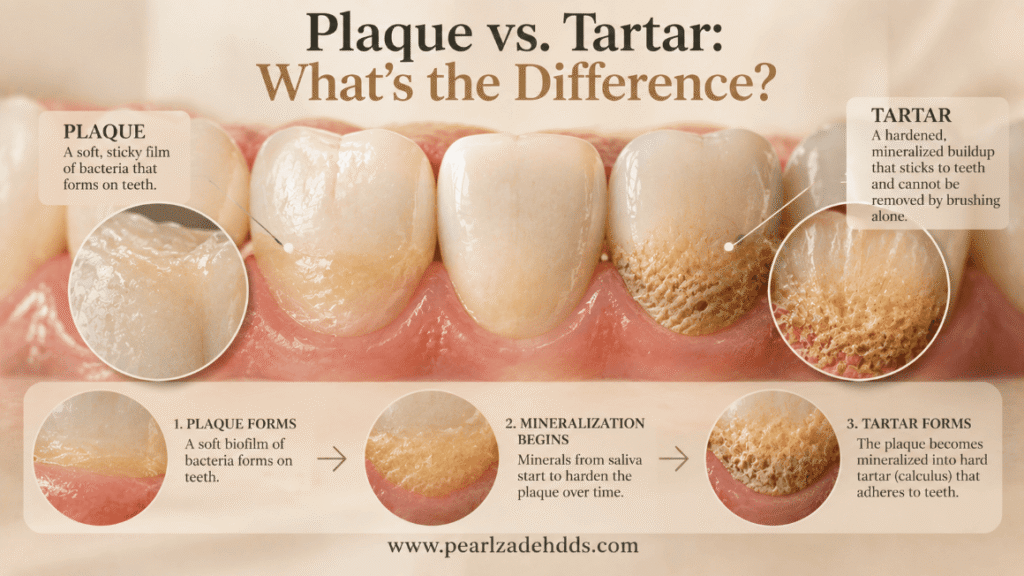
Plaque is a soft bacterial film that builds up on your teeth. Tartar is that same material after it has hardened into a mineral deposit. The distinction matters practically: daily brushing and flossing can disrupt plaque, but once it hardens into tartar, brushing alone generally cannot remove it. That difference shapes everything else about how each one gets handled.
What Is Plaque?
Plaque is a biofilm, a sticky layer of bacteria that forms continuously on tooth surfaces. The American Dental Association describes it as a sticky film containing bacteria that, after a meal or snack with sugar, can release acids that attack tooth enamel. Repeated acid attacks can break down enamel and eventually lead to cavities.
It is not simply food stuck between your teeth, though food residue feeds the bacteria within it. Plaque forms naturally as part of ordinary bacterial activity in your mouth, whether you have eaten recently or not. It tends to build up most along the gumline, between teeth, and on chewing surfaces with grooves and pits.
This is why plaque can feel fuzzy or slightly slippery when you run your tongue over your teeth, particularly later in the day. It starts reforming within hours of brushing, which is why daily cleaning is a repeated habit rather than a one-time fix. A toothbrush cannot fully clean between teeth or reach every groove, which is part of why plaque tends to persist in certain spots.
What Is Tartar?
Tartar, also called dental calculus, is not simply a thicker layer of plaque. It is a fundamentally different material: plaque that has mineralized and hardened onto the tooth surface, incorporating calcium and phosphate from saliva.
Where plaque feels soft and can be wiped away, tartar feels hard and rough, often described as gritty or crusty. It commonly develops along the gumline, particularly in areas that are harder to clean thoroughly, and can form both above the gum (visible) and below it (not visible without a dental exam).
Color varies. Tartar often appears yellow or tan, though it can look darker in some areas depending on staining from food, drinks, or tobacco. Appearance alone does not tell you how extensive the deposit is. A small visible patch can sit above a larger deposit below the gumline that you cannot see.
Plaque vs. Tartar: What Is the Difference?
The short version, side by side:
| Plaque | Tartar |
| Soft bacterial biofilm | Hardened, mineralized deposit |
| Develops continuously, all day | Forms only when plaque mineralizes |
| Can often be disrupted by daily brushing and flossing | Usually requires professional removal |
| Often feels fuzzy or slippery | Often feels hard or rough |
| Can contribute to cavities and gum inflammation | Can make plaque control harder and contribute to gum problems |
The appearance of plaque and tartar can vary from person to person. If you notice unusual buildup, discoloration, or rough areas on your teeth, a dental professional can help identify what is causing it and whether it needs attention.
Can Plaque Turn Into Tartar?
Yes. When plaque is not adequately removed through regular brushing and interdental cleaning, minerals from saliva gradually incorporate into it, and it hardens. The ADA describes this directly: plaque left in place can eventually harden into calculus, making it more difficult to keep teeth clean going forward.
How quickly this happens varies meaningfully between people. Saliva composition and flow rate play a role, and so does how consistently plaque gets removed day to day. There is no reliable universal timeframe that applies to everyone, despite how often specific numbers get repeated online. Some people notice hardened deposits forming quickly in certain spots; others rarely develop much at all, even with similar habits.
Can You Brush Away Plaque?
Largely, yes, from the surfaces your toothbrush can actually reach. Brushing twice daily with proper technique, angling bristles toward the gumline and covering all accessible tooth surfaces, disrupts and removes a meaningful amount of plaque before it has a chance to sit long enough to mineralize.
Technique and consistency matter more than how hard you brush. Rushing, missing the gumline, or skipping areas leaves plaque in those spots, even if the rest of your mouth looks clean. Brushing does not remove every trace, particularly between teeth, which is why interdental cleaning is a separate, necessary step.
Can You Brush Away Tartar?
No, generally not, once plaque has actually hardened into calculus. At that point it is bonded to the tooth surface in a way ordinary brushing pressure cannot disrupt.
Do not try to scrape it off with household objects, a metal pick, a fingernail, or a scaling tool bought online. Beyond simply not working well, aggressive scraping with the wrong instrument or technique can injure gum tissue or scratch tooth enamel, creating new problems without solving the original one. Removing established tartar safely requires a dental professional’s instruments and training.
Can Flossing Remove Tartar?
No, and this is worth being clear about since it is a common point of confusion. Floss and other interdental cleaners are effective at disrupting plaque between teeth before it has a chance to harden. Once that plaque has mineralized into tartar, floss simply is not designed to remove it. Our guide to flossing technique covers how to clean between teeth effectively, which is genuinely useful for preventing tartar buildup between teeth in the first place, even though it will not remove tartar that has already formed.
What Does Tartar Look and Feel Like?
Hard rather than soft is the defining physical trait, along with a rough or gritty texture you can sometimes feel with your tongue or notice when running floss across it. Color commonly runs yellow to tan, though darker deposits, brown or black in appearance, show up in some areas depending on staining. It tends to accumulate most noticeably behind the lower front teeth and around the molars.
It is worth being cautious here: you should not assume tartar based on appearance alone. Other discoloration, from coffee, tea, tobacco, or certain foods, can look similar without being hardened calculus at all. What you are looking at is something a dental exam can identify accurately; guessing from a mirror often cannot.
Why Does Tartar Build Up Behind the Lower Front Teeth?
This specific location is not a coincidence. The openings of two major salivary glands sit near the floor of the mouth, close to the inner surface of the lower front teeth. Saliva flowing from those glands carries minerals, and that steady mineral exposure in this particular spot makes it a common site for calculus to form, more so than many other areas of the mouth.
A similar pattern shows up near the upper back molars, close to another major salivary gland opening on the inside of the cheek. Noticing buildup in these two specific spots more than elsewhere is common and expected, not necessarily a sign that something else is wrong.
Can Plaque and Tartar Cause Bad Breath?
Plaque can, since the bacteria within it produce byproducts that contribute to oral odor. Tartar is not necessarily the direct cause of every case of bad breath on its own, but its rough surface gives plaque more places to cling to and accumulate, which can indirectly make odor worse over time.
Persistent bad breath has several possible causes beyond tartar, including tongue coating, dry mouth, certain foods, and other oral or systemic factors. It should not automatically be attributed to tartar without an actual look at what is going on.
Can Plaque and Tartar Cause Gum Disease?
Plaque accumulation along the gumline can lead to gingivitis, the earliest stage of gum inflammation. In some people, persistent, unaddressed inflammation can progress to more serious periodontal disease over time, though susceptibility varies between individuals.
Tartar’s role is somewhat different. Rather than being a direct, independent cause, its rough surface makes plaque control considerably more difficult once it is present, since plaque adheres to it more readily than to smooth enamel. That can indirectly contribute to ongoing gum irritation. Having tartar does not automatically mean someone has periodontal disease; it means plaque control in that area has gotten harder, which is worth addressing.
How Can You Prevent Tartar From Forming?
The approach is mostly about limiting how much plaque has the chance to sit long enough to mineralize. Brushing twice daily with fluoride toothpaste, cleaning between teeth daily, and paying particular attention to the gumline all help. Our article on whether to rinse after brushing covers one habit that affects how well fluoride toothpaste actually works between brushings.
Regular dental exams and cleanings catch and remove buildup before it becomes extensive. None of this guarantees zero tartar for every person; individual saliva composition and other factors mean some people are simply more prone to it than others, even with excellent habits.
How Is Tartar Removed?
Dental professionals use specialized instruments, hand scalers or ultrasonic devices, to physically remove hardened deposits from the tooth surface, both above and below the gumline. The specific approach depends on how much calculus is present and where it has developed.
A routine cleaning and a deeper periodontal treatment are not the same thing, and not every patient needs the latter. Someone with a modest amount of surface tartar typically needs a standard cleaning. Someone with significant gum disease and extensive subgingival calculus may need a different level of periodontal care, determined by an actual exam rather than assumed from how things look or feel at home.
How Often Should You Get a Professional Cleaning?
There is no single interval that fits every patient, and treating six months as a universal rule misses how individualized this actually is. Gum health, history of periodontal disease, how quickly plaque and calculus tend to build up for you specifically, cavity risk, and general oral hygiene all factor into what makes sense.
Some people do well on a roughly six-month schedule. Others, particularly those with a history of gum disease or faster calculus buildup, benefit from more frequent visits. A dentist assessing your specific mouth is what actually determines the right interval, not a blanket recommendation applied the same way to everyone.
What Happens If Tartar Is Left on Your Teeth?
Left in place, tartar tends to make everyday plaque control progressively harder in that area, since its rough surface gives plaque more to grip onto. Over time this can contribute to persistent gum inflammation in the affected spot.
How much this matters, and how it progresses, varies between individuals. It is not accurate to say tartar inevitably leads to tooth loss or severe disease for everyone who has it. It is accurate to say that untreated buildup does not resolve on its own and generally continues affecting the surrounding tissue until it is professionally removed.
Is Tartar the Same as a Stain?
No, and confusing the two is common. Plaque is a soft, active biofilm. Tartar is hardened, mineralized plaque. Extrinsic staining is a surface discoloration, from coffee, tea, wine, or tobacco, that sits on the tooth or on plaque and tartar without being either one itself. Your natural tooth color is a separate factor entirely, unrelated to any buildup.
A dark or yellow area is not automatically tartar. It could be surface staining on otherwise clean enamel, staining sitting on top of existing tartar, or simply how a particular tooth is colored. Not every visible discoloration needs scraping, and assuming so can lead to unnecessary worry or, worse, someone trying to remove it at home with the wrong tool.
Have Your Teeth Evaluated Rather Than Guessing
Plaque is a soft biofilm that daily brushing and flossing can help control. Tartar is hardened calculus that generally needs professional removal once it forms. Keeping plaque buildup in check is what actually reduces how much tartar accumulates over time.
If you have noticed rough or discolored areas on your teeth and are not sure what you are dealing with, Dr. Pearl Zadeh can take an actual look and let you know what it is and what, if anything, it needs.
Call (818) 716-6722 or click the button below to schedule your consultation online.
Frequently Asked Questions
Plaque is a soft bacterial film that forms continuously and can be disrupted by daily brushing and flossing. Tartar is that same plaque after it has hardened into a mineral deposit, which generally requires professional removal.
Yes. Plaque that is not adequately removed can absorb minerals from saliva and harden into tartar over time. How quickly this happens varies between individuals.
Largely yes, from surfaces your toothbrush can reach, with proper technique and consistency. Brushing does not remove every trace, particularly between teeth, which is why interdental cleaning matters too.
There is no reliable universal timeframe. Individual factors, including saliva composition and how consistently you remove plaque, can affect it, so the timeframe varies from person to person.
Major salivary gland openings sit near the inner surface of the lower front teeth, exposing that area to a steady flow of mineral-containing saliva, which makes it a common site for calculus to form.
This article is for informational purposes only and is not a substitute for professional dental advice. Please schedule a consultation with Pearl Zadeh DDS to discuss your specific situation.