
You reach the end of your Invisalign treatment plan expecting to see your final smile, but your dentist recommends additional aligners. For many patients, that moment creates the same concern: Why do I need more trays if treatment was supposed to be finished?
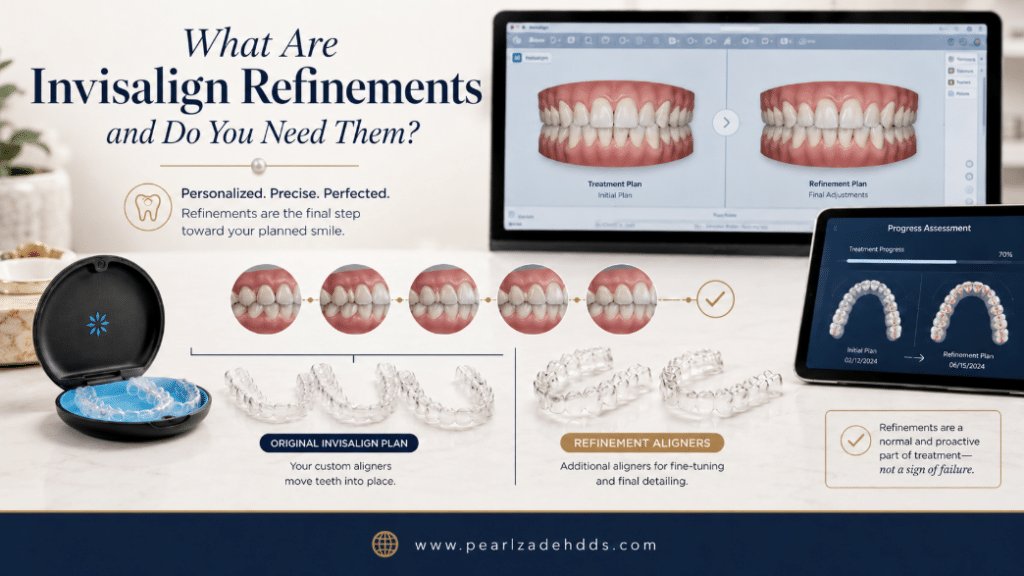
The answer is often simpler than it seems. Invisalign refinements are additional aligners used to fine-tune tooth movement and help achieve the planned result. They do not automatically mean something went wrong or that your original treatment failed.
Teeth do not always move exactly as predicted, and refinements allow your dentist to make adjustments based on how your smile responds during real treatment.
What Are Invisalign Refinements?
Refinements are an additional set, or sometimes a few sets, of aligners created after your original series to fine-tune movements that weren’t fully completed. Rather than starting your treatment over, refinements pick up exactly where your first series left off, targeting only the specific teeth or movements that still need adjustment.
Why Would You Need Invisalign Refinements?
Invisalign treatment plans are built from a digital prediction of how your teeth should move over the course of treatment. That prediction is detailed and generally reliable, but it’s still a prediction, and real teeth don’t always move in a perfectly straight line toward the planned result. Certain movements, particularly rotating a tooth or shifting it vertically, tend to be harder for aligners to execute with full precision compared to simpler tipping movements.
Some teeth respond a little slower than expected, or an attachment, the small tooth-colored bump that helps an aligner grip a tooth, loosens partway through treatment. Any of these can leave a small gap between where your teeth were supposed to land and where they actually landed, which is exactly what refinements are designed to close.
Do Refinements Mean Your First Treatment Failed?
No. It’s worth saying directly, since this is the assumption that causes the most unnecessary worry. Refinements address the natural gap between a digital prediction and biological reality, not a mistake in your original treatment plan. Many providers factor the likelihood of refinements into their planning from the start, treating them as an expected part of achieving a precise result rather than an exception that signals something went wrong.
How Common Are Invisalign Refinements?
Quite common. A retrospective study published in the American Journal of Orthodontics and Dentofacial Orthopedics, which reviewed records from 500 Invisalign patients, found an average of about two and a half Invisalign refinement scans per treatment. Needing one or more rounds of refinement is a routine part of the process for a large share of patients, particularly those with more complex starting alignment or movements that are naturally harder for aligners to complete precisely.
The same study found that about one in six patients ultimately switched from Invisalign to braces to complete treatment, which is worth knowing as one possible outcome in cases where aligners alone aren’t fully closing the remaining gap.
How Dentists Decide Whether Refinements Are Necessary
Near the end of your original aligner series, your dentist compares your current tooth positions against the plan’s intended final result. If everything landed where it was supposed to, no refinement is needed.
If certain teeth still need a bit more movement, whether that’s a small rotation, a remaining gap, or a bite relationship that isn’t quite settled, your dentist recommends refinement aligners to close that specific gap. This decision is based on a direct comparison between plan and reality, not a general guess.
When Do Refinements Usually Happen During Treatment?
Dentists most often order refinements near the end of your original aligner series. This usually happens after you complete the full set and your dentist can evaluate your progress.
In some cases, your dentist may recommend refinements earlier if your teeth are not tracking as planned. Starting adjustments sooner can help move treatment closer to your desired outcome instead of continuing with an ineffective sequence.
What Happens During the Refinement Process
The process begins with new digital scans or impressions of your current tooth position. Your dentist compares these results with your original treatment goals. They then create a shorter digital plan that focuses only on the remaining movements.
The new plan goes to the aligner manufacturer, and your dentist receives the refinement trays after production. Once they arrive, you wear the new aligners on the same schedule as your original set. Most patients wear them around 20 to 22 hours a day and switch trays as directed.
How Many Additional Aligners Might You Need, and How Long Does It Add to Treatment?
The number of refinement aligners varies by case. Some patients need only a few additional trays to adjust one or two teeth. Others with more complex movements may need a longer refinement series or, in some cases, multiple rounds. Refinements often add a few weeks to several months to treatment, depending on the number of aligners needed and how consistently you wear them. Although refinements extend the timeline, they are usually shorter than the original treatment phase because they focus only on remaining adjustments.
Do Invisalign Refinements Cost Extra?
The cost of refinements depends on your treatment plan and provider agreement. According to Invisalign’s provider resources, some treatment packages include additional aligners within a specific timeframe after the original treatment begins. Other refinements, especially those requested after treatment has ended, may require an additional fee. The best way to understand your coverage is to ask your dentist how your specific plan handles refinements.
What You Can Control: Wear Time and Regular Check-Ins
Aligner wear time is one of the few variables that’s genuinely in your hands. Wearing your aligners for the recommended 20 to 22 hours a day gives each tray its full intended effect, while removing them too often lets teeth drift back slightly between wears, which can widen the gap between plan and reality over time.
Attending your scheduled check-in appointments matters just as much, since these visits are when your dentist can catch a tooth that isn’t tracking as expected and make adjustments before the issue compounds. If your wear time has been consistent throughout treatment and you still need refinements, that’s simply the nature of how your specific teeth responded, not something to second-guess.
Caring for Your Aligners Through an Extended Treatment Timeline
Needing refinements means wearing aligners for longer than originally expected, which makes good aligner hygiene even more relevant. Our guide to cleaning Invisalign aligners the right way covers the daily routine that keeps trays clear and comfortable, which matters just as much for refinement aligners as it did for your original set.
Can Refinements Fix Remaining Gaps or Crooked Teeth?
Often, yes. Refinements are commonly used to address exactly these kinds of leftover concerns: a gap that didn’t fully close, a tooth that’s still slightly rotated, or a bite relationship that needs one more adjustment. Our explanation of how Invisalign closes gaps between teeth and our discussion of how Invisalign addresses overbite, underbite, and crowded teeth both cover concerns that sometimes carry into a refinement phase for extra precision.
Refinements target real, remaining movement needs. They don’t change what Invisalign can address overall, so the same general expectations around facial and bite changes that applied to your original treatment still apply here.
Getting Personalized Guidance From Dr. Pearl Zadeh in Woodland Hills
As an Invisalign Premier Provider, Dr. Pearl Zadeh monitors treatment progress closely throughout each stage, so if refinements become part of your plan, you understand exactly why before moving forward. You can learn more about Invisalign treatment in Woodland Hills directly, and her background and treatment philosophy centers on explaining realistic expectations at every stage rather than leaving patients guessing why an extra step was added.
Schedule a Consultation With Dr. Pearl Zadeh
Needing refinements does not automatically mean something went wrong with your Invisalign treatment. In many cases, it’s simply the last step in getting your smile exactly where the original plan intended.
Dr. Pearl Zadeh and her Woodland Hills team can evaluate your Invisalign progress, explain whether refinements may be needed, and help you understand the next steps for your smile.
Call (818) 716-6722 or click the button below to schedule a consultation online.
Schedule a ConsultationFrequently Asked Questions
1. What are Invisalign refinements?Refinement aligners are additional trays created after your original series. They fine-tune tooth movements that need further adjustment using updated scans of your current tooth positions.
2. Are Invisalign refinements normal?Yes. Needing one or more rounds of refinement is common and doesn’t indicate that your original treatment plan failed.
3. Does everyone need Invisalign refinements?No. Some patients finish their original aligner series with no further adjustments needed, while others, particularly with more complex cases, may need one or more refinement rounds.
4. How long do Invisalign refinements take?Your total treatment time depends on your specific case. Refinements often add a few weeks to several months, depending on the number of additional aligners you need.
5. Are refinement trays included with Invisalign?Often, yes, depending on your specific treatment package and timing, though this varies by provider agreement. Ask your dentist directly about how your plan handles refinements.
This article is for informational purposes only and is not a substitute for professional dental advice. Please schedule a consultation with Pearl Zadeh DDS to discuss your specific situation.