
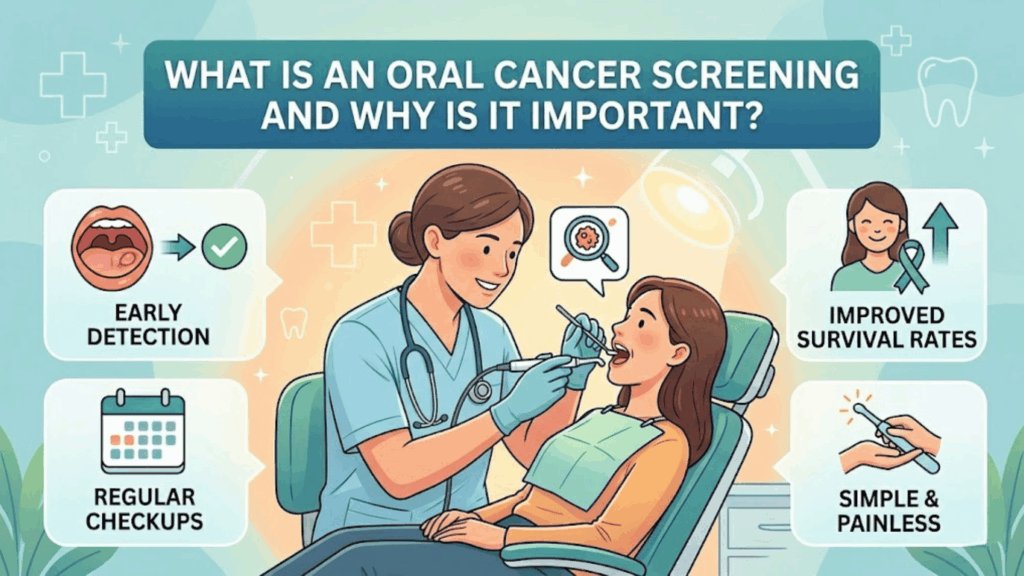
An oral cancer screening is a quick check done during a routine dental visit that looks for early signs of abnormal tissue changes in the mouth.
In the early stages, oral cancer often does not cause pain, which is why many cases go unnoticed until they progress.
Because of this, screenings play an important role in detecting changes early, when treatment outcomes are usually more effective.
Why Oral Cancer Can Be Hard to Notice Early
Unlike many other conditions that produce clear early symptoms, oral cancer often develops without causing pain in its early stages.
Small patches of abnormal tissue or minor sores may appear on the tongue, cheeks, or floor of the mouth, and people often mistake them for something minor like a canker sore or simple irritation.
This is why routine dental exams matter. A trained dentist can often spot subtle changes in the mouth that patients would otherwise miss.
What Actually Happens During a Screening
An oral cancer screening usually takes only a few minutes and is done during a routine dental visit without any special preparation.
The dentist examines the lips, cheeks, tongue, and all areas inside the mouth, including the floor and roof, to look for any visible changes. They also check the throat and the back of the tongue.
To complete the exam, the dentist gently feels the jaw and neck to identify any unusual lumps or swelling in the lymph nodes.
If something looks unusual, the dentist records it and monitors it over time to see if it changes.
In some cases, dentists also use tools such as fluorescence light to help highlight tissue changes that are not easily visible under normal lighting. These tools support the clinical exam rather than replace it.
What Your Dentist Is Actually Looking For
Oral cancer can appear in several different ways, although many of the changes dentists look for are not cancer.
White patches that do not wipe away or heal, known as leukoplakia, are one example. Red patches, called erythroplakia, are less common but carry a higher risk of being precancerous.
Other warning signs include sores that do not heal within two weeks, areas that bleed easily, or lumps and thickened tissue anywhere in the mouth.
Dentists also pay attention to changes in movement or sensation, such as numbness in the tongue or difficulty moving the jaw or tongue without a clear cause.
Most of these findings turn out to be harmless irritation or minor injury. Screening is important because it helps identify the small number of cases that need further evaluation.
Who Faces the Highest Risk
Certain lifestyle and health factors can increase the risk of oral cancer, although the condition can still develop in people without any clear risk factors.
Tobacco use is one of the strongest contributors, including cigarettes, cigars, and chewing tobacco. Alcohol use also increases risk, and the combination of alcohol and tobacco raises it significantly more than either factor alone.
HPV infection has also become an important risk factor, particularly for cancers in the back of the mouth and throat. Other risks include long-term sun exposure on the lips, a previous history of oral cancer, and increasing age, especially over 40.
The Oral Cancer Foundation notes that the combined effect of tobacco and alcohol creates a much higher risk profile than either on its own. HPV-related cases are also rising, including in patients who do not have traditional lifestyle risk factors.
Why Early Detection Changes the Outcome
Oral cancer outcomes are closely tied to how early the disease is found. When detected at an early stage, treatment is often simpler and recovery is generally easier.
| Stage at Diagnosis | General 5-Year Survival Outlook |
| Localized, caught early | Significantly higher, often cited above 80 percent |
| Spread to nearby lymph nodes | Moderately lower than localized cases |
| Spread to distant parts of the body | Substantially lower than early stage cases |
The American Cancer Society reports that survival rates are significantly higher when oral cancer is diagnosed early, and this pattern remains consistent across studies.
Early detection also influences the type of treatment needed. When doctors catch oral cancer early, they can often remove small, localized areas with a minor surgical procedure. When diagnosis happens at a later stage, treatment often involves more extensive surgery and additional therapies such as radiation, along with a longer recovery period.
Why Symptoms Alone Aren’t a Reliable Warning System
Oral cancer does not always produce clear or painful symptoms in its early stages, which is why relying on discomfort alone can delay diagnosis.
Early changes in the tissue are often painless, so a person may not notice anything unusual until the condition has already progressed.
Self-checks at home can help with awareness, but they do not replace a professional screening. Dentists are trained to pick up subtle tissue changes that are easy to overlook without clinical experience.
What Happens If Something Looks Suspicious
Most unusual areas found during a screening are not cancer and often resolve on their own within a couple of weeks.
If a spot does not improve or shows features that raise concern, a biopsy may be recommended. This involves taking a small sample of tissue and sending it to a laboratory for analysis.
The results guide the next steps. In many cases, the findings are benign, and the area is simply monitored over time during routine visits.
The National Institute of Dental and Craniofacial Research offers a clear explanation of how the diagnostic process works and what patients can expect after a biopsy.
How Often Should You Get Screened?
Most patients receive an oral cancer screening during routine dental checkups, usually every six months.
For those with higher risk factors such as tobacco or frequent alcohol use, a dentist may recommend closer monitoring of specific areas over time.
Since screening is part of a standard dental visit, there is usually no need to book a separate appointment for it.
Speak With a Dentist About Your Oral Cancer Screening
An oral cancer screening is quick, but it can make a meaningful difference by identifying concerns early, when treatment is usually simpler and outcomes are often better.
Dr. Pearl Zadeh’s Woodland Hills practice includes oral cancer screening as part of routine dental exams, so it becomes a natural part of your regular visit.
Call (818) 716-6722 or click the button below to schedule your appointment and stay on top of your oral health.
Schedule a ConsultationFrequently Asked Questions
1. Does an oral cancer screening hurt?No. An oral cancer screening is painless. It involves a visual exam of the mouth along with a gentle check of the jaw and neck to feel for any unusual changes.
2. Can young, healthy people get oral cancer?Yes. While risk increases with age, HPV-related cases have been seen in younger adults as well, even in people without traditional risk factors like smoking or heavy alcohol use.
3. Is every white or red patch in the mouth a sign of cancer?No. Most patches are caused by minor irritation and often resolve on their own. Any area that does not heal within about two weeks should be evaluated by a dentist.
4. How accurate is a visual screening alone?A clinical visual exam is highly effective at identifying suspicious changes. If something looks unusual, a biopsy is the only way to confirm a diagnosis.
5. Should I get screened even if I don’t smoke or drink?Yes. Although tobacco and alcohol significantly increase risk, oral cancer can still occur in people without either habit, particularly in HPV-related cases.