
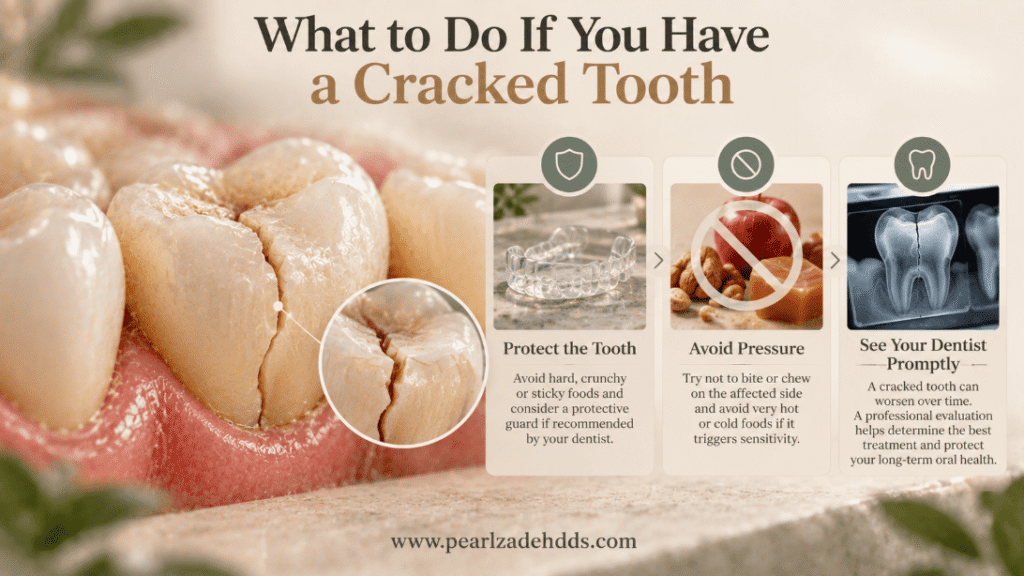
A cracked tooth does not always hurt, but it still deserves a dental evaluation. Some cracks affect only the outer enamel, while others extend deeper into the tooth. The right response depends on the crack’s location, depth, and symptoms. Knowing what to do early can help protect the tooth and preserve more treatment options.
What Should You Do First If You Think a Tooth Is Cracked?
Rinse your mouth gently with warm water to clean the area. If swelling develops, apply a cold compress to the outside of your face. The American Dental Association advises seeing your dentist as soon as possible after a broken tooth.
A few simple habits can protect the tooth until your appointment. Stop chewing on the affected side and choose softer foods for now. Avoid very hot or cold foods if they trigger sensitivity. Keep brushing and cleaning the area as you normally would, using a soft brush and gentle pressure.
Do not try to glue or repair the tooth yourself. Household glues are not made for use in the mouth. They can also make it harder for your dentist to evaluate the tooth.
If you develop severe pain, significant swelling, or a large broken piece, contact a dentist promptly. The same applies if the pain makes it difficult to eat or sleep. Otherwise, schedule an appointment as soon as you reasonably can.
Is a Cracked Tooth an Emergency?
Not always. Many cracked teeth need prompt attention but not emergency care. Others require more urgent evaluation. The difference usually depends on your symptoms and the condition of the tooth.
Contact a dentist promptly if you have severe or worsening pain. Significant swelling, fever, or pain that keeps you from eating or sleeping also warrants prompt attention. A tooth that has broken into a larger piece may need urgent care, especially after an injury.
Facial swelling, difficulty swallowing, or difficulty breathing can signal a more serious problem. Go to an emergency room or call 911 if you have trouble breathing or swallowing.
A lack of pain does not prove that a crack is harmless. Some cracks cause few or no symptoms. A dentist can determine whether the tooth needs treatment, monitoring, or no immediate treatment. You can learn more about urgent dental care on our website.
What Does a Cracked Tooth Feel Like?
Cracked tooth pain can feel different from typical cavity pain. The American Association of Endodontists (AAE) describes erratic pain when chewing and sudden sensitivity to hot or cold. The pain may also come and go.
Many people notice pain when biting down or releasing the bite. Cold sensitivity is common, and heat can trigger discomfort too. You may also notice a rough edge with your tongue or a faint visible line. Some cracked teeth cause no symptoms at all.
Why do the symptoms vary so much? A crack can open slightly under bite pressure and close again afterward. This movement can irritate the inner part of the tooth. Pain may appear with certain foods or bite angles and then disappear.
This pattern can also make the source of the pain difficult to identify. You may feel discomfort somewhere along one side of your upper or lower teeth. A tooth can also feel different or rough without causing pain. Mention any unusual changes to your dentist.
What Causes Teeth to Crack?
Teeth can crack for many reasons, and several factors may contribute. Biting down on hard foods such as ice, hard candy, or unpopped popcorn kernels can place significant stress on a tooth. Dental trauma, such as a fall or sports injury, can also fracture a tooth suddenly.
Other cracks develop gradually. Repeated chewing forces can create small cracks over time. A StatPearls review of cracked tooth syndrome identifies biting forces as a leading cause. It also lists age-related changes, poorly placed restorations, and tooth anatomy with steep cusps as contributing factors.
Large fillings can leave less natural tooth structure to withstand these forces. Previous dental treatment can also change how a tooth handles stress.
Clenching and grinding place repeated heavy forces on the teeth, often during sleep. Our article on how teeth grinding damages your teeth over the years explains how this repeated stress can affect teeth over time.
No single cause explains every crack. Your dentist can review your dental history, bite, and symptoms to identify likely contributors.
Are All Cracked Teeth the Same?
No. Dentists classify cracks because treatment depends on the type and extent of the damage. The AAE describes five common categories. You cannot reliably tell which type you have on your own. A dentist needs to examine the tooth.
Craze Lines
Craze lines are tiny cracks in the outer enamel. Adult teeth very commonly have them. Most cause no pain, and many may not need treatment.
Fractured Cusp
A cusp is a pointed part of the chewing surface. Weakened cusps can break off, often around a filling. This type rarely damages the inner pulp of the tooth, according to the AAE. Treatment often focuses on restoring the broken area.
Cracked Tooth
A cracked tooth has a fracture that extends from the chewing surface toward the root. The tooth has not separated into pieces. Symptoms often come and go, which makes this type easy to overlook.
Split Tooth
A split tooth has a deeper crack that separates the tooth into distinct segments. It often develops from a cracked tooth that progresses over time. The AAE notes that a split tooth cannot be saved intact. Treatment is usually more extensive, and your dentist can explain what remains possible.
Vertical Root Fracture
A vertical root fracture begins in the root and extends toward the chewing surface. It often produces minimal signs and symptoms. Its causes and treatment considerations differ from other crack types. A dentist may need additional imaging to evaluate it.
Can a Cracked Tooth Heal on Its Own?
No. A cracked tooth does not heal the way a broken bone does. Bone contains living cells that rebuild a break. Enamel does not regrow once it is damaged.
Some very minor surface lines, such as craze lines, may stay stable for years. That is stability, not healing. Deeper cracks are different. A crack that reaches the dentin or beyond can let the tooth flex under bite pressure.
Symptoms may fade for a while. That does not mean the crack has healed. Cracked tooth pain often comes and goes, so a quiet week proves little.
Not every crack will worsen. Infection is not inevitable either. An evaluation tells you which situation applies to your tooth.
What Should You Eat With a Cracked Tooth?
Softer foods such as yogurt, eggs, soup, mashed vegetables, and oatmeal are easier on a cracked tooth. Chew on the opposite side while you wait for your appointment.
Avoid very hard foods such as nuts, hard candy, ice, and crusty bread. Sticky foods like caramel and taffy can pull on a weakened tooth, so it is best to avoid them too. If hot or cold foods trigger sensitivity, let them reach a moderate temperature before eating or drinking.
You do not need to stop eating. Keep up your normal oral hygiene, brushing gently with a soft toothbrush and cleaning between your teeth. Do not avoid brushing the cracked tooth unless your dentist tells you otherwise.
How Does a Dentist Diagnose a Cracked Tooth?
Diagnosing a cracked tooth can be difficult. Cracks are often too fine to show clearly on a standard dental X-ray. The StatPearls review notes that X-rays become less useful when a crack runs parallel to the film. Dentists therefore combine several findings rather than relying on one test.
Your dentist will review your medical and dental history and ask about your symptoms and pain patterns. A visual examination often follows, sometimes with magnification. Your dentist may also perform a bite test with a small instrument to see whether it reproduces your pain.
Transillumination provides another way to look for cracks. The dentist shines a bright light through the tooth. A crack can block the light and appear as a dark line.
Gum health can provide additional clues. The American Association of Endodontists notes that isolated gum pocketing associated with a crack may not always be easy to detect with a probe. Imaging can provide additional information. X-rays can also show the surrounding bone, root, and other possible causes of pain.
When the findings remain unclear, your dentist may recommend additional imaging or a referral. No single test can identify every crack. Dentists use the full picture to determine what may be affecting the tooth.
What Happens During a Cracked Tooth Evaluation?
An evaluation usually starts with questions. Your dentist may ask when the pain began and what triggers it. They may also ask whether biting down or releasing the bite causes pain.
Your dentist will likely ask about fillings, crowns, or other treatment on the tooth. Recent trauma matters too. So does grinding or clenching. It can help to remember which foods or movements trigger your symptoms.
The dentist then examines the tooth and surrounding tissues. This includes the gums, your bite, and neighboring teeth. Most parts of the exam are noninvasive. Some tests, such as a bite or cold test, may cause brief discomfort. Tell your dentist if anything feels uncomfortable.
After the evaluation, your dentist should explain what they found and what remains uncertain. They can also discuss your treatment options. Some cases require a follow-up visit or monitoring before the diagnosis becomes clearer.
How Are Cracked Teeth Treated?
Treatment depends on the crack’s depth, location, and effect on the tooth. It also depends on whether the tooth remains structurally restorable. Not every cracked tooth needs the same treatment.
Minor craze lines often need only monitoring. A small chip may be smoothed or repaired when appropriate. Dental bonding can address some types of minor damage. A crown may help protect a tooth with more significant structural damage. Other restorative options depend on how much healthy tooth structure remains.
A StatPearls review describes bonded restorations that can help stabilize a cracked tooth and limit movement. It also discusses crowns that help distribute biting forces across the tooth. Some cracks extend into the pulp or below the gum line. The American Association of Endodontists explains that cracks extending below the gum line can make a tooth difficult or impossible to save. Your dentist may refer you for specialized care when needed.
If a tooth cannot be saved, your dentist can explain the available options. Our page on treatment for a cracked or broken tooth explains how Dr. Pearl Zadeh approaches damaged teeth.
When Might a Cracked Tooth Need a Crown?
A crown covers the tooth and can help protect it from chewing forces. It may help stabilize a tooth with significant structural damage. Not every crack requires a crown.
Your dentist considers the crack’s location and how much healthy tooth structure remains. Bite forces and existing restorations also matter. Your symptoms and whether the tooth remains restorable help guide the decision.
Crowns require reshaping some tooth structure, so the decision involves a trade-off. Your dentist needs to balance protecting the tooth with preserving as much natural structure as possible. You can learn more about dental crowns at Pearl Zadeh DDS.
A crown does not guarantee that a cracked tooth will survive long term. The outcome depends on factors such as the extent of the crack, your bite forces, and the overall health of the tooth.
What If the Crack Is in a Front Tooth?
Front teeth can crack for several reasons. Trauma is a common cause, including falls, sports injuries, and accidents. Biting hard objects such as pen caps or bottle tops can also fracture an edge. Existing fillings or previous damage may weaken the tooth as well.
Treatment depends on the type and extent of the damage. Smoothing or bonding may be enough for a minor chip. A larger edge fracture may require a different restoration. Deeper cracks need a more thorough evaluation of the entire tooth.
Prompt attention matters if a front tooth feels loose or shifts after an injury. Your dentist can also consider your cosmetic concerns when planning treatment.
Veneers are not automatically the right solution for a cracked front tooth. A good treatment plan starts with the most conservative option that suits the damage.
What If a Tooth Cracks Around a Filling or Crown?
Existing dental work can complicate the evaluation. Large fillings leave less natural tooth structure. The remaining tooth walls can crack under bite pressure. A crack can also begin beside a filling or crown.
Crowns can chip, crack, or loosen. Looseness may mean the tooth underneath has changed. Cracks under a crown can be hard to see because the crown covers the tooth. Your dentist may rely on bite tests, symptoms, and imaging.
The key question is whether the underlying tooth remains healthy and restorable. A damaged restoration does not always need replacement. Sometimes repair or monitoring is appropriate. Your dentist can tell you which applies.
What Happens If You Ignore a Cracked Tooth?
Some cracks remain stable for a long time. Others progress. Nobody can tell which type you have without an evaluation.
Delay can make it harder to determine the original cause of the crack. Over time, symptoms and structural damage may develop. That can narrow the treatment options.
Not every cracked tooth becomes infected, and not every cracked tooth is lost. Earlier evaluation simply gives your dentist more information. It also gives you more choices, and those choices are often more conservative.
How Can You Prevent Cracked Teeth?
No one can prevent every cracked tooth, but some habits can lower your risk. The AAE recommends avoiding hard objects, addressing grinding, and wearing a mouthguard during contact sports.
Avoid chewing ice, pens, and other very hard objects. If you clench or grind, ask your dentist about a protective appliance. Wear a mouthguard during contact sports. Keep regular dental exams so your dentist can spot problems early.
Replace damaged or worn restorations when your dentist recommends it. Treat cavities before they weaken the tooth. Follow your dentist’s advice if you have a tooth that is already weakened.
When to Call a Dentist
Call a dentist if you notice a visible crack, pain when you bite, lingering sensitivity, or a rough edge. A broken piece, swelling, or any other change that concerns you also warrants a call.
Severe pain, facial swelling, or fever need faster attention. If you are unsure how urgent your symptoms are, our team can help you decide. Learn more about emergency dentistry in Woodland Hills.
Dr. Pearl Zadeh is a Woodland Hills dentist who evaluates damaged and weakened teeth. Her approach focuses on conservative care and preserving natural tooth structure when clinically appropriate. She applies holistic and biomimetic principles where relevant and builds each treatment plan around an individual evaluation.
Not every tooth can be saved. An honest evaluation can help you weigh your options. Call (818) 716-6722 or click the button below to schedule your consultation online.
Frequently Asked Questions
No. Teeth do not repair cracks the way bones heal. Some minor craze lines stay stable without treatment, but a dentist needs to tell the difference.
Yes. Some cracks cause no symptoms, especially early on. A painless tooth can still have a crack, so any visible change is worth checking.
Usually not, but it deserves prompt attention. Severe pain, swelling, fever, or trouble swallowing or breathing call for urgent care.
Avoid very hard foods such as ice, nuts, and hard candy. Skip sticky foods if they pull on the tooth. Limit very hot or cold items if they trigger pain.
Often, yes, depending on the depth and location of the crack. Some teeth cannot be saved. Your dentist can explain what is realistic after an exam.
There is no safe waiting period that applies to everyone. Mild symptoms still deserve an appointment soon. Severe pain or swelling should be seen right away.
This article is for informational purposes only and is not a substitute for professional dental advice. Please schedule a consultation with Pearl Zadeh DDS to discuss your specific situation.