
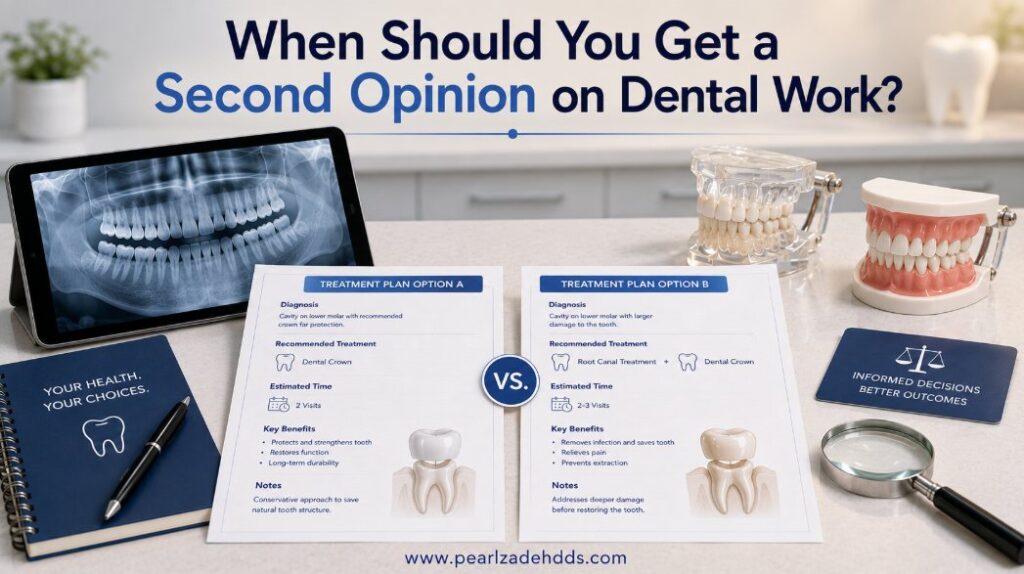
You went in expecting a small filling. You left with a treatment plan covering four teeth, a conversation about crowns, and a number that made you sit down in your car for a minute before driving home. Now you’re wondering whether to just schedule everything, or pause and get another set of eyes on it first.
Getting a second opinion isn’t necessarily about finding a dentist who tells you something different. Sometimes it’s simply about understanding your options before committing to something significant for your teeth.
What Does a Dental Second Opinion Mean?
Another dentist reviewing your case may look at your existing dental records, examine your teeth and gums directly, review your X-rays or other imaging, evaluate your bite, go through the proposed treatment, discuss alternatives, and explain what outcome you can realistically expect. Seeking a second opinion is a normal, professionally recognized part of dental care. The American Dental Association’s own Code of Ethics specifically addresses second opinions, expecting the dentist providing one to do so without a vested interest in which recommendation the patient ultimately follows. A second opinion can genuinely confirm what you were originally told. It can just as easily surface a difference in approach, timing, or an alternative you hadn’t considered.
When Should You Consider a Second Opinion?
A handful of situations are reasonable moments to pause and ask for another perspective:
- You’ve been recommended extensive dental work
- You’re unsure why several procedures are necessary
- You’ve been given multiple treatment options and don’t know how they differ
- The proposed treatment involves several teeth
- You’re considering major restorative work
- You’re considering veneers or other cosmetic treatment
- You’ve been recommended a crown, bridge, or replacement of existing dental work
- Your treatment could significantly change your bite
- You’re considering full-mouth reconstruction
- You’re uncomfortable proceeding without more information
- You received different recommendations from different dentists
- You want to understand whether treatment needs to happen immediately or can reasonably wait
Not every patient needs a second opinion for every recommendation. These are simply situations where one tends to add genuine value.
Do You Need a Second Opinion Before a Crown or Bridge?
This comes up often enough to deserve its own mention. A second opinion can be reasonable when a proposed crown or bridge involves an important treatment decision, multiple teeth, unclear alternatives, or a meaningful change to your bite. Our full discussion of second opinions before a crown or bridge goes into this specific situation in more depth.
What About Veneers or Cosmetic Dental Work?
Cosmetic treatment is elective, which is exactly why patients often want more clarity before moving forward. Reasonable questions include whether veneers are genuinely the best option for your goals, whether a more conservative alternative exists, how much natural tooth structure the plan would actually alter, how the treatment might affect your bite, what happens if you change your mind later, and what ongoing maintenance to expect. Our practical guide to porcelain veneers covers what the treatment actually involves if you’re still gathering information. None of this is a knock against veneers or cosmetic dentistry generally. It’s simply that elective treatment deserves the same clarity as anything else.
What About Full-Mouth Reconstruction?
Extensive restorative treatment covering most or all of your teeth is a significant undertaking, and wanting another professional perspective before committing is entirely reasonable. Before moving forward, it helps to understand what specific problems the treatment is meant to address, which teeth actually need treatment, what happens if the work is staged over time rather than done all at once, how the plan affects your bite, what alternatives exist, and what maintenance the finished result will require. Our overview of full-mouth reconstruction in Woodland Hills covers what that treatment actually involves in more detail. A second opinion for treatment at this scale isn’t about doubting your dentist. It’s about making sure you understand a plan that will shape your dental health for years.
Is a Second Opinion a Sign You Don’t Trust Your Dentist?
Not necessarily. Patients seek another opinion for plenty of reasons that have nothing to do with distrust: wanting more information, wanting confirmation, wanting another perspective, wanting a clearer explanation, or simply wanting more confidence before committing to something significant. Good communication between a patient and dentist should leave room for questions, not discourage them. Seeking clarity isn’t an adversarial act.
Does a Second Opinion Mean the First Dentist Was Wrong?
Not necessarily. Dentists can recommend genuinely different approaches while working from the exact same underlying diagnosis. Differences often show up in treatment timing, materials, the specific restorative approach, how many procedures are involved, whether treatment gets staged over time, or a more conservative versus a more comprehensive strategy. Two different treatment plans for the same tooth doesn’t automatically mean one dentist made a mistake. It often just reflects a genuinely different, reasonable read on the same situation.
What Questions Should You Ask During a Second Opinion?
A few genuinely useful questions to bring with you: What problem are we actually treating? What happens if I wait? Does this need to happen now? Are there alternatives worth considering? What are the benefits and downsides of each option? How much healthy tooth structure would be affected? How could this affect my bite? How long should the treatment realistically last? What maintenance will I need afterward? What happens if the restoration eventually fails? Does anything about my existing dental work change the recommendation? And which part of this plan is essential, versus which part is optional?
What Should You Bring to a Second Opinion?
Bringing the right information makes the visit considerably more useful. That generally means recent X-rays, your dental records, any existing treatment plan you’ve already been given, your previous dental history, a list of your current concerns, information about previous restorations, and the specific questions you actually want answered. If records can be transferred directly between dental offices, you can simply ask both offices about that process rather than managing it yourself.
Should You Tell Your Dentist You’re Getting a Second Opinion?
You don’t need to feel uncomfortable about this. You can simply explain that you want to make an informed decision before moving forward with something significant. That’s a completely reasonable thing to say to any dentist, and it shouldn’t change how you’re treated.
Should Cost Be the Reason You Get a Second Opinion?
Cost differences between two treatment plans can genuinely exist, but price shouldn’t be the only thing you compare. Look at:
- What’s actually being recommended
- Why it’s being recommended
- The materials involved
- Expected longevity
- How many appointments are required
- Follow-up care
- Risks
- Available alternatives
The most expensive option isn’t automatically the best one, and the cheapest option isn’t automatically the better value. Comparing the full picture matters more than comparing two numbers.
What If Two Dentists Recommend Different Treatments?
Don’t simply choose whichever plan sounds easier or costs less. Ask both dentists directly why they recommend their specific approach, what problem their treatment is meant to address, what alternatives they considered, what happens if treatment is delayed, and what the long-term expectations actually are. If the two recommendations differ substantially, you may need additional records, imaging, or input from a specialist to get a clearer picture before deciding.
When You May Not Need a Second Opinion
A second opinion tends to matter less when the treatment is straightforward, the diagnosis is clear, you actually understand the recommendation, the plan feels reasonable to you, and you feel genuinely comfortable with your dentist’s explanation. This isn’t meant to suggest getting multiple opinions before every routine filling or cleaning. Save it for decisions that actually warrant the extra step.
When a Specialist Opinion May Make More Sense
Some situations call for evaluation by a dentist or specialist with training specific to that problem. Examples include complex oral surgery, complicated orthodontic cases, significant jaw disorders, certain gum conditions, complex endodontic problems, and difficult restorative cases. A second opinion from another general dentist and a consultation with a specialist aren’t always the same thing, and depending on your situation, either one, or both, might be the right next step.
How to Compare Two Treatment Plans
A simple framework helps when you’re weighing two different recommendations side by side:
- Diagnosis: are both dentists actually treating the same problem?
- Goal: what is each treatment trying to accomplish?
- Alternatives: are there less invasive or genuinely different options?
- Timing: does treatment need to happen immediately?
- Longevity: how long is the proposed treatment expected to last?
- Maintenance: what will you need to do afterward?
- Risks: what are the possible complications or limitations?
- Cost: what’s actually included, and what future treatment might still be needed?
This framework is meant to help you compare clearly, not to tell you which dentist to choose.
What Should You Do After Getting a Second Opinion?
The goal was never simply collecting two opinions and picking one at random. Take time to actually compare what each dentist told you, and ask follow-up questions if anything remains unclear. If the two recommendations differ significantly, another conversation, or a specialist evaluation, may genuinely help. Ultimately, choose a treatment plan you actually understand and feel comfortable moving forward with.
What Matters Most When Choosing Between Treatment Plans?
The real question was never simply which dentist is right. What matters is whether you understand your diagnosis, the purpose of the treatment being proposed, your actual alternatives, the risks involved, the expected outcome, and what long-term maintenance will look like. A second opinion is useful when it gives you more clarity, not simply when it happens to produce a different answer than the first one did.
Speak With Dr. Pearl Zadeh Before You Move Forward
You should feel comfortable asking questions before committing to significant dental treatment. Dr. Pearl Zadeh, a member of the American Dental Association and California Dental Association, can review your dental concerns, examine your teeth and bite, discuss your treatment options, and help you understand the reasoning behind a proposed plan.
Call (818) 716-6722 or click the button below to schedule a consultation online..
Frequently Asked Questions
Does getting a second opinion mean I don’t trust my dentist?
Not necessarily. Patients often seek another opinion for more information, confirmation, or confidence before a significant decision, not because of distrust.
Will a second dentist automatically disagree with the first?
Not necessarily. A second opinion can confirm the original recommendation just as easily as it can offer a different approach.
Should I choose the cheaper treatment plan if two dentists disagree?
Not automatically. Compare what’s included, materials, longevity, and risks alongside cost rather than price alone.
What should I bring to a second opinion appointment?
Recent X-rays, your dental records, your existing treatment plan, and a list of specific questions all make the visit more useful.
Do I need a second opinion for a simple filling?
Usually not. A second opinion tends to matter most for extensive, unfamiliar, or irreversible treatment, not routine or straightforward care.
This article is for informational purposes only and is not a substitute for professional dental advice. Please schedule a consultation with Pearl Zadeh DDS to discuss your specific situation.
Speak With Dr. Pearl Zadeh Before You Move Forward
You should feel comfortable asking questions before committing to significant dental treatment. Dr. Pearl Zadeh, a member of the American Dental Association and California Dental Association, can review your dental concerns, examine your teeth and bite, discuss your treatment options, and help you understand the reasoning behind a proposed plan.
Call (818) 716-6722 or use the website’s consultation booking option.