
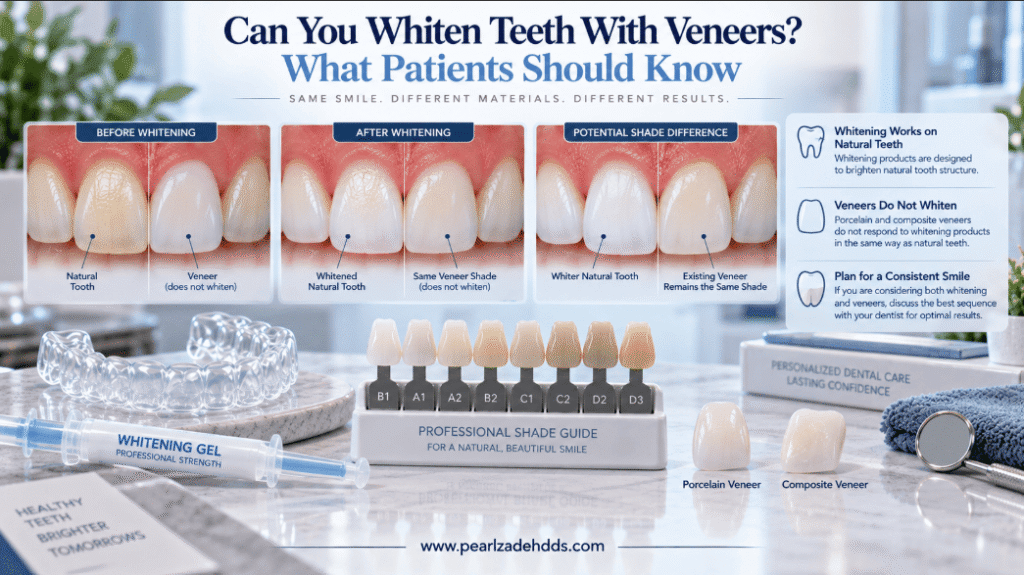
Whitening treatments work differently on natural teeth than they do on dental restorations. If you have veneers, your natural teeth can respond to whitening and become lighter, while your veneers generally stay close to their existing shade. This isn’t a flaw or a failure of either the veneer or the whitening product. It’s simply how two different materials respond to the same treatment.
This matters most if you have veneers on only some of your teeth, rather than a full set covering your entire smile. A shade difference between your natural teeth and your veneers is a real possibility worth understanding before you start whitening, not something to discover afterward.
Can You Whiten Teeth With Veneers?
Yes, for your natural teeth, though the veneers themselves generally won’t change shade the same way. Natural tooth enamel responds to whitening agents chemically, while porcelain veneers and composite veneers are made from entirely different materials that don’t respond the same way.
The American Dental Association is direct on this point: only natural teeth can be whitened, not tooth-colored restorations. Whitening products generally don’t change the intrinsic shade of a veneer the way they change natural tooth color. This isn’t an absolute rule for every possible product or circumstance, but it’s the general pattern worth planning around.
Do Veneers Whiten Like Natural Teeth?
Not in the same way. Whitening agents penetrate natural tooth structure and break down compounds that cause discoloration. This chemical process works because of the structure of enamel and the dentin underneath it.
A veneer, whether porcelain or composite, uses a separate material bonded to the front of your tooth. It does not have the same internal structure for whitening agents to act on.
The specific material used for your veneer genuinely matters here, since porcelain and composite behave differently from each other, not just differently from natural teeth. A veneer generally keeps close to its original shade regardless of what whitening does to the teeth around it. This is exactly why whitening a smile that includes both natural teeth and veneers takes more planning than whitening a smile made up entirely of natural teeth.
What Happens If You Whiten Natural Teeth Around Veneers?
Your natural teeth can become lighter through whitening while your veneers stay close to where they started. Depending on how visible your veneers are and how much your natural teeth actually lighten, this can create a noticeable shade difference, with your natural teeth ending up lighter than the surrounding veneers and the smile looking less uniform than before. Picture a patient with veneers on their two front teeth who whitens the rest of their smile substantially.
Those front veneers, once perfectly matched, can end up looking noticeably darker simply because everything around them changed while they stayed the same. Greater contrast around the restoration is possible, especially the closer the veneer sits to teeth that whitened significantly. This doesn’t mean a mismatch will always happen. Some patients whiten mildly enough, or have veneers positioned further back in the smile, that any difference stays minimal or unnoticeable.
Can You Whiten Porcelain Veneers?
Traditional whitening methods do not lighten porcelain veneers. Porcelain has a fired, glazed surface that is essentially non-porous. This quality helps veneers resist staining and maintain their color over time. It also means whitening agents generally cannot penetrate or chemically affect the material, whether you use them professionally or at home.
Professional cleaning and polishing can remove minor surface deposits and restore some shine to a porcelain veneer. However, that process differs from bleaching the material to a lighter shade. If a porcelain veneer looks noticeably darker than before, something other than the porcelain itself usually causes the change.
Can You Whiten Composite Veneers?
Composite veneers are made from a resin material that behaves differently from both natural teeth and porcelain. Composite is more porous than glazed porcelain, meaning it can gradually pick up surface staining from coffee, tea, wine, and similar sources over time. A peer-reviewed in vitro study on stained composite veneering material tested bleaching and re-polishing on a composite material stained with several pigmented substances, and found that bleaching can act on the surface of composite resin through the same kind of oxidative reaction it uses on natural tooth pigments, offering some restoration of the stained composite alongside polishing.
This is a genuinely different situation than porcelain, where whitening agents essentially have nothing to work with. That said, this doesn’t mean every composite material or every whitening product produces a meaningful result, and the outcome depends heavily on the composite formulation and how it was originally finished. Cleaning and polishing remain the more predictable tools for restoring a composite veneer’s appearance.
What If Your Veneers Look Yellow or Stained?
A few different things can explain this, and the right response depends on which one is actually going on. Surface staining or deposits from food, drinks, or plaque buildup are one possibility, and this tends to build up gradually rather than appearing overnight. Changes in the natural teeth surrounding the veneer, either lightening from whitening or darkening from aging, can make a veneer look different by comparison even if the veneer itself hasn’t changed at all. Picture a veneer placed years ago that hasn’t changed color at all, sitting next to natural teeth that have gradually darkened with age.
The veneer would look progressively brighter by comparison, even though nothing actually happened to the veneer itself. The original veneer shade may simply not be what you’re hoping for anymore, since your goals may have shifted since it was placed. Ordinary aging and wear on the restoration’s surface can dull its appearance over time too. Our discussion of common reasons whitening doesn’t work covers a similar kind of troubleshooting for natural teeth. Replacement isn’t the automatic answer here. Figuring out the actual cause comes first.
Can Veneers Be Professionally Cleaned?
Yes, and it’s worth distinguishing what cleaning actually accomplishes from what it doesn’t. Professional cleaning removes surface deposits and buildup, which can meaningfully improve how a veneer looks if surface staining is the issue, sometimes bringing back shine that looked dulled by months of accumulated residue. It doesn’t change the actual underlying color of the restoration material itself, no matter how thoroughly it’s polished.
A dental evaluation helps determine whether what you’re seeing is genuine surface staining, a change in the restoration’s own appearance over time, or simply a growing difference between the veneer and the natural teeth around it. Professional cleaning won’t restore every discolored veneer to how it looked on day one, particularly if the cause isn’t surface staining at all.
What If Your Veneers No Longer Match Your Natural Teeth?
This is a common situation, and there’s no single universal fix. Depending on what’s actually driving the difference, a few approaches may apply: evaluating your natural teeth to understand what’s changed, a professional cleaning if surface buildup is contributing, whitening your natural teeth when that’s appropriate for your goals, an honest conversation about whether your existing veneer shade still works for you, or considering replacement of the restoration when that’s clinically or cosmetically appropriate.
A patient whose natural teeth have simply darkened with age might do well with whitening alone. Someone whose veneers were placed many years ago under different lighting or shade-matching standards might genuinely be better served by replacement. What actually makes sense depends entirely on your specific restoration and the teeth around it, not a default next step that applies to everyone in this situation.
Can Whitening Damage Veneers?
This is worth separating into two questions. Whitening products generally do not damage veneer material. Porcelain and composite do not respond to bleaching agents like natural teeth do. They also do not undergo a chemical reaction that causes structural damage.
The more relevant safety concerns involve your natural teeth and gums. These concerns apply to anyone who uses whitening products, whether they have veneers or not. You may also experience temporary sensitivity in your remaining natural teeth.
Professional whitening still may not suit every patient or restoration without an evaluation. This matters especially when visible margins connect the veneer to your natural tooth. A darker-looking veneer does not necessarily mean the restoration has failed or needs urgent attention. One of the causes discussed above usually explains the color change rather than a structural problem with the veneer itself.
Should You Whiten Before Replacing Old Veneers?
If you’re planning to replace existing veneers, the shade you want your natural teeth to be is worth deciding before the new restoration’s shade gets finalized. Our discussion of whitening before veneers or crowns goes into that sequencing question in detail, along with how shade selection fits into a cosmetic veneer case more broadly.
When Should You Talk to Your Dentist?
A few situations are worth bringing up directly: your veneers look darker than you expected, your natural teeth no longer match your veneers the way they used to, staining has developed around a restoration, you’re hoping for a noticeably whiter smile, you’re considering replacing existing veneers, or you’re genuinely unsure whether you’re looking at staining or an actual change in the restoration.
An evaluation before repeatedly trying whitening products on your own tends to save both time and frustration, especially since whitening won’t do anything for a veneer regardless of how many times you try it. Repeated at-home whitening attempts aimed at a veneer that simply won’t respond can also mean unnecessary exposure of your natural teeth to whitening agents they didn’t need.
Get the Right Whitening Plan for Your Smile
Whitening your natural teeth may be appropriate, but it will not change the shade of your existing veneers in the same way. A professional evaluation can help determine whether whitening, cleaning, or another approach makes sense for your smile.
Dr. Pearl Zadeh can assess your natural teeth and existing veneers, explain your options, and help you avoid a noticeable shade mismatch.
Call (818) 716-6722 or click the button below to schedule your consultation online.
Frequently Asked Questions
Can you whiten teeth with veneers?
Your natural teeth can often be whitened, but the veneers themselves generally won’t change shade the same way.
Can you whiten porcelain veneers?
Not with traditional whitening methods. Porcelain’s non-porous surface doesn’t respond to bleaching agents the way natural teeth do.
Can you whiten composite veneers?
Composite responds differently than porcelain and may show some limited change with bleaching, though cleaning and polishing remain the more reliable options.
Do veneers whiten?
Generally, no, not the way natural teeth do. Both porcelain and composite behave differently from natural tooth enamel under whitening agents.
Can you whiten natural teeth if you have veneers?
Yes, your natural teeth can typically still be whitened, though the veneers themselves will stay close to their existing shade.
What happens if you whiten your teeth with veneers?
Your natural teeth may become lighter while your veneers stay the same, which can create a visible shade difference depending on your specific situation.
This article is for informational purposes only and is not a substitute for professional dental advice. Please schedule a consultation with Pearl Zadeh DDS to discuss your specific situation.