
You followed the instructions, waited the recommended time, and checked the mirror expecting a real change. Instead, your teeth look almost exactly like they did before you started. That’s genuinely frustrating, and it’s worth understanding why before assuming the product failed or you did something wrong. Maybe you tried strips for weeks, or sat through a professional treatment, and the difference feels barely noticeable either way.
Whitening doesn’t produce the same result for everyone. Some discoloration responds well to bleaching. Other color changes have entirely different causes that whitening was never really built to address. A handful of specific reasons tend to explain most cases where results fall short.
What Can Prevent Teeth From Whitening?
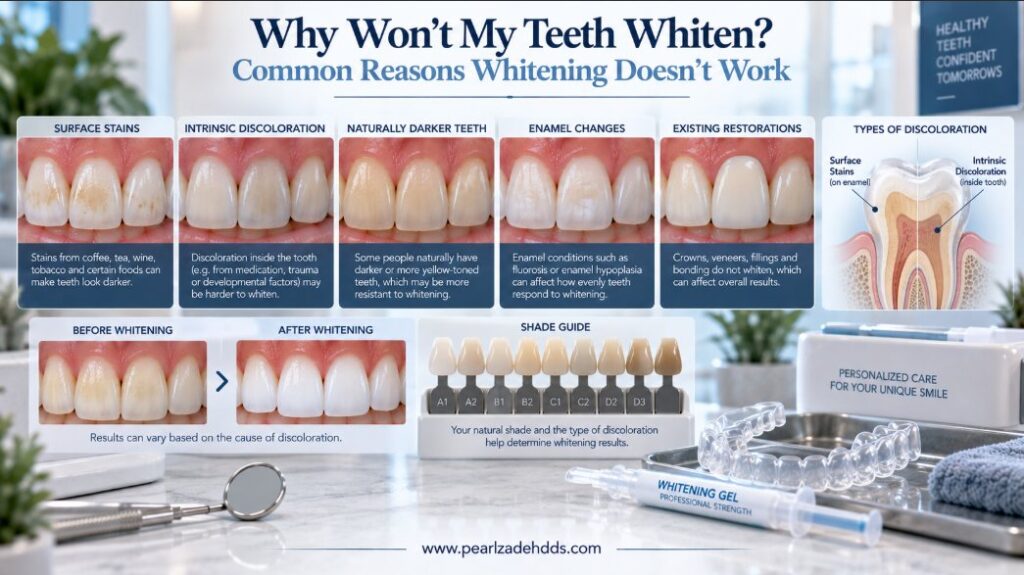
Whitening works best on certain types of tooth discoloration, and the actual cause of your color matters more than which product you picked. Surface stains from things like coffee or tobacco tend to respond well. Deeper discoloration that developed within the tooth structure itself behaves differently.
Sometimes what looks like a stain is simply your natural tooth color, or the result of existing dental work that doesn’t respond to whitening at all. None of these possibilities can be sorted out just by staring in the mirror, which is exactly why the reasons below are worth going through one at a time.
1. The Stains May Not Respond Well to Whitening
Dentists generally separate stains into two categories. Extrinsic stains sit on the surface of your teeth, usually from coffee, tea, tobacco, red wine, or other strongly pigmented foods and drinks. These tend to respond reasonably well to whitening and even professional cleaning. Intrinsic discoloration develops within the tooth structure itself, below the surface, and behaves quite differently under a whitening agent.
The source and depth of your discoloration genuinely determines how much bleaching can actually change your tooth’s appearance. A whitening product that works beautifully on surface coffee stains may barely touch discoloration sitting deeper in the tooth.
2. Your Teeth May Be Naturally More Yellow or Darker
Tooth color varies naturally from person to person, and this has nothing to do with staining at all. Dentin, the layer underneath your enamel, is naturally yellow, and it contributes significantly to your overall tooth color. Thinner or more translucent enamel lets more of that dentin show through, which can make teeth look more yellow even when nothing is actually stained.
Two people can have identical oral hygiene and identical diets, yet still end up with noticeably different baseline tooth shades simply because of how their enamel and dentin are naturally structured. None of this means naturally yellowish teeth are unhealthy. It simply means whitening has real limits when your underlying natural tooth color is doing most of the work, rather than an actual stain sitting on top of it.
3. Enamel Changes Can Affect How Your Teeth Look
Enamel naturally thins somewhat with age, and thinner enamel tends to become more translucent. The American Dental Association notes that as enamel becomes thinner and more translucent with age, more of the yellower dentin underneath shows through, which can darken overall tooth color. This isn’t the same thing as a stain, and it doesn’t mean every translucent or darker-looking tooth automatically needs whitening. It does mean that when this structural change is the real reason behind your tooth color, whitening isn’t addressing the actual underlying cause, and results may end up more limited than you expected.
4. Certain Types of Intrinsic Discoloration Are Harder to Whiten
Some discoloration develops within the tooth rather than sitting on its surface, and the specific cause genuinely affects how it responds to bleaching. The ADA lists several recognized causes of intrinsic discoloration, including dental fluorosis from excess fluoride exposure during childhood tooth development, certain antibiotics like tetracycline taken during those same developing years, tooth trauma, genetic conditions affecting enamel or dentin formation, and even prolonged use of certain antiseptic mouth rinses. This doesn’t mean intrinsic discoloration is untreatable, and it isn’t accurate to say whitening simply cannot work on it.
The same ADA resource notes that brown staining from fluorosis or tetracycline tends to respond better to bleaching than white spot staining, which may simply become less noticeable as the rest of the tooth lightens around it. Tetracycline-related discoloration specifically can require several months of consistent nightly treatment to see meaningful change, considerably longer than what most patients expect from typical whitening. None of this can be diagnosed from a mirror. Some intrinsic discoloration responds incompletely to bleaching no matter how patiently you stick with it, and a different cosmetic approach may genuinely make more sense.
5. Your Teeth May Have Dental Restorations
This is a limitation many patients simply don’t expect. Natural tooth structure and dental restorations do not respond to bleaching the same way. Crowns, veneers, and tooth-colored fillings generally stay at whatever shade they were made in, regardless of what whitening does to the teeth around them. If some of your visible teeth are actually restorations, you may notice uneven color after whitening, with your natural teeth looking brighter while the restored ones stay exactly where they started. Our discussion of whitening before veneers or crowns goes further into that timing question. This doesn’t mean a restoration automatically needs replacing after whitening. It simply explains a mismatch that whitening itself won’t resolve.
6. The Whitening Product May Not Match Your Type of Discoloration
Whitening products genuinely differ in strength, formulation, application method, and what they’re designed to address. Whitening toothpaste primarily helps remove surface stains through mild abrasion and does not work like a true bleaching treatment. At-home strips and kits use peroxide-based agents at lower concentrations than those used by dentists in the office. Professional treatment typically offers stronger formulations along with an evaluation beforehand.
Picture someone using whitening toothpaste every day for months to address discoloration that actually developed from a childhood medication. No amount of extra brushing with that toothpaste is going to touch that kind of stain, since it was never designed to. If you’ve been using a product designed mainly for surface stains on discoloration that’s actually intrinsic, the mismatch between product and problem, not a defective product, may explain your limited results.
7. You May Not Have Given the Treatment Enough Time
How quickly whitening results become noticeable varies considerably from person to person, and there’s no single number of days that applies to everyone. Some people see a visible change fairly quickly. Others need more time, or genuinely need a different treatment approach entirely rather than simply repeating the same one longer.
Our discussion of how long professional teeth whitening actually takes goes further into what affects that timeline. If results seem slow, that’s a reason to talk to a dentist about what’s actually going on, not a reason to whiten more often or more aggressively on your own.
8. An Underlying Dental Problem May Need Attention First
Sometimes what looks like a whitening failure is actually a sign that something else needs attention. Tooth decay, gum disease, cracks, significant sensitivity, or other unexplained changes in tooth color can all affect how your teeth respond, or simply mean whitening isn’t the right priority yet. Our discussion of early signs of gum disease covers what’s worth watching for. None of this can be diagnosed from symptoms alone, but treating an underlying dental issue often needs to happen before cosmetic whitening makes sense.
Can You Whiten Teeth That Did Not Respond the First Time?
It depends entirely on why the first attempt produced limited results. A dentist considers what actually caused your discoloration, what type of whitening you already tried, whether you have existing restorations, your sensitivity level, your overall oral health, and what you’re actually hoping to achieve. Someone whose first attempt used a low-concentration strip on genuinely intrinsic staining might reasonably try a stronger, professionally supervised approach next.
Someone whose discoloration comes mainly from natural tooth color or existing restorations may need an entirely different conversation instead. Simply reaching for a stronger product isn’t automatically the answer, and in some cases it isn’t the right answer at all. Understanding why the first round didn’t work is what actually determines whether trying again makes sense, and what that second attempt should look like.
What If Whitening Still Doesn’t Give You the Result You Want?
Whitening isn’t the only cosmetic option available, and depending on the cause and condition of your teeth, a dentist may discuss other approaches entirely. Our overview of cosmetic treatment options for stained teeth goes further into what else might apply depending on your specific situation. Veneers are sometimes part of that conversation, though they aren’t a universal solution either. What actually fits depends on your teeth, not a default upgrade path whenever whitening falls short.
How a Dentist Can Determine Why Your Teeth Aren’t Whitening
An evaluation typically starts with reviewing what you’ve already tried and how your teeth responded. Your dentist examines your actual tooth color and surfaces, checks for any restorations that might explain uneven results, assesses your enamel and overall tooth structure, and looks for oral health issues that might be part of the picture.
That conversation also covers your actual cosmetic goals, since what counts as a good outcome varies from patient to patient. Identifying the real cause is what determines whether whitening still makes sense and what result is realistically achievable. Not every patient needs extensive testing to get there. Sometimes a straightforward exam and conversation is enough to explain what’s actually going on.
How to Avoid Over-Whitening Your Teeth
Repeatedly applying whitening products in pursuit of a stronger result isn’t necessarily the answer, and it can genuinely work against you. Overuse can contribute to tooth sensitivity, gum irritation, and simply chasing a shade that isn’t realistic for your specific teeth. Our discussion of teeth whitening for sensitive teeth and our look at whether whitening can damage enamel both go further into what excessive whitening can actually mean for your teeth. Following product directions and dental guidance protects your teeth far better than simply doing more of what already isn’t working.
Speak With Dr. Pearl Zadeh About Whitening That Isn’t Working
Whitening doesn’t work the same way for every type of discoloration. Dr. Pearl Zadeh, a dentist providing professional teeth whitening and cosmetic dentistry in Woodland Hills, can evaluate your teeth and help identify why results have been limited, and whether whitening or another cosmetic approach actually makes sense for you.
Call (818) 716-6722 or click the button below to schedule your consultation online.
Frequently Asked Questions
Why won’t my teeth whiten even after using whitening products?
Your discoloration may be intrinsic rather than surface-level, your natural tooth color may be contributing, or the product you used may not match the type of discoloration you actually have.
Why are my teeth still yellow after whitening?
Yellow tone often comes from dentin showing through thinner enamel, which is a natural characteristic rather than a stain that whitening can fully remove.
Can some teeth not be whitened?
Certain types of intrinsic discoloration, and existing restorations, respond incompletely or not at all to whitening, though the specific cause needs an evaluation to confirm.
Why don’t my crowns or veneers whiten?
Restorations don’t respond to bleaching the way natural tooth structure does, so they generally stay at their original shade regardless of whitening.
Can intrinsic stains be whitened?
Sometimes, depending on the cause. Certain intrinsic stains respond better than others, and some require significantly more time or a different approach entirely.
This article is for informational purposes only and is not a substitute for professional dental advice. Please schedule a consultation with Pearl Zadeh DDS to discuss your specific situation.