
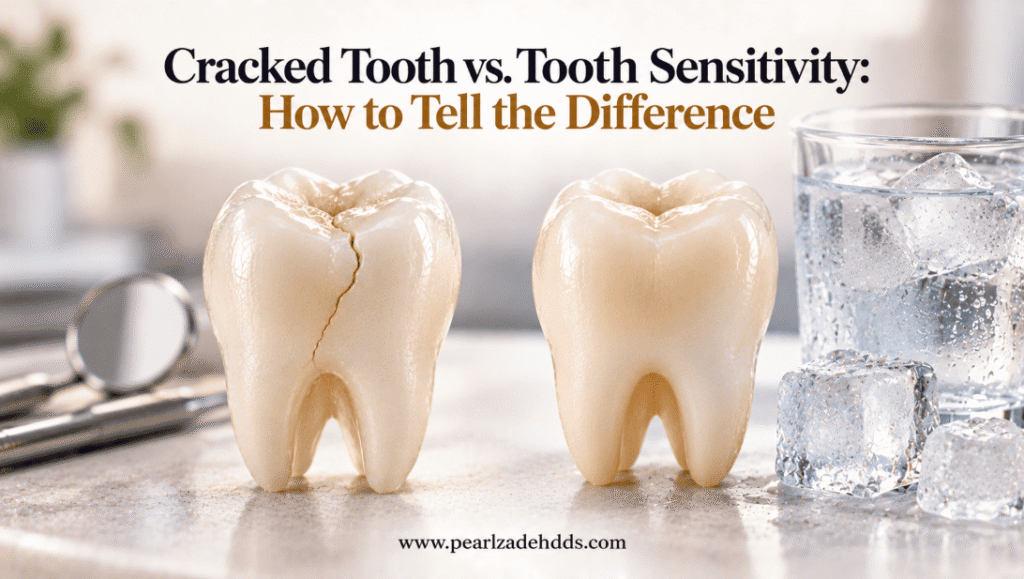
Tooth sensitivity and a cracked tooth can both cause discomfort with cold drinks or chewing. Certain symptom patterns may offer clues, but only a dental examination can identify the cause.
Ordinary sensitivity often occurs after a specific trigger and fades soon after. A cracked tooth may cause unpredictable pain when chewing or biting. These patterns can overlap, so symptoms alone cannot confirm the cause.
Knowing how the symptoms differ can help you describe what you feel to your dentist. Persistent or recurring discomfort should be checked rather than guessed at.
What Does Ordinary Tooth Sensitivity Feel Like?
Cleveland Clinic says sensitivity can make it painful to eat or drink something hot, cold, sweet, or sour. MouthHealthy, the American Dental Association’s (ADA) consumer site, also mentions discomfort with brushing or flossing.
The discomfort often links to a particular trigger and may ease soon after the trigger goes away. That pattern is common, but it is not guaranteed.
Sensitivity has several possible causes. MouthHealthy points to exposed dentin, gum recession, worn enamel, tooth decay, and worn fillings. Exposed dentin lets heat, cold, acidic foods, or sticky foods reach the nerves inside the tooth.
Sensitivity does not automatically mean a crack. Cleveland Clinic says it can sometimes signal a bigger problem. Examples include a cavity, gum disease, or a cracked tooth. The page also notes that fillings, cleanings, or other treatments can cause short-term sensitivity.
What Are the Signs of a Cracked Tooth?
StatPearls is a clinical reference hosted by the National Institutes of Health (NIH). It calls sudden sharp pain upon biting down the most frequently reported symptom. Some patients also feel a fleeting sharp pain when they release the bite.
The American Association of Endodontists (AAE) describes erratic pain when chewing, possibly with the release of biting pressure. Pain can also appear with temperature extremes.
Cold drinks and food may trigger symptoms too. StatPearls adds that patients often struggle to identify which tooth is responsible.
Cracks can also be quiet. Cleveland Clinic says cracked teeth do not always cause symptoms. Some cracks are also hard to see.
Our article on chipped versus cracked teeth explains how they differ. You can also read about common causes of cracked teeth.
Cracked Tooth vs. Tooth Sensitivity: Key Differences
The table compares common patterns. Treat it as a general guide, not a set of diagnostic rules.
| Factor | Ordinary tooth sensitivity | Possible cracked tooth |
|---|---|---|
| Common triggers | Often a specific trigger, such as cold, heat, sweets, acidic foods, or brushing | Chewing or biting, and sometimes temperature changes or sweets; triggers can seem inconsistent |
| Pain when biting or releasing pressure | Less often the main complaint, though other dental problems can also cause it | May cause sharp pain on biting or a brief sharp pain when the bite is released |
| How long discomfort may last | Often brief, and may ease soon after the trigger is removed | Varies; the pain can be fleeting, and some cracks cause little or no discomfort |
| Whether symptoms come and go | Often follow the trigger | May be intermittent or erratic, which can make the tooth hard to identify |
| Why the pattern cannot confirm the cause | Cracks, decay, and other conditions can also cause sensitivity | Cold, heat, and biting pain also occur with other dental problems |
These patterns overlap. A tooth that fits one column can still have the other problem, or a different one entirely.
Why Can a Cracked Tooth Feel Like Tooth Sensitivity?
A crack can change how a tooth responds to pressure and temperature. That overlap helps explain why cold drinks or chewing can hurt in both situations.
Sources reflect this overlap. Cleveland Clinic names a crack or chip among the problems that can irritate a tooth and cause sensitivity. MouthHealthy lists fractured teeth as a cause too.
Cold sensitivity therefore does not rule out a crack. A cracked tooth can react to cold or heat. Temperature sensitivity alone does not separate a crack from other dental problems.
Pain location is not a reliable guide either. The AAE says a dentist may have difficulty locating which tooth is causing the discomfort. Decay or a damaged filling can add further overlap. Pain when biting does not always mean a crack.
How Does a Dentist Find the Cause?
A dentist usually starts with a conversation. Questions may cover when the pain began, what triggers it, and whether it comes and goes. StatPearls stresses an accurate history and diagnostic tests.
The dentist then examines the tooth. Magnification and bright light may reveal fracture lines. A bite assessment can help pinpoint the affected tooth and cusp, according to StatPearls.
Cleveland Clinic adds that dentists may use a staining dye to see a crack more clearly. Dental X-rays may also be part of the evaluation.
Imaging has limits. StatPearls says a radiograph may reveal a thin line in some cracks. Visibility depends on how the crack runs relative to the film. It also says an X-ray helps rule out other problems.
A normal X-ray therefore does not always rule out a crack. Dr. Pearl’s article on how a cracked tooth is diagnosed when an X-ray looks normal covers the methods.
What Should You Do If You Are Unsure?
Arrange a dental examination rather than guessing. Persistent or recurring pain, pain when biting, or unexplained sensitivity warrants assessment. Cleveland Clinic advises people to call their dentist if they have symptoms of a cracked tooth. Do not wait for symptoms to settle if you suspect a crack.
Until the visit, avoid chewing hard foods on the painful tooth. Cleveland Clinic lists ice, hard candy, and fingernails among the things not to chew.
Skip any home testing. Repeatedly biting hard objects or applying extreme temperatures can cause pain. It may also stress a damaged tooth.
Notes can help the dentist assess the problem. Consider writing down:
- When the pain started and how often it happens.
- What triggers it, such as cold, heat, sweets, chewing, or releasing the bite.
- How long each episode lasts.
- Whether the pain comes and goes.
- Any recent dental work on that tooth.
Some symptoms need faster care. Facial swelling, fever with dental symptoms, or rapidly worsening pain requires prompt attention. Cleveland Clinic notes that a badly cracked tooth may be a dental emergency. Mayo Clinic’s guidance on tooth abscess says to go to the emergency room for trouble breathing or swallowing. It also advises the emergency room for fever with facial swelling when you cannot reach your dentist.
Our article on what to do if you have a cracked tooth covers immediate steps to take. You can also learn whether a cracked tooth can heal on its own.
Sensitivity and cracked-tooth symptoms can overlap, so persistent or recurring discomfort should be assessed rather than guessed at. Dr. Pearl Zadeh can examine the tooth, review your symptoms, and discuss the findings. Treatment depends on what the examination shows. You can also read about dental crown treatment at Pearl Zadeh DDS. Crowns are one option dentists may discuss for some cracked teeth.
Call (818) 716-6722 or click the button below to schedule your consultation online.
Frequently Asked Questions
Yes, it can. StatPearls notes that patients with a cracked tooth may report sensitivity to cold drinks and food. Cold sensitivity alone cannot separate a crack from other dental problems.
No. A cracked tooth can cause pain with biting, but other dental problems can too. Only an examination can identify the cause.
Possibly. Some cracks do not show on X-rays. Dentists also rely on symptom history, a close examination, and bite assessment.
Sometimes. Cleveland Clinic says sensitivity sometimes goes away on its own. The cause matters, so ask your dentist about discomfort that persists or returns.
See a dentist for persistent or recurring pain, pain when biting, or unexplained sensitivity. Facial swelling, fever with dental symptoms, or rapidly worsening pain needs prompt attention. Trouble breathing or swallowing needs emergency care.
The information above is for informational purposes only and is not a substitute for professional dental advice. Please schedule a consultation with Pearl Zadeh DDS to discuss your specific situation.