
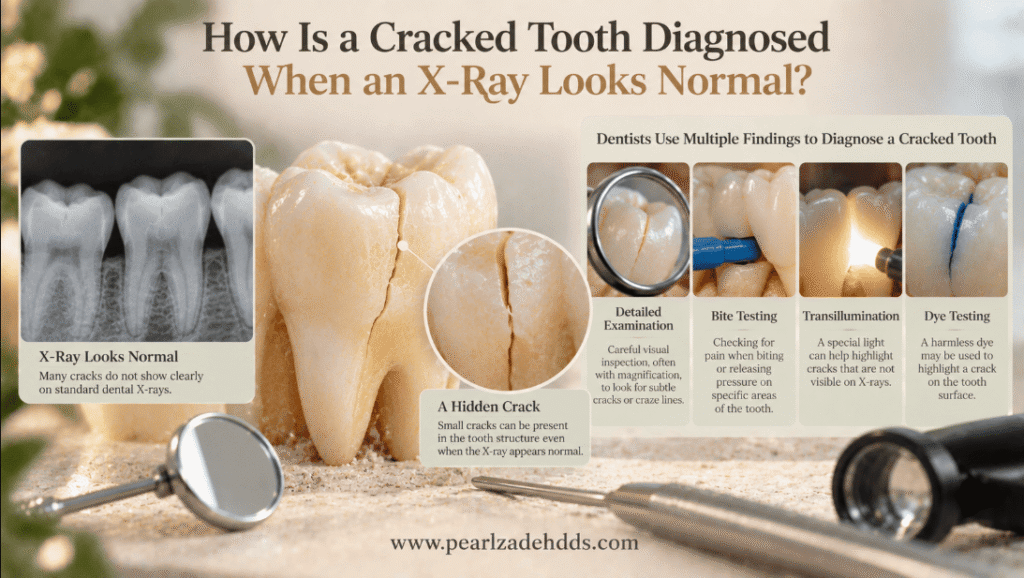
Your tooth hurts when you bite, or it twinges with cold. Then the X-ray comes back, and your dentist says everything looks normal. That result can feel confusing and frustrating. A normal X-ray does not necessarily rule out a cracked tooth. Some cracks are difficult to see on a standard dental X-ray.
Your dentist may need to combine your symptoms, clinical tests, and imaging to identify the problem. For first steps, urgency, and treatment, see our article on what to do if you have a cracked tooth.
Why Might a Cracked Tooth Not Show Up on an X-Ray?
A standard dental X-ray produces a two-dimensional image. It compresses a three-dimensional tooth into a single view. Overlapping structures can hide fine details, and many cracks are extremely thin. The crack’s direction also matters. A StatPearls review notes that an X-ray may reveal a thin line when the crack runs from cheek to tongue. The X-ray becomes less useful when the crack runs parallel to the film.
Some cracks also cause no visible changes in the surrounding bone or tooth structure. Without those changes, the image may provide little evidence of the crack. A 2025 mini review in Frontiers in Oral Health states that radiographs rarely diagnose cracks directly. Bone defects may appear at later stages, and these findings can raise suspicion.
X-rays still play an important role. They can show bone, roots, decay, infection, and other conditions that may cause similar symptoms. A normal X-ray can help rule out some of these causes. It simply cannot rule out a cracked tooth on its own.
What Can a Dentist Learn From Your Symptoms?
Your description helps guide the evaluation. Pain when biting is a common clue. So is pain when you release the bite. Intermittent pain and sensitivity to temperature can also matter. Some symptoms are difficult to reproduce during an appointment, which makes a detailed history especially useful.
Your dentist may also ask whether you recently bit something hard, such as a popcorn kernel or a fruit pit. Symptoms that consistently affect one specific tooth can help narrow the search.
These symptoms provide clues, not proof. Other dental problems can cause similar pain. A symptom pattern can raise or lower suspicion, but it cannot confirm a crack on its own.
What Does a Dentist Look for During the Examination?
The examination gives your dentist information that an X-ray cannot. Your dentist inspects the tooth under good lighting and magnification. The American Association of Endodontists (AAE) notes that the naked eye can miss subtle details of cracks.
Visible crack lines are one clue. Changes in tooth structure can provide additional information. So can fractured or loose areas, existing fillings or crowns, and changes around the gumline. Worn areas may also provide clues about your bite.
Can a Bite Test Help Find a Cracked Tooth?
A bite test asks you to bite down on a small instrument. Your dentist applies pressure to one part of the tooth at a time. StatPearls describes directing force through each cusp while you report which area triggers your symptoms. A cusp is a raised point on the chewing surface.
If pressure on one spot reproduces your pain, it provides an important clue. The Frontiers mini review describes the bite test as useful but not confirmatory. Other dental problems can also cause pain when you bite. Your dentist interprets the result alongside the rest of the examination.
What Does a Dentist Look for During the Examination?
The examination gives your dentist information that an X-ray cannot. Your dentist inspects the tooth under good lighting and magnification. The American Association of Endodontists (AAE) notes that the naked eye can miss subtle details of cracks.
Visible crack lines are one clue. Changes in tooth structure can provide additional information. So can fractured or loose areas, existing fillings or crowns, and changes around the gumline. Worn areas may also provide clues about your bite.
Can a Bite Test Help Find a Cracked Tooth?
A bite test asks you to bite down on a small instrument. Your dentist applies pressure to one part of the tooth at a time. StatPearls describes directing force through each cusp while you report which area triggers your symptoms. A cusp is a raised point on the chewing surface.
If pressure on one spot reproduces your pain, it provides an important clue. The Frontiers mini review describes the bite test as useful but not confirmatory. Other dental problems can also cause pain when you bite. Your dentist interprets the result alongside the rest of the examination.
What About Gum or Periodontal Probing?
Dentists measure the depth of the gum pocket around a tooth with a thin probe. Checking the full perimeter in small steps can reveal a narrow, isolated deep area. The Frontiers review describes this finding as a finding that can raise suspicion of a crack.
A localized deep pocket can provide useful information. It does not automatically mean the tooth is cracked. Gum disease and other problems can also deepen a pocket. Small crack-related pockets can also be easy to miss, so probing is only one part of the evaluation.
Can CBCT Find a Cracked Tooth That an X-Ray Misses?
A standard dental X-ray produces a flat image. Cone-beam computed tomography (CBCT) works differently. The machine rotates around your head and captures multiple images. Software then combines them into a three-dimensional view of the teeth and surrounding bone.
That view may provide additional information in selected cases. StatPearls says CBCT can be valuable when radiographic assessment is inconclusive but a crack remains strongly suspected. An AAE publication notes that clinicians may consider CBCT when the clinical examination and standard X-rays are inconclusive. Your dentist should weigh its potential benefit against the additional radiation exposure.
CBCT does not make every crack visible. Metal posts and root-filling materials can create image artifacts. A systematic review of vertical root fractures in root-filled teeth found pooled sensitivity of roughly 70% to 73%. The authors also called for more research. Some cracks remain difficult to visualize even with advanced imaging.
What If the X-Ray Is Normal but the Pain Continues?
A normal first X-ray does not end the investigation. Persistent symptoms still deserve further evaluation. Your dentist may reconsider several possibilities.
Is the pain coming from the tooth you suspect? Pain can be referred, meaning you feel it in a different tooth from the one causing it. Does the symptom pattern fit a crack? How does the tooth respond to bite and pulp tests? Your dentist may also reassess the gums and existing restorations.
Your dentist may consider other causes of dental pain. Additional imaging or a specialist evaluation may be appropriate in some cases. None of this means a crack is automatically the cause. Sometimes the evaluation points to a different problem.
Could Something Other Than a Crack Cause the Same Symptoms?
Several problems can mimic a cracked tooth. Decay can cause pain with biting or temperature changes. A defective or stressed filling may cause similar symptoms. Pulp inflammation can produce lingering sensitivity or an ache. Excessive bite forces from clenching can leave teeth sore. Simple tooth sensitivity can cause discomfort with cold. Gum problems can also cause discomfort when you chew.
StatPearls lists dentine hypersensitivity, parafunctional pain, and galvanic pain among other possible mimics. These terms describe sensitivity from exposed tooth surfaces, pain associated with clenching or other excessive forces, and pain related to contact between different metals.
Because several conditions can cause similar symptoms, no single symptom or X-ray can settle the diagnosis. A complete dental evaluation helps determine the most likely cause.
How Does a Dentist Put All the Findings Together?
How can a dentist diagnose a cracked tooth if the X-ray is normal? By combining your symptoms, clinical findings, imaging, and other diagnostic tests. The approach depends on the suspected location and type of crack.
An AAE Communiqué article describes cracked teeth as diagnosed through clinical findings and several examination tests. These may include transillumination, periodontal probing, bite testing, and magnification. Dentists look for a pattern across the findings. Symptoms, clinical examination, bite testing, pulp testing, periodontal findings, and imaging each provide another piece of information.
No single finding determines the diagnosis. One finding can fit several conditions. Several findings that point in the same direction build a stronger case. Even then, a dentist may not be able to identify the exact location of a crack. Some cases remain uncertain. Your dentist may then recommend monitoring, further testing, or a specialist evaluation.
When Should You Have a Tooth Rechecked?
Return to your dentist if symptoms persist, worsen, or return after a normal X-ray. Increasing pain, swelling, and pain when biting all deserve attention. Significant temperature sensitivity, a visible fracture, or a loose or broken tooth fragment also warrant a recheck. Difficulty chewing is another reason to contact your dentist.
Not every mild twinge is an emergency. However, even occasional symptoms deserve follow-up if they continue. Swelling, severe pain, or a broken tooth that affects eating calls for faster attention. Learn more about urgent dental care on our website. Our article on cracked tooth symptoms and treatment covers the next steps in more detail.
When Tooth Pain Does Not Match the X-Ray
A normal dental X-ray does not always explain persistent tooth pain or sensitivity. Some cracks are difficult to see on standard images. Your dentist may need to combine your symptoms, clinical examination, and other diagnostic tests.
If you continue to have pain when biting, temperature sensitivity, or another unexplained tooth symptom, schedule a dental evaluation. Your dentist can investigate the possible cause and determine whether further testing or treatment is appropriate.
Call (818) 716-6722 or click the button below to schedule your consultation online.
Frequently Asked Questions
Yes. Some cracks are difficult to see on standard dental X-rays because of their size, location, or direction. A dentist may use your symptoms, clinical examination, bite testing, and other diagnostic methods to investigate further.
A dentist may combine several findings, including your pain pattern, visual examination, magnification, bite testing, transillumination, pulp testing, and periodontal probing. Additional imaging may also be considered when appropriate.
CBCT imaging can provide three-dimensional information that a standard X-ray cannot. However, it does not make every crack visible. Whether CBCT is useful depends on the suspected crack, symptoms, and other examination findings.
Pain when biting can have several causes, including a cracked tooth, decay, a stressed restoration, pulp inflammation, or bite-related problems. A normal X-ray does not identify all of these conditions, so persistent pain may require a more detailed examination.
If pain or sensitivity continues, schedule a dental evaluation rather than assuming nothing is wrong. Your dentist can review your symptoms, examine the tooth again, and decide whether additional testing or imaging is appropriate.
This article is for informational purposes only and is not a substitute for professional dental advice. Please schedule a consultation with Pearl Zadeh DDS to discuss your specific situation.