
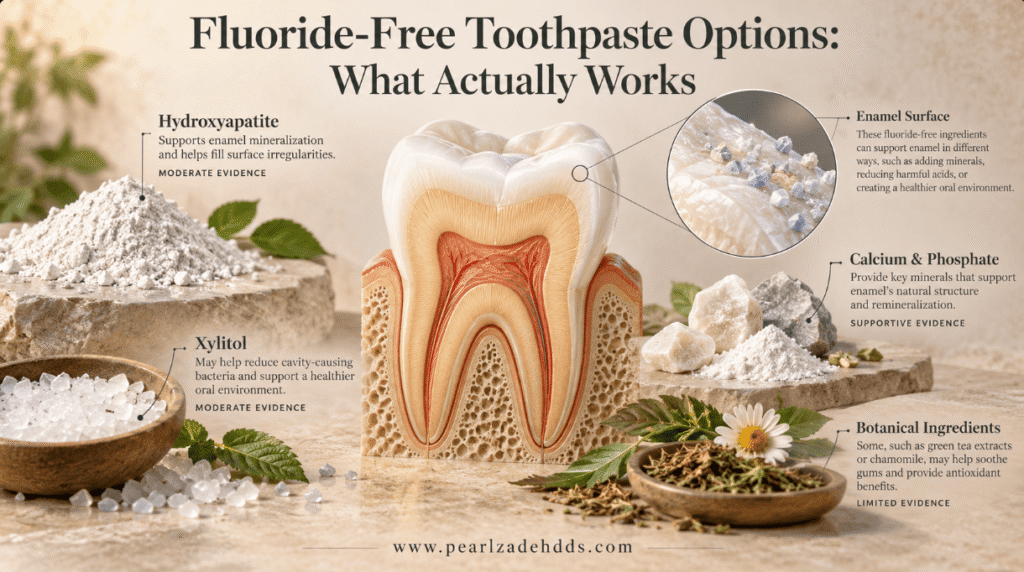
Choosing a fluoride-free toothpaste can feel surprisingly complicated. You may see hydroxyapatite, xylitol, calcium compounds, or herbal ingredients promoted as alternatives to fluoride. But the important question is not how impressive the ingredient list looks. It is whether the toothpaste can actually help protect your teeth from cavities.
Fluoride has a long history of evidence behind its role in cavity prevention. Fluoride-free options have been studied too, but the evidence varies widely depending on the ingredient, formulation, and outcome being measured. Some may support enamel or help with specific oral-health concerns, while that does not necessarily mean they provide the same cavity protection as fluoride.
If you are considering switching, it helps to look beyond the label and separate established benefits from promising but limited evidence.
What Does Fluoride-Free Toothpaste Mean?
Fluoride-free toothpaste is simply toothpaste that does not contain fluoride as an active ingredient. The term tells you what the formula leaves out, but not what it uses instead.
That distinction matters because fluoride-free toothpaste is not one specific type of product. Formulations can differ considerably in their ingredients, intended benefits, and evidence.
A toothpaste may be fluoride-free because it uses another ingredient intended to support enamel, reduce sensitivity, control plaque, or provide other oral-health benefits. Those purposes are not necessarily the same as preventing cavities.
Why Do Some People Choose Fluoride-Free Toothpaste?
People choose fluoride-free toothpaste for a range of personal reasons. Some simply prefer the taste or texture of a particular formula. Others have concerns about fluoride exposure, whether from personal research or family history. Some are drawn to a specific ingredient, such as hydroxyapatite, based on what they have read. Others may have switched after an unpleasant experience with a particular toothpaste.
These reasons can explain why someone prefers a fluoride-free option, but they do not tell you how well that option protects your teeth. That question depends on the ingredients, formulation, and available evidence.
What Ingredients Are Used in Fluoride-Free Toothpaste?
Fluoride-free formulas can contain several different active ingredients, and they are not designed to work in exactly the same way.
Nano-hydroxyapatite is a synthetic form of the mineral found in natural tooth enamel. It has been studied for its potential role in supporting enamel and early mineral loss.
Xylitol is a sugar alcohol that may be included because of its effects on the oral environment and certain bacteria. Its presence does not mean the toothpaste provides the same cavity protection as fluoride.
Calcium-based compounds appear in some formulations alongside phosphate. These ingredients are intended to provide minerals that may support the tooth surface.
Arginine is an amino acid found in some toothpastes, particularly formulations designed for sensitivity. Some products also promote it for broader oral-health benefits.
Herbal and botanical ingredients, such as neem or clove extracts, are common in naturally marketed toothpastes. They may serve different purposes, including flavor, but evidence for cavity prevention varies by ingredient and formulation.
The important point is that “fluoride-free” describes what the toothpaste does not contain. It does not tell you what provides its active benefits. Looking at the specific ingredients is more useful than relying on terms such as “natural” or “fluoride-free.”
Does Fluoride-Free Toothpaste Prevent Cavities?
Cavity prevention depends on more than which toothpaste sits on your sink. According to the American Dental Association, fluoride helps strengthen enamel and supports the repair of early mineral loss caused by acids from oral bacteria. Its role in cavity prevention has been studied for decades.
Fluoride-free ingredients have also been studied, but the available research varies by ingredient, formulation, and outcome. That makes it important to look at what a study actually measured rather than treating every positive finding as proof of cavity prevention.
For example, a laboratory study using isolated tooth samples cannot tell us exactly how a toothpaste performs in everyday use. A reduction in certain plaque bacteria does not necessarily mean fewer cavities. Likewise, an improvement in a marker of remineralization does not automatically mean that an established lesion has reversed.
These distinctions matter when comparing fluoride-free options. An ingredient may show a promising effect in one area without having the same level of evidence for preventing cavities in people.
Is Nano-Hydroxyapatite a Good Alternative to Fluoride?
Hydroxyapatite is a mineral that makes up much of natural tooth enamel. That structural similarity is one reason it has attracted interest as a fluoride-free toothpaste ingredient.
An 18-month randomized clinical trial in adults examined changes in tooth surface damage related to cavities. About 89% of participants using hydroxyapatite showed no increase in the measured damage, compared with about 87% of those using fluoride. The study found hydroxyapatite to be statistically non-inferior to fluoride for the outcome it measured.
A systematic review of hydroxyapatite research also found evidence supporting its effectiveness in the clinical studies it analyzed. However, the review included a relatively small number of trials, and some were considered to have limitations in study quality.
That matters when interpreting the results. Several studies involved specific populations or relatively short follow-up periods, so the findings may not represent every adult or every toothpaste formulation. The research also does not yet match the depth and duration of the evidence supporting fluoride for cavity prevention.
So, while nano-hydroxyapatite is a promising fluoride-free ingredient, the current evidence does not establish it as a universal replacement for fluoride. Its potential benefits should be considered alongside your cavity risk, oral-health needs, and the specific toothpaste formulation.
For a closer look at how nano-hydroxyapatite works, see our guide to nano-hydroxyapatite toothpaste.
Can Xylitol Help If You Use Fluoride-Free Toothpaste?
Xylitol is a sugar alcohol, not a mineral, and it works differently from fluoride. Research suggests it may affect certain oral bacteria and the oral environment, but those effects do not automatically translate into fewer cavities.
A Cochrane review of xylitol research found the evidence too limited and inconsistent to support firm conclusions about its ability to prevent tooth decay. The modest benefit identified in some research involved xylitol added to fluoride toothpaste, rather than a fluoride-free toothpaste containing xylitol.
Chewing gum is also a separate category from toothpaste, and findings from xylitol gum cannot simply be applied to toothpaste. Our article on xylitol gum and cavity prevention looks at that evidence in more detail.
For that reason, the presence of xylitol in a fluoride-free toothpaste should not be treated as proof that the product prevents cavities.
Can Fluoride-Free Toothpaste Remineralize Enamel?
Remineralization occurs when minerals are redeposited into enamel after it has started to lose them. This process is different from treating an established cavity, where tooth structure has already been lost.
Early, non-cavitated enamel changes may respond to remineralization. Once decay has created a cavity, however, toothpaste cannot simply rebuild the missing tooth structure.
Fluoride has a well-established role in supporting enamel remineralization and slowing the progression of early carious lesions. Hydroxyapatite and certain calcium-based ingredients are also being studied for their potential effects on enamel mineralization.
The evidence for these fluoride-free ingredients depends on the specific compound, formulation, and study design. Some findings are promising, but they should not be interpreted as proof that every fluoride-free toothpaste can remineralize enamel to the same extent as a fluoride toothpaste.
Is Fluoride-Free Toothpaste Good for Sensitive Teeth?
Some fluoride-free formulas contain ingredients aimed at dentin sensitivity, including arginine or certain calcium compounds. These ingredients may reduce sensitivity by affecting the pathways involved in pain transmission.
That benefit is separate from cavity prevention. A toothpaste can help reduce sensitivity without providing the same protection against cavities associated with fluoride.
Sensitivity can also become more noticeable during or after whitening. Our guide to teeth whitening for sensitive teeth covers that issue in more detail.
Can Fluoride-Free Toothpaste Whiten Teeth?
Whitening ability depends on the ingredients and how they work. Many toothpastes, whether they contain fluoride or not, can help remove surface stains through mild abrasives. That is different from chemical bleaching, which changes the color of the tooth itself.
Some fluoride-free formulas contain ingredients intended to help with surface staining, while others do not. The absence of fluoride does not make a toothpaste more or less effective for whitening.
If whitening is the main goal, look at the specific whitening ingredients and their mechanism rather than the fluoride content alone.
Is Fluoride-Free Toothpaste Safe?
Safety depends on the specific formulation and how the product is used. A fluoride-free toothpaste is not automatically safer than a fluoride toothpaste, but choosing a fluoride-containing product does not make every formulation appropriate for every person either.
When available, the ADA Seal of Acceptance can provide useful information about products that have met the ADA’s evaluation requirements.
The more important question is whether the toothpaste fits your oral-health needs and provides the benefits you are looking for.
Who May Need to Think Carefully Before Switching?
Some people have a higher risk of developing cavities than others. That risk is worth considering before switching away from fluoride.
Factors that can increase cavity risk include:
- Frequent exposure to sugary or carbohydrate-rich foods and drinks
- A history of previous cavities
- Dry mouth or reduced saliva flow
- Certain medications or medical conditions that affect saliva
- Gum recession that exposes root surfaces
- Difficulty maintaining consistent oral hygiene
- Existing dental problems
Root surfaces are more vulnerable to decay because they do not have the same protective enamel covering as the crowns of teeth.
Having one or more of these risk factors does not automatically rule out fluoride-free toothpaste. It does mean that the potential benefits and limitations deserve closer consideration.
What Matters More Than the Toothpaste Brand?
Toothpaste is only one part of cavity prevention. Daily habits and your overall oral-health routine matter too.
Brushing twice daily helps remove plaque from tooth surfaces. Cleaning between your teeth reaches areas a toothbrush cannot clean effectively. Limiting frequent sugar exposure reduces repeated acid challenges to the teeth. Managing dry mouth can also be important when saliva flow is reduced.
Regular dental examinations provide another layer of prevention by allowing problems to be identified before they progress.
Choosing a different toothpaste cannot make up for gaps in the rest of your oral-hygiene routine.
Should You Switch to Fluoride-Free Toothpaste?
There is no single answer that applies to every adult. The decision depends on why you want to avoid fluoride, your cavity risk, the specific formulation you are considering, and the evidence supporting its active ingredients.
Someone with a low cavity risk may have different considerations from someone who has developed cavities repeatedly or has significant dry mouth.
The important question is not whether fluoride-free toothpaste is universally good or bad. It is whether the particular product provides enough benefit for your individual needs and whether you understand what you may be giving up by switching.
If you are unsure how your cavity risk affects that decision, a dentist can assess your oral health and discuss the options with you.
Talk to Dr. Pearl Zadeh About Your Oral Health Routine
Toothpaste is only one part of preventing cavities. The active ingredients, your personal cavity risk, and your daily routine all play a role together. Brushing technique, diet, and regular checkups matter just as much as what is in the tube.
If you have questions about your cavity risk or your overall prevention plan, Dr. Pearl Zadeh and her Woodland Hills team can help you build a routine suited to your needs.
Call (818) 716-6722 or click the button below to schedule your consultation online.
Frequently Asked Questions
There is no single best option, since fluoride-free formulas vary widely in ingredients and evidence. The right choice depends on your cavity risk, oral health needs, and what you are hoping to address.
Some fluoride-free ingredients, particularly hydroxyapatite, have shown promising results in a limited number of studies. The evidence is not as extensive as the decades of research behind fluoride, and results vary by ingredient and formulation.
Effectiveness depends on the specific active ingredient and what it is meant to do. Some ingredients have meaningful supporting evidence, while others have little research behind their cavity-prevention claims
Current research suggests hydroxyapatite can perform comparably to fluoride in some studies, but the evidence base is smaller and newer. It has not been shown to definitively replace fluoride for every adult.
Some fluoride-free ingredients may support remineralization of early, non-cavitated changes in enamel. No toothpaste can fully rebuild enamel that has already been lost to an established cavity.
This article is for informational purposes only and is not a substitute for professional dental advice. Please schedule a consultation with Pearl Zadeh DDS to discuss your specific situation.