
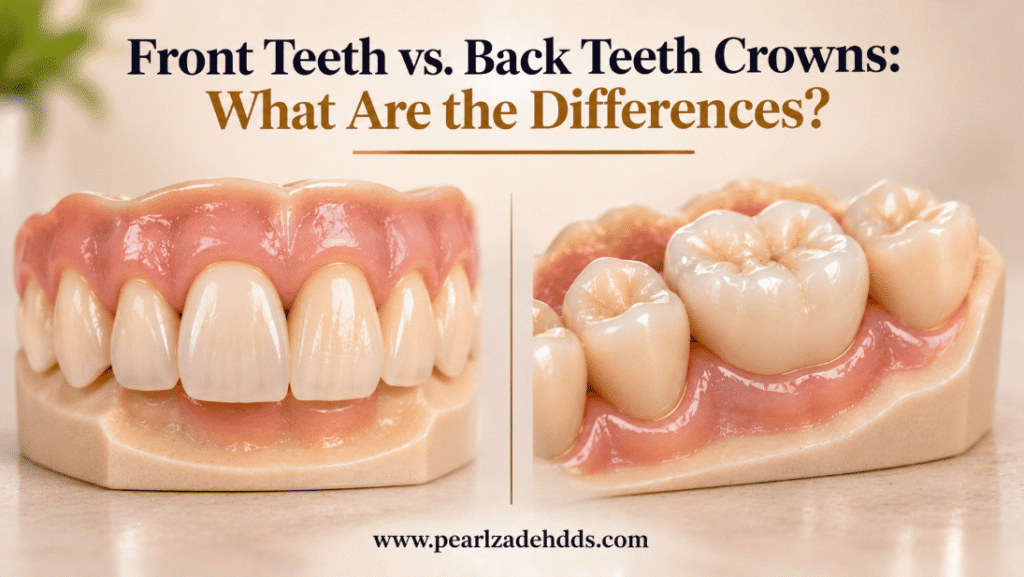
Front teeth and back teeth crowns involve different priorities. A front tooth is visible when a person smiles or speaks, so natural-looking details matter. Back teeth handle much of the chewing pressure, making strength, fit, and bite function important.
Both appearance and function matter for every crown, regardless of its location. The difference is which factors may need more attention when restoring a particular tooth.
Why Does Tooth Location Matter When Choosing a Crown?
Teeth differ in shape, function, and visibility:
- Front teeth are primarily involved in biting and cutting food.
- Premolars and molars help crush and grind food.
- Front teeth are more visible when smiling and speaking.
- Back teeth experience substantial chewing forces.
Cleveland Clinic explains that incisors have narrow edges for cutting food, while molars are the main chewing teeth, helping crush and grind food.
These differences can influence crown design and material selection. Dentists also consider the tooth’s condition, remaining structure, and the patient’s bite before recommending a restoration.
Dental Crowns for Front Teeth
A crown on a front tooth restores an area that is often visible when smiling or speaking. Its appearance depends on several details:
- Color compared with neighboring teeth.
- Natural translucency and surface texture.
- Shape, size, and symmetry.
- Gumline appearance and crown margins.
- Bite alignment and how the front teeth meet.
- Preservation of healthy tooth structure, when clinically appropriate.
Translucency describes how light passes through a tooth. Crown margins are the edges where the restoration meets the natural tooth. Both details can affect how natural the finished crown looks.
All-porcelain and other suitable metal-free ceramic crowns may be considered for visible teeth. Cleveland Clinic notes that porcelain and all-ceramic crowns can mimic the appearance of natural tooth enamel.
However, appearance is only one part of the decision. The condition of the tooth and the way the front teeth come together also influence the choice. An exact color match cannot be guaranteed because natural teeth vary in shade and translucency.
Dr. Pearl’s practice focuses on metal-free ceramic restorations selected to match the natural color and translucency of teeth. Learn more about porcelain dental crowns at Pearl Zadeh DDS.
Dental Crowns for Back Teeth
A crown on a back tooth, such as a molar dental crown, must withstand substantial chewing pressure. Several factors matter when restoring these teeth:
- Chewing forces during everyday eating.
- Bite alignment and pressure distribution.
- Resistance to fracture and wear.
- The amount of natural tooth structure remaining.
- Crown fit and function.
- Grinding or clenching habits, when relevant.
Grinding and clenching can place additional stress on teeth and restorations. Cleveland Clinic advises people who grind or clench their teeth to ask their dentist about a custom mouth guard.
The choice of ceramic material should account for the tooth’s location, condition, and functional demands. Strength is important, but it is not the only consideration. Fit, appearance, bite forces, and the amount of remaining tooth structure also matter.
Appearance still plays a role, particularly for premolars that may show when smiling. There is no single ceramic material that is automatically right for every back tooth.
Front Teeth vs. Back Teeth Crowns: Main Differences
| Consideration | Front teeth | Back teeth |
| Main function | Biting and cutting food | Crushing and grinding food |
| Visibility | More visible when smiling and speaking | Usually less visible |
| Appearance | Natural color, shape, and translucency are important | Appearance still matters, especially for visible premolars |
| Functional demands | Must withstand biting forces and proper front-tooth contact | Must withstand substantial chewing forces |
| Crown selection | Considers appearance, bite, and remaining tooth structure | Considers chewing forces, bite, and remaining tooth structure |
Are the Same Crown Materials Used for Front and Back Teeth?
Some ceramic materials can be used for both front and back teeth. The choice depends on the material’s properties and the demands placed on the specific tooth. Cleveland Clinic notes that dentists use pressed ceramic crowns on both front and back teeth.
All-porcelain and other metal-free ceramic options may be considered depending on the clinical situation. However, ceramics differ in strength, translucency, and appearance. The dentist must consider how these properties suit the tooth being restored.
A closer comparison of zirconia versus porcelain crowns explains the differences between two ceramic options. The final choice also depends on the examination and the materials available at the practice.
What If a Front or Back Tooth Has Extensive Damage?
The amount of healthy tooth structure remaining can affect whether a crown is appropriate.
The American Dental Association’s (ADA) MouthHealthy site explains that a crown may strengthen a tooth when too little natural tooth remains to support a filling.
Before recommending treatment, the dentist evaluates the extent of the damage, the tooth’s stability, and the patient’s bite. Depending on these findings, another type of restoration may be more suitable. Not every damaged front or back tooth needs a crown.
An examination helps determine what treatment may be appropriate. Symptoms alone cannot establish whether a crown is necessary.
How Does a Dentist Decide Which Crown Is Right?
The decision involves more than tooth location. Factors include:
- The tooth’s condition.
- The amount of natural tooth structure remaining.
- Bite forces and alignment.
- Grinding or clenching habits.
- Appearance requirements.
- Suitable ceramic materials.
- The patient’s dental needs and preferences.
A dental examination helps Dr. Pearl assess these factors and determine which crown material and design may work for the tooth. Patients considering a crown for a front or back tooth can discuss their options with Dr. Pearl Zadeh DDS in Woodland Hills.
Call (818) 716-6722 or click the button below to schedule your consultation online.
Frequently Asked Questions
They can be. Front tooth crowns put extra emphasis on natural color, shape, and translucency. Back tooth crowns put extra emphasis on chewing forces and fit. Both need good function and good appearance.
No single type is best for every front tooth. All-porcelain and other metal-free ceramics may be considered because they can mimic natural enamel. The dentist also weighs the bite, the remaining tooth, and the patient’s goals.
Sometimes. Suitability depends on the tooth’s condition, the bite, and grinding habits. Cleveland Clinic notes that dentists use pressed ceramic crowns, one ceramic type, on both front and back teeth.
Back teeth face greater chewing forces, so strength matters. Front teeth still need to withstand biting and tooth contact. Strength is one factor among several, not the only one.
Longevity varies. It depends on the material, fit, oral hygiene, bite forces, and other individual factors. No crown has a guaranteed lifespan. Cleveland Clinic ties crown lifespan to proper care, including a mouth guard for grinding.
The information above is for informational purposes only and is not a substitute for professional dental advice. Please schedule a consultation with Pearl Zadeh DDS to discuss your specific situation.