
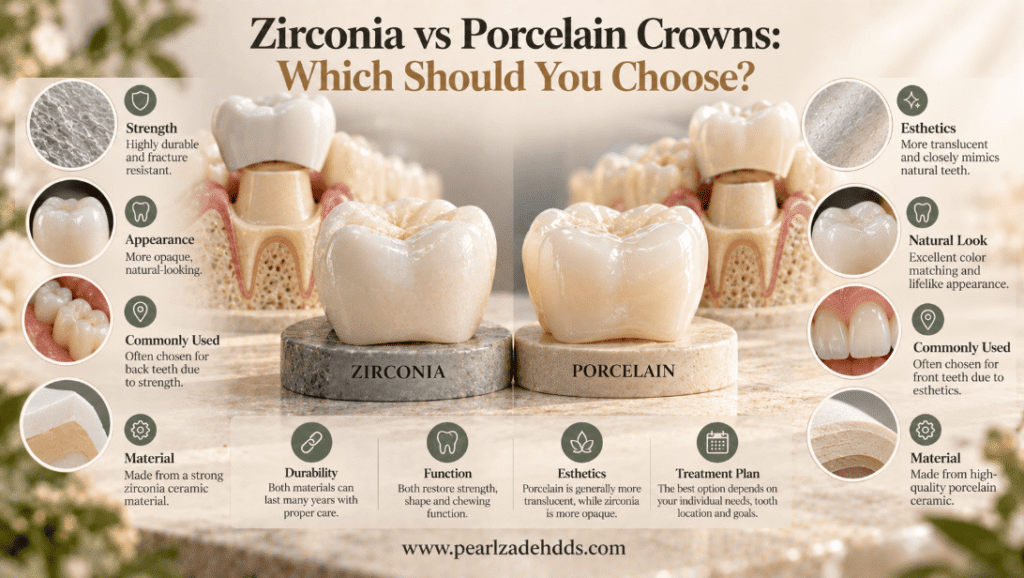
Your dentist says you need a crown. Then the options come up: zirconia, porcelain, maybe lithium disilicate. Which one is strongest? Which looks best? The choice is not simply about picking the strongest or most attractive material. Different ceramic systems have different properties, and the most appropriate option depends on the tooth and the treatment plan.
What Is a Zirconia Crown?
Zirconia is a ceramic material used for dental restorations. The ADA describes zirconia ceramics as having a natural white-colored appearance and reportedly high flexural strength. Dentists value it for strength and fracture resistance. Those measures come from laboratory testing, so they do not predict every clinical result.
Zirconia crowns come in two main designs. A monolithic crown is made of zirconia throughout. Layered crowns have a zirconia core covered with veneering ceramic. Each design involves trade-offs that a dentist weighs.
Formulations differ too. The ADA notes that more yttria improves translucency but makes zirconia more brittle, with lower flexural strength. Zirconia crowns are not all identical.
What Do People Mean by a Porcelain Crown?
Patients usually say “porcelain crown” for any tooth-colored ceramic crown. Dentistry uses more precise terms. Dental ceramics include several material systems. Lithium disilicate is a glass-ceramic that comes in low, medium, and high translucency forms. Feldspathic porcelain has long been layered over metal in metal-ceramic crowns.
Zirconia is also a ceramic. The line between “porcelain” and “zirconia” is therefore not a clean one. Each system balances strength, translucency, and esthetics differently. If your dentist uses a term you do not know, ask for a plain-language explanation.
Zirconia vs Porcelain: What Is the Main Difference?
This table gives a general comparison. Each factor can vary depending on the specific material and crown design.
| Factor | Zirconia | Porcelain / other ceramic |
| Strength | Often high, depending on material and design | Varies considerably by ceramic system |
| Esthetics | Can look very natural, especially with modern translucent zirconia | Some systems offer excellent translucency and natural appearance |
| Chipping and fracture | Depends on design and whether ceramic is layered | Depends strongly on material and design |
| Tooth location | Often useful where strength matters | Some systems suit areas where esthetics come first |
| Thickness and space | Depends on system and design | Depends on system and design |
| Bite forces | An important consideration | An important consideration |
| Longevity | Depends on material, design, tooth, and patient | Depends on material, design, tooth, and patient |
Is Zirconia Stronger Than Porcelain?
Zirconia is generally known for high strength. The ADA’s material summary reports lower flexural strength for lithium disilicate than for zirconia. “Porcelain” covers several systems, so the answer varies by system.
Strength alone does not decide whether a crown suits a tooth. Design, thickness, cementation or bonding, and tooth preparation all matter. So do bite forces and the condition of the supporting tooth. Stronger does not automatically mean better. Zirconia is not unbreakable, and laboratory strength is not clinical performance. A very strong material can still fail if the design, fit, or bite does not suit the tooth. Bonding or cementation methods may also differ by system, and the dentist chooses one that suits the material.
Which Crown Looks More Natural?
Natural appearance depends on translucency, which describes how light passes through the material. Color, surface texture, and the neighboring teeth matter too.
The ADA describes full-contour zirconia as having better translucency than framework zirconia, because of its lower alumina content. It also notes that lithium disilicate’s range of translucencies allows a wider range of anterior indications. Neither material always looks more natural. A skilled dentist and lab can achieve good results with either. Neighboring teeth shift in shade from neck to edge, and the crown must blend with them.
Whitening plans matter here. The ADA states that only natural teeth can be whitened, not tooth-colored restorations. If you want brighter teeth, read our article on teeth whitening before veneers or crowns first. Whitening plans can affect which crown shade your dentist selects.
Is Zirconia or Porcelain Better for Front Teeth?
No universal answer exists. Front teeth often place greater emphasis on appearance. Space can be tighter at the front, which may influence design choices. Still, available space, tooth structure, bite, and color requirements also shape the decision. So does the specific ceramic system.
A front tooth alone does not determine the material. The wider translucency range of lithium disilicate does not rule out zirconia either. Your dentist weighs the details of your tooth. Treatment goals matter too. A patient who wants a very subtle match may weigh different trade-offs than one with a heavily worn tooth.
Which Crown Is Better for Back Teeth?
Back teeth absorb substantial chewing forces. Strength and fracture resistance can therefore carry more weight. Chewing patterns vary, so two molars can face different demands. Dentists may consider zirconia where mechanical demands are significant. It is not automatically right for every molar. Remaining tooth structure also plays a part. A tooth with little healthy structure may need a different design than one with plenty.
A 2022 systematic review pooled nine trials of monolithic zirconia single crowns, 1,657 restorations in all. Its conclusion emphasized back teeth. Survival ranged from 91% to 100%. Follow-up averaged about one year. The authors noted moderate study quality and high heterogeneity. That is encouraging but short.
The dentist also considers the tooth, the bite, the available space, and the restoration design.
Can Zirconia or Porcelain Crowns Chip or Crack?
Yes, both can. The ADA reports that chipping and fracture are the most common complications of zirconia-based restorations, as with porcelains. Ceramic crowns of any type can also wear.
Layered designs add a specific risk. A systematic review of single crowns found zirconia crowns lost to veneering ceramic fracture more often than metal-ceramic crowns. Another summary of reviews on zirconia restorations called chipping the most frequently reported technical complication. Framework fracture and loss of retention, where a crown loosens, came next.
Monolithic zirconia has no veneering layer, so that problem does not apply. Even so, monolithic crowns can still fracture or develop other complications. Wear is a factor too. The ADA notes that polished zirconia resists wear from opposing teeth better than the feldspathic porcelain in metal-ceramic crowns.
Does Teeth Grinding Affect the Choice?
Clenching and grinding raise the forces on crowns, so bruxism can influence material choice. It is only one consideration. Zirconia does not automatically solve problems caused by grinding. A 2026 systematic review of zirconia and lithium disilicate crowns in bruxism patients included only three studies. The randomized trial found no significant difference between the materials. Observational data showed more complications in patients with bruxism.
Dentists may consider protective measures when appropriate. MouthHealthy notes that a dentist may recommend a night guard. A night guard does not guarantee that a crown will not fail. Bruxism also significantly influenced survival in a retrospective study spanning several crown materials.
Does Crown Thickness Matter?
Yes, because available space influences both material and design. A crown needs enough thickness to function well. The dentist also wants to preserve healthy tooth structure. Those goals pull in different directions.
Preparation matters here. To make room for a crown, the dentist reshapes the tooth. More reduction can leave more room for the material but removes more natural tooth. The dentist balances the two. Different ceramics may call for different amounts of reduction, so the choice can affect how much tooth is prepared.
Requirements vary by material and product, and manufacturers specify them for each system. Laboratory thickness tests do not prove clinical performance. This article offers no universal minimum. Your dentist applies the right guidance for the material chosen.
Which Crown Lasts Longer?
No material always lasts longer. Longevity depends on the material, the crown design, and the tooth location. It also depends on the supporting tooth, bite forces, bruxism, hygiene, gum health, and crown fit. Habits and follow-up care matter too. Follow-up lets a dentist spot early changes at the margins, the gums, or the bite. Our article on how long porcelain crowns last covers those factors in depth.
The evidence comes in separate pieces. A summary of reviews reported 5-year survival of 91.2% to 95.9% for tooth-supported zirconia single crowns, veneered and monolithic. An overview on lithium disilicate reported 93.8% to 100% survival for tooth-supported lithium disilicate crowns up to five years. It noted limited data beyond that. Those figures come from different reviews and cannot be compared directly.
One retrospective study found that crown material type did not significantly influence survival. Bruxism did. Its categories were all-ceramic, metal-ceramic, and gold crowns.
Can Zirconia or Porcelain Crowns Be Used With Existing Dental Work?
Existing dental work can shape the plan. Fillings, previous restorations, adjacent teeth, and opposing teeth all influence the decision. Neighboring restorations affect shade matching. Opposing teeth meet the crown surface every time you bite. Tell your dentist about grinding, whitening plans, or recent dental work. A new crown may also replace an older restoration that no longer holds up. The dentist then evaluates what remains of the tooth before choosing a material.
Your dentist considers how a new crown will work with what is already there. If you whiten, see our article on whitening with fillings or crowns. That keeps the restorative plan and your shade goals aligned.
So, Which Crown Should You Choose?
No single material is best for every crown. Your dentist may consider the factors below. They are not a ranking. Factors interact, and a dentist weighs them together.
1. Where the tooth is located
2. How much healthy tooth structure remains
3. Your bite
4. Grinding or clenching
5. Available space
6. Esthetic requirements
7. The specific ceramic system
8. The design of the crown
9. The condition of the gums and supporting tooth
10. Your individual treatment goals
The material should serve the treatment plan, not the other way around.
When Should You Talk to a Dentist About Crown Material?
You do not need to pick the ceramic system yourself. A dental evaluation can assess the tooth, bite, surrounding tissues, available space, and esthetic needs. Your dentist can then recommend a material. The same evaluation shows whether a crown is the right treatment for the tooth.
Share your priorities, such as appearance, grinding, or longevity questions. Most patients do not need an extensive consultation just to compare materials. If your current crown feels fine, a stronger material alone is no reason to replace it.
The Right Crown Fits the Tooth and the Patient
Zirconia and other ceramic crown systems each have different properties. The appropriate choice depends on the tooth and your individual circumstances. Dr. Pearl Zadeh evaluates the tooth and plans appropriate restorative care. She does not claim one material is always best. Learn more about crowns at Pearl Zadeh DDS.
Call (818) 716-6722 or click the button below to schedule your consultation online.
Frequently Asked Questions
Not universally. Each ceramic system has different strengths. The better choice depends on the tooth, bite, space, and esthetic goals.
Zirconia is generally known for high strength, but “porcelain” covers several systems. Strength is one factor among many.
Either can look natural. Translucency, color, and surface texture matter. Modern zirconia and some other ceramics both achieve good esthetics.
It can be. Space, bite, tooth structure, and color needs also matter. Your dentist considers the specific system.
No single crown suits every molar. Dentists may consider zirconia where chewing demands are high. Design and tooth condition also count.
This article is for informational purposes only and is not a substitute for professional dental advice. Please schedule a consultation with Pearl Zadeh DDS to discuss your specific situation.