
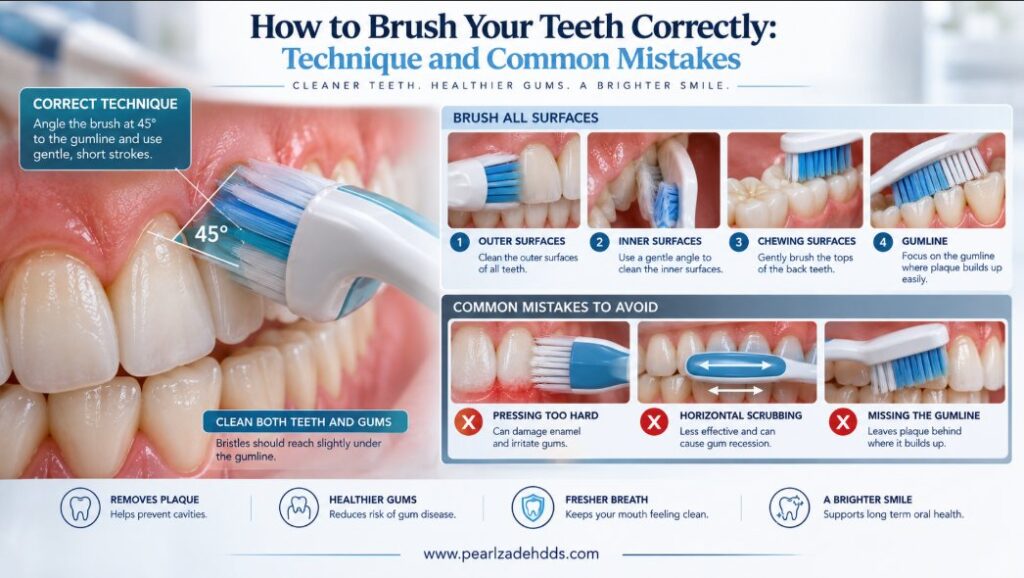
You brush every day, probably twice. But you might still be scrubbing a little too hard, rushing through it while thinking about your morning commute, focusing mostly on the teeth you can see in the mirror, or skipping past the spot where your teeth actually meet your gums.
None of that means you’ve been doing it wrong your whole life. Brushing regularly matters, but so does technique, and small adjustments tend to make a bigger difference than people expect.
Why Brushing Technique Matters
Effective brushing removes plaque, food debris, and bacteria that build up around the gumline, the spot where teeth meet gums and where problems most often start. Brushing isn’t about scrubbing as hard as possible. It’s a balance between removing that buildup, protecting your enamel, and protecting your gums at the same time. More pressure doesn’t mean cleaner teeth. Past a certain point, it just means more wear on your gums and enamel for no real cleaning benefit.
How to Brush Your Teeth Correctly
Choose the Right Toothbrush
The American Dental Association recommends a soft-bristled brush, since medium bristles can effectively remove plaque but carry more risk of gum irritation. A smaller brush head often makes it easier to reach your back teeth and awkward angles that a larger head simply can’t access. One systematic review the ADA cites found that brushes with multi-level or angled bristles outperform flat-trimmed bristles at removing plaque, so the bristle pattern matters more than the brand name on the handle. Electric brushes aren’t universally better than manual ones. What matters most is whether you’re actually using good technique with whichever one you pick.
Use the Right Amount of Toothpaste
A pea-sized amount of fluoride toothpaste is enough for an adult. Fluoride strengthens enamel and helps it resist the acids that cause decay. Specialty toothpastes can be reasonable choices for specific concerns like sensitivity, but there’s no need to assume you need one unless your dentist actually recommends it.
Hold the Brush at the Right Angle
Angle the bristles at roughly 45 degrees toward your gumline, not straight into your teeth. This lets the bristles reach just above and below where your gums meet your teeth, which is exactly where plaque tends to collect. Move the brush gently in short strokes rather than long sweeps across multiple teeth at once. For the inside surfaces of your front teeth, tilt the brush vertically and use small up-and-down strokes instead.
Use Gentle Pressure
Let the bristles do the work rather than pressing hard against your teeth. If you’re gripping the brush tightly or your bristles look flattened and splayed out within a few weeks, that’s usually a sign you’re pressing harder than you need to.
Clean Every Tooth Surface
Every tooth has an outer surface, an inner surface, and a chewing surface, and all three need attention. It’s easy to focus mostly on the outer surfaces you see in the mirror and rush past the inner surfaces and back teeth, simply because they’re harder to see and reach.
Brush the Gumline
Plaque collects right where your teeth meet your gums more than almost anywhere else in your mouth, since it’s an easy spot to brush past quickly. Spending a few extra seconds angling the bristles into that junction on each tooth makes a real difference for gum health over time.
Don’t Forget the Tongue
A light brush across your tongue can help reduce bacterial buildup and contribute to fresher breath. It’s a helpful habit, not a dramatic one, so there’s no need to scrub it aggressively.
Brush for Long Enough
Two minutes is the commonly recommended duration, and it’s genuinely easy to underestimate how slowly that time passes when you’re not paying attention. Most people brush closer to 45 seconds without realizing it. One practical fix dentists suggest is mentally dividing your mouth into four sections, upper left, upper right, lower left, and lower right, and spending about 30 seconds on each one before moving to the next.
How Much Pressure Should You Use?
Aggressive scrubbing doesn’t clean teeth any better than gentle, controlled brushing, since plaque is a soft film that comes off easily without much force at all. Technique, meaning the angle and motion of the brush, does far more of the actual work than sheer pressure. Toothbrush condition offers a useful clue here: bristles that splay outward within just a few weeks usually mean you’re bearing down harder than necessary. Aggressive brushing over years has been associated with gum recession, enamel wear, and increased sensitivity in some patients, though all three of these can have several other causes as well, including genetics, grinding, and gum disease itself. If you suspect you’ve been brushing too hard, switching to a soft-bristled brush, loosening your grip, and consciously using shorter, gentler strokes are the practical changes worth making.
Common Brushing Mistakes
A few patterns show up again and again. Brushing too quickly is probably the most common one, since two minutes feels longer than it is, and rushing tends to leave the same surfaces undertreated every time, usually the inner surfaces and back teeth. Missing the gumline is a close second, often simply because the angle feels less natural than brushing straight across the tooth. Focusing mainly on visible front teeth while neglecting chewing and inner surfaces is another frequent pattern, along with skipping the back molars entirely since they’re harder to reach and easy to forget.
Using a worn-out brush is its own issue. Once bristles fray or splay, they clean less effectively regardless of your technique, which is why replacing a brush every three to four months, or sooner if it looks worn, actually matters. Choosing hard bristles over soft ones on the assumption that harder means more effective is a common misconception, when the opposite is closer to true for most patients. Aggressive back-and-forth scrubbing, as opposed to short, controlled strokes, is really the same pressure problem covered above showing up as a technique habit. And brushing inconsistently, thorough one day and rushed or skipped the next, matters more for long-term oral health than the occasional less-than-perfect session. Consistency beats occasional intensity by a wide margin.
Can Brushing Too Hard Damage Your Teeth?
It can contribute to gum irritation, gum recession, tooth sensitivity, and enamel wear in some circumstances, though none of these conditions has a single cause, and it would be inaccurate to say hard brushing automatically leads to permanent damage for everyone who does it. If you’re noticing recurring sensitivity, gums that seem to be pulling back from your teeth, or gums that feel irritated after brushing, those are worth mentioning to your dentist rather than just switching brushes and hoping it resolves on its own.
Should You Brush Before or After Breakfast?
Both approaches have a reasonable case behind them, and the better choice depends partly on what you’re eating. Brushing before breakfast clears overnight plaque and gives fluoride a chance to strengthen enamel before it faces the day’s first acid exposure. Brushing after breakfast can leave lingering food particles in place a bit longer, but if breakfast includes something acidic, like citrus or coffee, brushing immediately afterward can wear down enamel that’s temporarily softened. If you eat something acidic, the more reasonable approach is waiting roughly 30 to 60 minutes before brushing rather than treating this as a fixed rule that applies to every breakfast.
Should You Rinse After Brushing?
Fluoride toothpaste leaves a protective residue on your teeth after brushing, and rinsing immediately with a large amount of water washes a good portion of that away before it can finish doing its job. An American Dental Association spokesperson has recommended spitting out excess toothpaste and either skipping the rinse or using just a light sip of water, delaying a fuller rinse by around 20 minutes if you prefer one. It’s a small adjustment, but it lets the fluoride actually stay in contact with your teeth a while longer.
Manual vs. Electric Toothbrushes
Either type can work well when used with good technique, so this isn’t really a question of one being categorically better. A Cochrane systematic review of 56 studies found that powered brushes using a rotation-oscillation motion reduced plaque by about 11% at one to three months and 21% after three months, with a smaller reduction in gingivitis as well. That’s a real but modest benefit, specific to that particular type of powered brush rather than electric brushes generally. Electric brushes can also make consistent pressure and timing easier for people who tend to scrub too hard or rush, since many include built-in timers or pressure sensors. A manual brush used with careful technique, the right angle, gentle pressure, and full coverage of every surface, can absolutely deliver comparable results. This mostly comes down to which one you’ll actually use consistently and correctly.
How to Brush Around Dental Work
Crowns, bridges, veneers, fillings, and Invisalign attachments or other orthodontic components all still need thorough cleaning, though a bit of extra care around the edges helps. The margin where a restoration meets your natural tooth can collect plaque just as easily as anywhere else, sometimes more so. Gentle, thorough brushing works better here than aggressive scrubbing, which can wear at the margin or irritate surrounding gum tissue over time. If your dentist has given you specific instructions for cleaning around particular dental work, those instructions should always take priority over general guidance like this.
What If Your Gums Bleed When You Brush?
Bleeding shouldn’t automatically be chalked up to brushing too hard. It can also point toward plaque buildup, gingival inflammation, early gum disease, a technique issue, or other oral health factors entirely. Occasional light bleeding after a more thorough cleaning or a new flossing habit isn’t necessarily concerning on its own. Bleeding that keeps happening, though, especially alongside puffy or tender gums, is worth having evaluated rather than assumed away. Our discussion of early signs of gum disease goes further into what else to watch for.
A Simple Brushing Routine to Follow
1. Use a soft-bristle toothbrush.
2. Apply a pea-sized amount of fluoride toothpaste.
3. Start at the gumline, angled at roughly 45 degrees.
4. Use gentle, controlled short strokes.
5. Clean the outer, inner, and chewing surfaces of every tooth.
6. Spend real time on the back teeth, not just a quick pass.
7. Brush your tongue if you’d like fresher breath.
8. Spit out toothpaste and skip an immediate heavy rinse.
When Should You See a Dentist?
A few patterns are worth getting evaluated rather than adjusting your brushing on your own and hoping it helps:
- Recurring bleeding gums
- Gum recession
- Tooth sensitivity
- Tooth pain
- Persistent bad breath
- Visible enamel wear
- Loose teeth
- Gums that stay swollen or tender
A dentist can tell whether what you’re noticing actually relates to brushing technique or points to something else that needs its own attention. Not every minor issue with your brushing routine needs an appointment, but a pattern that keeps showing up does.
Frequently Asked Questions
What is the correct way to brush your teeth?
Use a soft-bristled brush angled at 45 degrees toward the gumline, with gentle short strokes covering the outer, inner, and chewing surfaces of every tooth, for about two minutes.
How hard should you brush your teeth?
Gently. Let the bristles do the work rather than pressing hard. Bristles that splay within a few weeks usually mean you’re brushing too aggressively.
Is a soft toothbrush better for your teeth?
Yes, for most patients. Soft bristles clean effectively while carrying less risk of irritating gums or wearing down enamel than medium or hard bristles.
How long should you brush your teeth?
About two minutes, twice a day. Dividing your mouth into four sections and spending roughly 30 seconds on each helps you actually reach the full two minutes.
Should you brush your teeth before or after breakfast?
Either can work. If breakfast includes something acidic, waiting 30 to 60 minutes after eating before brushing helps protect enamel that’s temporarily softened.
Should you rinse after brushing?
A light rinse or none at all is preferable to a heavy rinse right away, since it lets fluoride from your toothpaste stay on your teeth longer.
Can brushing too hard damage your gums?
It can contribute to gum irritation and recession over time, though these issues can also have other causes, so recurring symptoms are worth having evaluated.
Why do my gums bleed when I brush?
Bleeding can come from plaque buildup, gum inflammation, early gum disease, or brushing technique. Bleeding that keeps recurring is worth mentioning to your dentist.
This article is for informational purposes only and is not a substitute for professional dental advice. Please schedule a consultation with Pearl Zadeh DDS to discuss your specific situation.