
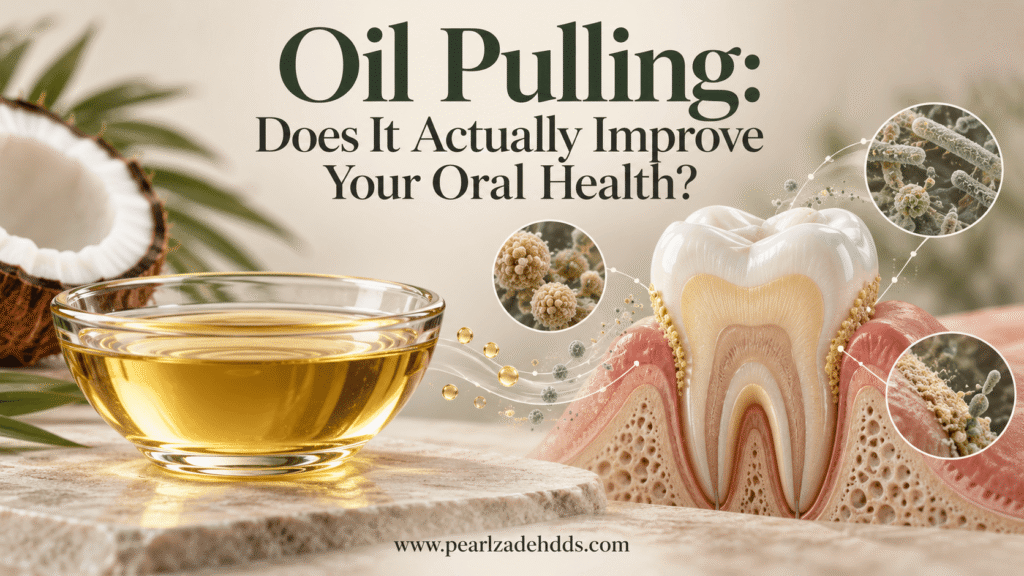
Oil pulling shows up constantly online, promoted for cleaner teeth, fresher breath, whiter smiles, healthier gums, fewer cavities, and pulling toxins out of the mouth. Some of that has been studied. Some of it has not. A few claims run ahead of what the research actually supports.
Several clinical trials have looked at oil pulling in recent years, including a comprehensive 2024 review comparing it against mouthwash and chlorhexidine. The evidence shows some plausible effects on specific measures, alongside real limitations that matter for anyone deciding whether to try it.
What Is Oil Pulling?
Oil pulling involves swishing oil around the mouth for an extended period, then spitting it out. It traces back to Ayurvedic tradition, where it is referred to as Kavala or Gandusha.
Traditional instructions commonly call for about a tablespoon of oil, swished for anywhere from several minutes up to 15 to 20 minutes, on an empty stomach before brushing. Sesame oil and coconut oil are the two most studied options, though sunflower and other oils appear in some research and traditional use. The oil is spit into a trash can rather than a sink, since oil can clog pipes over time, and it should not be swallowed.
These are traditional and commonly cited instructions, not a medically established protocol. No dental or medical organization has issued an official recommended duration or frequency.
Why Do People Try Oil Pulling?
Reasons vary. Some people are drawn to natural oral-care practices generally, or specifically want to avoid alcohol-based mouthwashes. Some are chasing fresher breath or a brighter-looking smile. Many encounter it through social media, where it is often presented with far more confidence than the underlying research supports. Some believe it removes toxins from the body, a claim rooted in traditional belief rather than demonstrated biological mechanism.
Why someone tries oil pulling and what the evidence actually shows are two different questions. The rest of this article focuses on the second one.
Does Oil Pulling Actually Remove Plaque?
Plaque is the sticky bacterial film that builds up on teeth throughout the day. Left in place, it can lead to gum inflammation and, over time, cavities. Physically disrupting it matters, which is the whole rationale behind brushing.
Several trials have measured plaque index before and after oil pulling. A 2024 systematic review and meta-analysis in the International Journal of Dental Hygiene pooled this evidence and found that chlorhexidine mouthwash remained more effective than oil pulling at reducing plaque scores. The review rated the overall certainty of the evidence as very low.
Two separate randomized trials from the Medical University of Innsbruck, run by the same research group with a similar design, add real nuance here rather than a clean answer. A 2024 trial using pure sesame oil against distilled water, in 40 adults over eight weeks, found sesame oil pulling significantly outperformed water on the same plaque index (a median reduction of 18.98% versus 10.49%). A second, later trial from the same team tested a different product, a commercial “sesame-based tooth oil” blended with mint, turmeric, lemon, eucalyptus, clove, myrrh, Manuka, and sage oils, against distilled water, in a separate group of 40 adults. That trial found both groups improved significantly with no difference between them.
The two trials are not simply contradictory noise. They tested different products, one plain sesame oil and the other a multi-ingredient blend, which may partly explain the different results. The honest picture from this specific research group’s own work is mixed, not settled, and which product was tested matters as much as whether oil pulling was done at all.
Can Oil Pulling Help With Gingivitis?
Gingivitis is inflammation of the gums, usually driven by plaque that has been left in place long enough to irritate gum tissue. It shows up as redness, puffiness, and bleeding when you brush or floss.
The 2024 systematic review and meta-analysis found that, compared with non-chlorhexidine mouthwashes, oil pulling produced a clinically and statistically significant improvement in modified gingival index scores. The authors described this as a probable benefit for gingival health. That finding came with the same caveat as the plaque results: very low certainty in the underlying evidence, and the studies it drew from varied in oil type, duration, and design.
Both Innsbruck trials above agree on this specific measure: neither found a significant difference between oil pulling and plain water on gingival index, even though they disagreed on plaque. That is accurate to describe as a probable improvement compared with certain mouthwashes in some research, and not accurate to describe as oil pulling treating or curing gingivitis, which is a clinical diagnosis a dentist manages, typically alongside professional cleaning.
Does Oil Pulling Prevent Cavities?
There is currently insufficient evidence to say oil pulling prevents cavities. This is worth stating plainly, because it is one of the most commonly repeated claims about the practice and one of the least studied.
Multiple reviews of the oil pulling literature, including the 2024 meta-analysis above, note that none of the included trials directly measured dental caries as an outcome. Studies have measured plaque, gingival index, and bacterial counts, which are related to cavity risk but are not the same as counting actual new cavities over time.
Cavity prevention depends on more than any single practice. Fluoride exposure, consistent mechanical plaque removal, how often and how long teeth are exposed to sugar, saliva flow, your individual cavity history, and your overall hygiene routine all factor in. A reduction in a bacterial count on a lab report does not, by itself, establish that fewer cavities will follow.
Can Oil Pulling Whiten Teeth?
Some people report their teeth look brighter after oil pulling, and that is plausible without meaning much clinically. Swishing oil, like swishing anything, may help dislodge some surface debris and loose staining. That is different from changing the intrinsic color of a tooth, which is what professional teeth whitening does through a bleaching agent that penetrates the tooth structure.
Oil pulling does not chemically bleach teeth, and no clinical trial has established a meaningful whitening effect from it. Anecdotal reports of a brighter smile after a few sessions are exactly that: anecdotal, and easily explained by removing surface debris rather than by any lightening of the tooth itself.
Does Oil Pulling Kill Harmful Bacteria?
This claim is more complicated than the marketing around it suggests. Your mouth hosts hundreds of species of bacteria, most of them harmless or even helpful. “Killing bacteria” broadly is not the same thing as creating a healthier oral environment, and indiscriminately reducing bacterial counts is not automatically a good outcome.
Some studies have measured reductions in specific bacteria after oil pulling, including Streptococcus mutans, a species associated with cavity formation. Findings across studies are inconsistent, with some trials reporting significant reductions and others, including the 2023 Innsbruck trial, finding no significant microbiological change at all.
It is not accurate to say oil pulling kills all harmful oral bacteria, detoxes the mouth, or eliminates the organisms responsible for dental disease. The available evidence points to modest, inconsistent effects on specific bacterial counts in some studies, not a broad antimicrobial sweep.
Can Oil Pulling Replace Brushing and Flossing?
No. Nothing in the current research suggests oil pulling should substitute for mechanical plaque removal.
Toothbrushing with fluoride toothpaste, cleaning between your teeth daily, and regular professional dental care remain the established foundation of oral hygiene, with a far larger and more consistent body of evidence behind them than oil pulling currently has. The 2024 review noted that oil pulling appears to have limited ability to reach bacteria below the gumline, an area that a toothbrush, floss, or a dental hygienist’s instruments reach more effectively. If you enjoy oil pulling and want to continue it, doing so alongside your regular routine, not instead of it, is what the evidence actually supports.
Is Oil Pulling Safe?
For most healthy adults using it as an occasional addition to their routine, oil pulling carries modest, manageable risks rather than significant danger.
Swallowing a large amount of oil can cause an upset stomach or a laxative effect in some people, so spitting it out rather than swallowing matters. Disposing of the oil in the trash rather than the sink prevents drain buildup over time. Prolonged, vigorous swishing could plausibly aggravate jaw discomfort in someone who already has jaw pain or a temporomandibular joint issue, similar to how extended gum chewing might.
There is also a genuine, if rare, documented risk worth naming honestly: case reports in the medical literature describe lipoid pneumonia, a lung condition caused by inhaling oil, occurring in people who practiced oil pulling repeatedly. These cases are uncommon and generally involved either an underlying difficulty with swallowing or repeated, extended practice over time, not a single occasional session in a healthy adult. The practical takeaway is straightforward: keep the oil in your mouth, do not inhale or aspirate it, and stop if you have any condition affecting your ability to safely swish and spit.
None of this makes oil pulling inherently dangerous for everyone. It does mean treating it with the same ordinary care you would give any oral-care habit, rather than assuming natural automatically means risk-free.
Does Coconut Oil Work Better Than Other Oils?
Coconut oil is the most popular choice online, partly due to its antimicrobial reputation and partly due to taste and marketing. Popularity is not the same as demonstrated superiority. A 2020 systematic review focused specifically on coconut oil pulling identified four eligible randomized trials with 182 total participants, lasting 7 to 14 days. It found significant reductions in salivary bacterial colony counts and plaque index scores, while explicitly concluding that the data were insufficient for conclusive findings, given mixed study quality and a high risk of bias across the included trials.
A separate randomized crossover trial compared sesame oil directly against coconut oil in the same 24 participants, measuring plaque regrowth after professional cleaning. Direct oil-to-oil comparisons like this remain limited in number. Existing research does not support ranking coconut oil above sesame oil, or any other studied oil, as clinically superior. Choosing one oil over another based on current evidence comes down more to preference and availability than to a proven difference in effectiveness.
What Does the Research Actually Show?
Sorting the evidence into what is plausible and what remains unestablished gives a clearer picture than treating oil pulling as either a proven remedy or a complete waste of time.
Findings with some supporting evidence: measurable short-term reductions in plaque index in several trials, though not clearly more effective than a control condition in at least one rigorous recent trial; a probable improvement in gingival index scores compared with non-chlorhexidine mouthwashes, per meta-analysis, though rated very low certainty; and inconsistent reductions in specific oral bacteria across individual studies.
Not established by current evidence: reliable prevention of cavities, since no trial has directly measured caries outcomes; genuine tooth whitening through any bleaching mechanism; oil pulling as a replacement for brushing and flossing; broad detoxification effects anywhere in the body; and prevention of serious oral disease beyond the specific, modest measures studied.
Across nearly all of this research, the same limitations recur: small sample sizes, short study durations often measured in days or weeks rather than months or years, inconsistent oil types and swishing durations between studies, and, as the 2024 meta-analysis explicitly concluded, very low overall certainty in the evidence. Future trials with longer follow-up and more standardized protocols would meaningfully improve what can be said here.
Focus on What Your Teeth Actually Need
Oil pulling may be a reasonable optional addition for someone who enjoys the practice, alongside, not instead of, brushing with fluoride toothpaste, cleaning between teeth, and regular dental visits. Current evidence does not support treating it as a substitute for established preventive care. Early signs of gum disease are worth knowing regardless of which home-care habits you use, since catching them early is what actually protects your teeth and gums.
What your mouth needs depends on your own risk factors, habits, and history, not on a single trending practice. Dr. Pearl Zadeh can assess your oral health and help you build a routine grounded in what the evidence actually supports.
Call (818) 716-6722 or click the button below to schedule your consultation online.
Frequently Asked Questions
For some specific, narrow measures like short-term plaque and gingival index scores, some studies suggest a modest effect. For broader claims like cavity prevention or detoxing the body, evidence is lacking.
No trial has directly measured whether oil pulling reduces cavities. Current evidence does not support this specific claim, even though related measures like plaque have shown some change.
Not through bleaching. It may help remove some surface debris, which can look like brightening, but it does not chemically change the intrinsic color of teeth the way professional whitening does.
Some research found a probable improvement in gingival index scores compared with certain mouthwashes, rated very low certainty. It should not be treated as a cure or substitute for dental evaluation.
No. Brushing with fluoride toothpaste and cleaning between teeth have far stronger, more established evidence, and oil pulling appears limited in reaching bacteria below the gumline.
It is commonly used and studied, but evidence does not show it working better than sesame or other studied oils. Choice largely comes down to preference.
This article is for informational purposes only and is not a substitute for professional dental advice. Please schedule a consultation with Pearl Zadeh DDS to discuss your specific situation.