
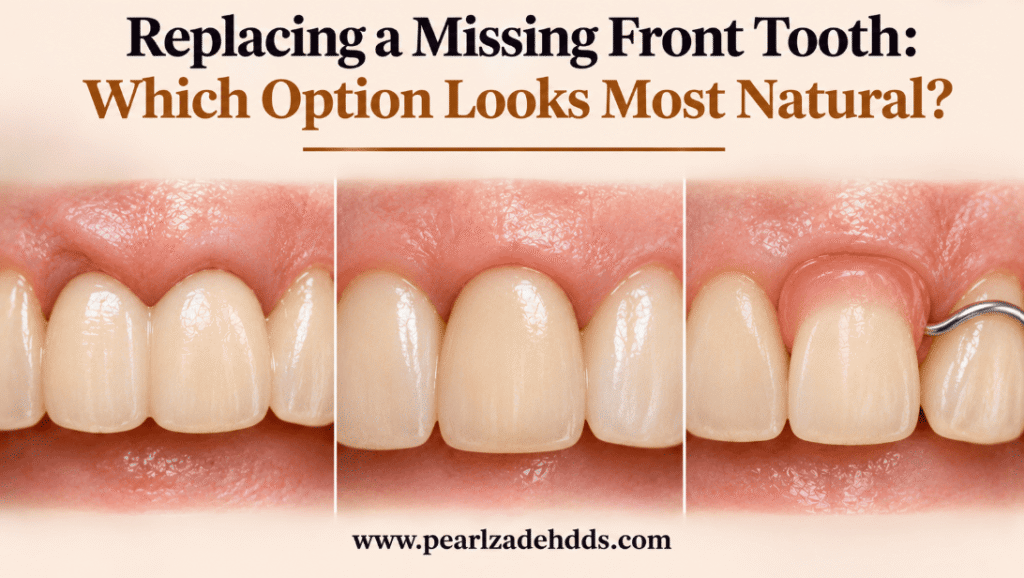
Replacing a missing front tooth involves more than filling the gap. The replacement should look natural when a person smiles, speaks, or has their photo taken.
Three options are commonly considered: a dental bridge, a dental implant with a crown, and a partial denture. Each has a different design and can produce a different appearance. The surrounding teeth, gums, and overall oral health also influence the result.
What Makes a Replacement Front Tooth Look Natural?
Several details affect how closely a replacement tooth resembles the natural teeth around it:
- Color: The shade should blend with nearby teeth. Careful selection helps avoid a replacement that looks noticeably lighter or darker.
- Shape and size: The tooth should suit the proportions of the neighboring front teeth and the overall smile.
- Translucency: Natural enamel allows some light to pass through. A replacement with different light-reflecting properties may look less lifelike.
- Gumline: The way the replacement meets the surrounding gum tissue affects its appearance.
- Alignment and symmetry: Its position should look balanced alongside the neighboring teeth.
- Surface texture: Natural teeth have subtle variations in texture and shade rather than a perfectly uniform finish.
These details are especially noticeable with front teeth because they are visible during everyday activities such as smiling and speaking.
Dental Bridge for a Missing Front Tooth
A dental bridge replaces a missing tooth using neighboring teeth for support. Porcelain can be used to create a replacement tooth that resembles the natural teeth beside it. Cleveland Clinic explains that dentists can make custom bridges that match the shade of natural teeth.
The dentist and dental laboratory consider the surrounding teeth when selecting the bridge’s shade, shape, and proportions. The supporting teeth and gumline also influence how the finished restoration looks.
A fixed bridge stays in place and is not removed by the patient for daily cleaning.
A traditional bridge usually requires preparing the neighboring teeth. Cleveland Clinic explains that the dentist removes some enamel during this process. This change is irreversible. Other bridge designs may be suitable in selected cases, depending on the teeth and available support.
Dr. Pearl Zadeh DDS offers porcelain bridges and focuses on metal-free ceramic restorations. Read more about dental bridges for front teeth.
Dental Implant and Crown for a Missing Front Tooth
A dental implant is a small post placed in the jawbone to support a replacement tooth. Once the implant is ready for restoration, a connector called an abutment supports the crown. The American Academy of Periodontology explains how a single-tooth implant and crown are connected in its guide to single-tooth dental implants.
Several factors affect the crown’s appearance:
- The crown can be made to resemble the neighboring natural teeth.
- Its shade, shape, size, and translucency influence how well it blends with the smile.
- The gum tissue around the implant-supported crown affects the appearance of the gumline.
- Implant position and the condition of the surrounding bone and gums can influence the final result.
Replacing a front tooth with an implant requires careful planning. Gum recession, changes in the supporting bone, and the condition of nearby tissues can all affect the appearance of the finished restoration.
An implant crown does not automatically look more natural than a bridge. The result depends on the individual case and the condition of the surrounding teeth and tissues. Dr. Pearl does not place dental implants, so patients considering this option should consult a qualified implant provider.
Partial Denture for a Missing Front Tooth
A removable partial denture can replace one or more missing teeth, including a front tooth. The American Dental Association explains that replacement teeth are usually attached to pink or gum-colored plastic bases.
The design can affect how visible the denture is. Some partial dentures have a metal framework and clasps that attach to nearby teeth. The ADA also describes partial denture designs with different types of connectors, which may have a less noticeable appearance.
Not every partial denture has visible metal clasps. Its fit, position, and design all influence how it looks when smiling or speaking.
The shape of the gums and surrounding tissues can change over time, which may affect how the denture fits. The ADA recommends having a dentist adjust a denture that no longer fits properly.
Unlike a fixed bridge or implant-supported crown, a partial denture is removed for cleaning. It may also feel different from a fixed restoration. Dr. Pearl Zadeh DDS offers partial dentures.
Which Front Tooth Replacement Option Looks the Most Natural?
All three options can provide a natural-looking replacement, but the result depends on the individual case.
- Porcelain bridge: A fixed replacement that can be matched to the shade and shape of neighboring teeth. Its appearance also depends on the supporting teeth and gumline.
- Implant-supported crown: A fixed replacement that can resemble a natural tooth. Implant position, crown design, and the surrounding bone and gums affect the result.
- Partial denture: A removable option that replaces a missing front tooth. Its base, connectors, fit, and position can influence how noticeable it looks.
The most suitable option depends on the condition of the remaining teeth, available bone and gum support, oral health, and the patient’s preferences. A dental examination helps determine which choices are appropriate.
| Replacement option | Appearance considerations | Important factors |
| Dental bridge | Can be matched to neighboring teeth | Condition of supporting teeth and gumline |
| Implant-supported crown | Can resemble a natural individual tooth | Implant position, bone, gum tissue, and crown design |
| Partial denture | Artificial tooth can be matched to surrounding teeth | Fit, denture design, and visible components |
Fixed and removable restorations differ in more than appearance. This comparison of dental bridges and dentures explains how their designs, care, and use differ.
What Can Affect the Appearance of a Replacement Front Tooth?
Several factors influence how natural a replacement tooth looks, regardless of the option chosen:
- The shade and appearance of neighboring teeth.
- Gum recession or uneven gum levels.
- Changes in the bone and gum tissue after tooth loss.
- The position and condition of nearby teeth.
- The material, shape, and design of the restoration.
- The accuracy of the dentist’s assessment and treatment planning.
A replacement tooth may not reproduce every detail of a natural tooth. The aim is to create an appearance that suits the patient’s smile while allowing the restoration to function properly.
How Do You Choose the Right Option for Your Smile?
Appearance is one consideration, but the condition of the mouth also determines which replacement options may work.
The dentist considers:
- The health of the neighboring teeth.
- Whether those teeth can support a bridge.
- The condition of the gums and jawbone.
- Whether the patient prefers a fixed or removable restoration.
- Daily cleaning and long-term maintenance needs.
- The patient’s overall dental needs and preferences.
A dental examination helps determine which options are suitable. An implant, bridge, or partial denture should not be chosen based on appearance alone.
Schedule a Consultation With Dr. Pearl
If you have a missing front tooth, Dr. Pearl Zadeh DDS can examine the surrounding teeth and gums to assess whether a porcelain bridge or partial denture may be suitable.
Her practice in Woodland Hills, California, offers both options for patients who need tooth replacement.
Call (818) 716-6722 or click the button below to schedule your consultation online.
Frequently Asked Questions
It depends on the patient. A bridge, an implant-supported crown, and a partial denture can each look natural in the right situation. Oral health, tissues, and planning shape the result.
Often it can look very close. The porcelain tooth can be matched in shade, shape, and surface detail. A perfect match cannot be guaranteed.
Not always. An implant crown can look natural when the implant position and tissues support it. A well-planned bridge can also look natural.
Yes. A removable partial denture can replace one or more missing teeth. Its appearance depends on the design, the fit, and any visible components.
Shade, shape, translucency, gumline, and neighboring teeth all matter. So do the restoration’s design and the dentist’s planning.
The information above is for informational purposes only and is not a substitute for professional dental advice. Please schedule a consultation with Pearl Zadeh DDS to discuss your specific situation.