
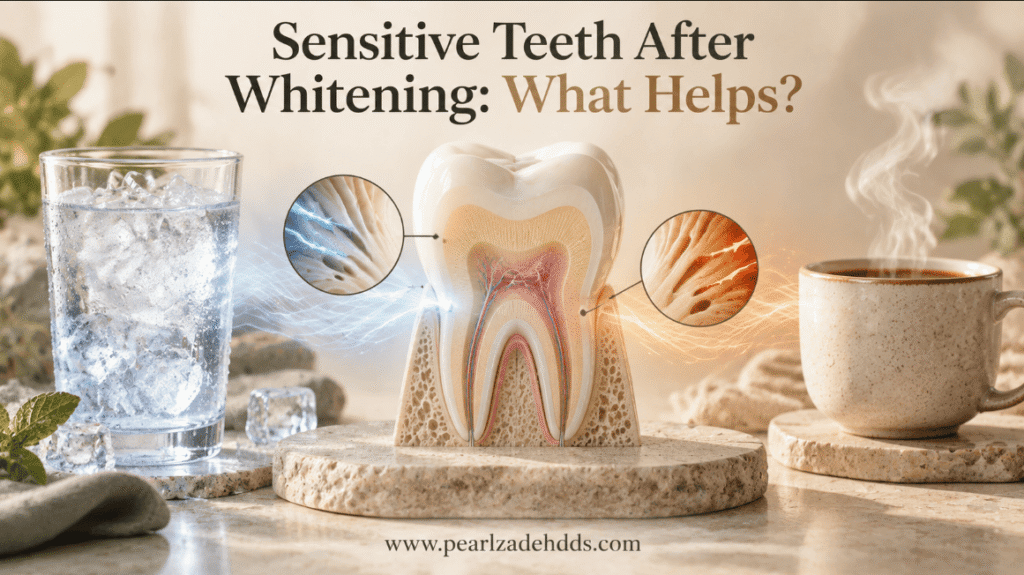
Whitening can leave your teeth feeling more sensitive than usual, especially when you eat or drink something hot or cold. The sensation can be sharp and uncomfortable, but it does not necessarily mean the whitening harmed your teeth.
For most people, whitening-related sensitivity is temporary. What matters is how severe it is, how long it lasts, and whether anything else could be causing the discomfort. A few simple changes may make your teeth more comfortable while the sensitivity settles.
Why Are My Teeth Sensitive After Whitening?
Whitening agents work by releasing peroxide, which needs to pass through the enamel and dentin to break apart the compounds causing discoloration. That same peroxide can also reach the pulp, the soft tissue at the center of the tooth where the nerves live, and cause mild, temporary inflammation there. Inflamed nerves tend to react more strongly to everyday triggers like cold air or a cold drink. This is a somewhat different pathway than ordinary sensitive teeth, which the American Dental Association explains usually comes from worn enamel or gum recession exposing the tubules that lead to the nerve. That difference is part of why whitening sensitivity can come on quickly and affect several teeth at once, rather than building up gradually in one spot.
Several factors influence how noticeable this becomes, including sensitivity you already had before whitening, exposed dentin or tooth roots, enamel wear, gum recession, a stronger whitening concentration, longer or more frequent exposure, and simple differences in how one person’s teeth respond compared to another’s. Having sensitive teeth after whitening does not mean your enamel was damaged. It usually reflects a temporary pulpal response to the whitening process itself.
What Does Whitening Sensitivity Feel Like?
Most people describe it as a short, sharp zing rather than a dull, lingering ache. Common triggers include cold drinks, cool air, and sometimes hot foods or beverages. Some notice discomfort that comes and goes throughout the day, while others feel a more generalized sensitivity across several teeth rather than one specific spot.
The pattern matters. Brief sensitivity that shows up with a specific trigger and fades once the trigger is gone fits the typical profile of whitening-related sensitivity. A single symptom is not enough to determine the cause, so it helps to watch how it behaves over the following days rather than trying to diagnose it from one uncomfortable moment.
What Helps Sensitive Teeth After Whitening?
A few practical steps tend to make the biggest difference while your teeth settle down.
Give hot and cold foods a break for a few days if they trigger discomfort. Switch to a toothpaste formulated for sensitive teeth, since potassium nitrate and similar ingredients have shown modest evidence of reducing sensitivity intensity in some patients, even though the research on how often they prevent sensitivity outright is mixed. Keep brushing gently rather than skipping oral hygiene altogether. Hold off on any additional whitening while you are still uncomfortable. Follow the product’s directions closely rather than extending wear time or reapplying more often to speed results. And give your teeth time. For many people, sensitivity peaks in the first day or two and eases from there.
No single remedy works the same way for everyone. If desensitizing toothpaste does not bring meaningful relief within a few days, that is a good reason to check in with your dentist rather than try increasingly aggressive home remedies.
Should You Stop Whitening If Your Teeth Hurt?
There is a difference between finishing a whitening plan your dentist already reviewed and reaching for more whitening because you have not hit the shade you wanted yet. If sensitivity develops, adding more sessions or leaving the product on longer to compensate tends to make things worse, not better. Whether to pause completely or simply finish a planned, limited course depends on how severe the sensitivity is, which method you are using, and the condition of your teeth going in. Mild discomfort that fits the typical pattern often does not require stopping a short, already-planned regimen. Anything more than mild calls for stopping and reassessing.
How Long Does Tooth Sensitivity Last After Whitening?
For most people, sensitivity is temporary. A recent review of research on bleaching-related sensitivity found that it is common but usually transient, and that discomfort tends to peak within the first one to three days after treatment before fading. There is no single timeline that applies to everyone, so it is not accurate to promise resolution within a specific number of hours.
How long it lasts depends on the whitening method used, how much peroxide exposure your teeth had, whether you already dealt with sensitivity before whitening, and the general condition of your enamel and dentin. Sensitivity that peaks early and eases over a few days is different from sensitivity that lingers well beyond that window or keeps getting worse, and the second pattern deserves more attention.
Does Sensitivity Mean Whitening Damaged Your Teeth?
Not necessarily. Temporary sensitivity is a known, common side effect of the whitening process itself, not proof that your enamel was harmed. It generally reflects a short-term response inside the tooth rather than a lasting structural change. At the same time, it would be inaccurate to say whitening can never affect teeth or that professional whitening removes all risk. If you want a fuller picture of what the current evidence says about whether whitening can damage enamel, that is covered in more detail separately. The short version here is that sensitivity alone is not evidence of damage, and it is not something to try to self-diagnose from symptoms.
What Should You Avoid While Your Teeth Are Sensitive?
You do not need a strict diet, just a bit of common sense while things settle. Very cold drinks, very hot foods, and anything highly acidic can make discomfort more noticeable. Additional whitening during this window tends to compound the problem, and so can aggressive brushing or using a whitening product more often than directed. Outside these specific triggers, there is no need to overhaul your diet. Most people find avoiding the one or two things that clearly set off discomfort is enough.
Can You Brush Your Teeth When They Are Sensitive After Whitening?
Yes, and you should. Sensitivity is not a reason to skip brushing or flossing. Use a soft-bristled toothbrush, apply gentle pressure rather than scrubbing, and consider a toothpaste made for sensitive teeth if cold or hot triggers are bothering you. Keeping up with your normal oral hygiene routine matters just as much while your teeth are sensitive as it does the rest of the time, since skipping it can create other problems on top of the temporary discomfort.
When Is Sensitivity After Whitening Not Normal?
Most whitening-related sensitivity is mild, temperature-triggered, and short-lived. A few patterns fall outside that and are worth a dental evaluation: pain that feels severe, discomfort that persists or worsens over several days, pain concentrated in one specific tooth, pain that starts on its own without an obvious trigger like cold or heat, pain that lingers after the trigger is removed, any swelling, sensitivity that simply is not improving, or sensitivity that existed before whitening and has become noticeably more intense. These symptoms do not necessarily mean whitening caused a problem. They can point to something unrelated, such as decay, a crack, exposed roots, or gum issues, that whitening happened to make more noticeable. A dentist can examine the tooth and figure out what is actually going on rather than guessing from symptoms alone.
Why Is One Tooth More Sensitive Than the Others?
Sensitivity after whitening usually affects multiple teeth at once, so if one tooth stands out as noticeably worse than the rest, that is worth paying attention to. Possible explanations include gum recession affecting that area, more advanced dentin exposure there than elsewhere, thinner enamel, existing dental work, a crack or other structural issue, or an underlying problem unrelated to whitening. Sometimes it is simply natural variation between teeth. A single tooth becoming significantly more sensitive than its neighbors, especially if the sensation is new or does not fade like the rest, is a stronger signal for evaluation than generalized sensitivity across your whole smile.
Can You Whiten Again After Your Teeth Become Sensitive?
Not automatically, and not simply because the discomfort has faded. How soon it makes sense to whiten again depends on how strong the original reaction was, which method you used, the current condition of your teeth, and whether you had sensitivity even before the first treatment. There is no universal waiting period that applies to everyone, so resist the temptation to look for a fixed number of days online. Whitening again before the underlying sensitivity has genuinely settled tends to make the next round more uncomfortable, not less, which is part of why a brief check-in with your dentist before restarting is worth it.
How Can You Prevent Sensitivity During Future Whitening?
A history of sensitivity is useful information for planning your next session, not a reason to assume it will always happen. Tell your dentist about any sensitivity from a previous treatment, follow the product instructions exactly rather than extending exposure for faster results, and consider a more gradual approach if your teeth have reacted strongly before. It also helps to address any existing sensitivity or dental issues, such as cavities or exposed roots, before adding whitening on top of them. None of this guarantees a sensitivity-free experience, but going in with a plan tends to produce a more comfortable result than repeating the same approach that caused discomfort last time.
Does Professional Whitening Cause Less Sensitivity?
Professional whitening has one real advantage here: a dentist can look at your teeth and gums beforehand, check for existing sensitivity or issues like exposed roots, and adjust the concentration or approach accordingly. That planning can reduce the chances of an unpleasant surprise. It does not eliminate sensitivity as a possibility. Professionally supervised whitening can still cause it, particularly at higher concentrations. If you are weighing your options, how professional treatment compares in general is worth reading, but sensitivity risk is something to discuss directly with your dentist rather than assume away.
What If You Already Had Sensitive Teeth Before Whitening?
Pre-existing sensitivity is different from sensitivity that shows up for the first time after whitening, and it is worth mentioning to your dentist before you start. It does not mean you cannot whiten. It usually means the approach may need to be adjusted, whether that means a lower concentration, a more gradual schedule, desensitizing products used ahead of treatment, or addressing the underlying cause of your existing sensitivity first. If you already deal with sensitive teeth, the whitening options built around that starting point cover this in more depth.
Talk to Dr. Pearl Zadeh About Your Sensitivity
Temporary sensitivity after whitening is common, and for most people it settles on its own within a few days with a little care. But sensitivity that is severe, focused on one tooth, or simply is not improving deserves a closer look rather than being written off as a normal part of the process.
Dr. Pearl Zadeh and her Woodland Hills team can help you figure out why your teeth are reacting the way they are, whether that means confirming it is a typical post-whitening response or identifying something else that needs attention.
Call (818) 716-6722 or click the button below to schedule your consultation online.
Frequently Asked Questions
For most people, sensitivity peaks in the first one to three days after treatment and eases from there. There is no fixed timeline that applies to everyone, so sensitivity that lingers well beyond that or keeps worsening is worth having checked.
A toothpaste formulated for sensitive teeth, avoiding hot and cold triggers for a few days, gentle brushing, holding off on additional whitening, and giving your teeth time to recover all tend to help. No single remedy works identically for everyone.
Whitening peroxide can reach the pulp at the center of the tooth and cause temporary, mild inflammation there, which can make nerves react more strongly to cold, heat, or air. This is a known, usually short-lived response rather than a sign of damage.
Yes. Toothpaste made for sensitive teeth, often containing potassium nitrate, may help reduce discomfort for some patients and is a reasonable first step while sensitivity settles.
It depends on how severe the sensitivity is. Mild discomfort during an already-planned, limited course may not require stopping, but adding extra whitening sessions to compensate for sensitivity usually makes things worse. When in doubt, pause and check with your dentist.
Yes, and you should keep brushing. Use a soft-bristled brush, gentle pressure, and a sensitive-teeth toothpaste if needed. Skipping oral hygiene is not a recommended way to manage sensitivity.
This article is for informational purposes only and is not a substitute for professional dental advice. Please schedule a consultation with Pearl Zadeh DDS to discuss your specific situation.