
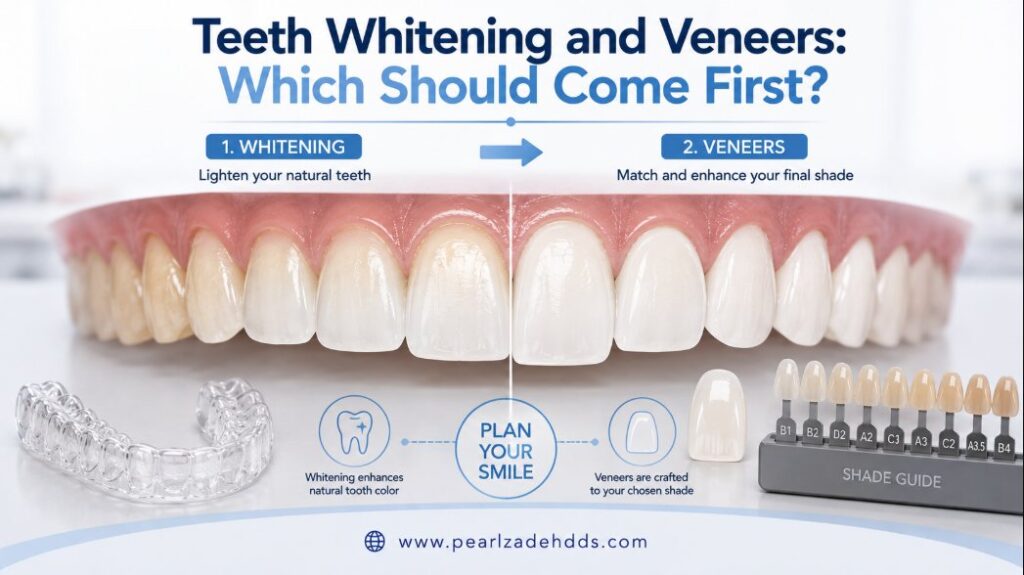
You want a brighter smile, and you’re planning veneers on a couple of front teeth too. It seems simple enough. Get the veneers now, whiten everything later, done. One smile, two upgrades, whatever order works for your schedule.
Not quite. Natural teeth can change shade with whitening. Porcelain veneers generally don’t respond to whitening the same way. That difference means treatment order can actually affect how consistently your teeth match once everything’s finished.
The Short Answer: Whitening Often Comes First
When whitening is part of your goal, it often makes sense before your final veneer shade gets selected, especially when only some of your visible teeth are getting veneers, you want the surrounding natural teeth to look noticeably lighter, or matching the veneers to your natural teeth matters to you. That said, whitening doesn’t automatically come first for every patient. Your dentist needs to look at your full treatment plan before deciding what sequence actually makes sense for you.
Why Does the Order Matter?
Whitening treatments work by lightening the natural structure of your tooth. Porcelain veneers are fabricated in a shade that’s selected and locked in during the lab process. Whitening treatment doesn’t lighten porcelain the way it lightens natural enamel. If you whiten your natural teeth after your veneers are already placed, you can end up with a visible color difference between the two.
Worth being upfront about here: the specific research on bleaching timing and veneer color is mostly laboratory work on extracted or animal teeth, not real patient outcomes measured over time. One study looking at porcelain veneers found that whether bleaching happened right before or right after preparing the same tooth didn’t significantly change how well the veneer masked underlying discoloration, though that study was testing a narrower question than the everyday scenario of whitening teeth that sit next to veneers placed earlier. Separate laboratory research on composite veneer material found that bleaching can interact with a veneer’s thickness and shade to change its final appearance in more complex ways than a simple before-or-after rule would suggest. None of this settles the practical question with certainty. It’s part of why sequencing gets decided case by case rather than from a fixed formula.
What Happens If You Whiten Before Getting Veneers?
Whitening first lets your dentist see your natural teeth at their lighter color before finalizing anything. Veneers can then be matched to the shade you’re actually aiming for, rather than a shade based on darker, unwhitened teeth. This tends to help with color consistency specifically when only selected teeth are getting veneers and the rest of your smile stays natural.
Your dentist likely won’t finalize your veneer shade the same day whitening ends. Tooth color can shift slightly as it settles, so allowing some time before making final restorative decisions is common. There’s no single universal waiting period that applies to every patient, and any specific number would be more confident than the evidence actually supports. Your dentist can give you a realistic timeframe based on your case.
What Happens If You Whiten After Getting Veneers?
Picture this: you get veneers on two front teeth, then decide to whiten the rest of your smile a year later. Your natural teeth lighten. Your veneers stay exactly where they started. The color difference between the two can become considerably more noticeable than it was before whitening.
A professional cleaning may help with external surface staining sitting on top of a veneer, but that’s different from actually changing the veneer’s underlying shade. Whitening treatment doesn’t work on porcelain the way it works on natural enamel. Don’t attempt to whiten veneers yourself with an over-the-counter product hoping for a similar effect. It isn’t designed for that material and isn’t going to change the veneer’s actual color.
Do You Always Need to Whiten Before Veneers?
No. Some patients already like their natural tooth color and have no interest in changing it. Others are getting veneers on a larger number of visible teeth, which shifts how much surrounding natural tooth color even matters for the final look. Existing restorations elsewhere in the smile can also influence the overall shade plan in ways that make a different sequence more sensible. Your dentist may simply recommend a different order based on what your case actually needs. Our rundown of common veneer myths touches on a few other assumptions patients make about veneer treatment that don’t always hold up. The treatment plan should be what guides the sequence, not a general rule applied automatically.
What If You’re Only Getting One or Two Veneers?
Shade matching becomes especially important when just a couple of teeth are getting veneers, since those restorations need to blend in with everything around them rather than standing on their own. If whitening is part of your goal, bringing it up before your veneers are fabricated gives your dentist a real chance to plan the shade accurately around your intended result. That said, no dentist can promise a perfect, invisible match in every lighting condition. The goal is a genuinely good blend, not an unrealistic guarantee.
What If You Already Have Veneers and Want Whiter Teeth?
Your natural teeth may still be reasonable candidates for whitening, depending on your oral health and overall treatment plan. Your existing veneers, though, will generally stay at their original shade regardless of what whitening does to the teeth around them. That can create a mismatch between the veneers and your newly whitened natural teeth.
Your dentist can evaluate what’s actually going on before recommending anything. The underlying concern might be surface staining, natural teeth that have genuinely darkened over time, existing veneers that simply look darker by comparison now, or an older restoration that no longer fits the rest of your smile the way it used to. None of these automatically means you need new veneers. It depends on what’s actually happening in your specific mouth.
Can Whitening Remove Stains From Veneers?
It helps to separate three different things: surface stains or buildup sitting on a veneer, changes happening in your surrounding natural teeth, and any change involving the veneer material itself. A professional cleaning can often address certain external stains sitting on the surface of a veneer. Whitening treatment itself doesn’t work on porcelain the way it works on natural enamel, since it’s designed to lighten tooth structure, not ceramic. A dentist should actually look at the veneer in question before recommending any specific approach.
How Does a Dentist Choose the Final Veneer Shade?
Choosing veneer color involves more than picking the brightest option on a shade guide. Your dentist may weigh:
- Your natural tooth color
- Your neighboring teeth
- Your cosmetic goals
- The thickness of the veneer itself
- Its translucency
- The color of the tooth underneath it
- Any existing restorations nearby
- How everything looks together as a full smile
Our guide to preparing for your veneers appointment goes further into how that planning process actually works.
Why Planning the Whole Smile Matters
Whitening and veneers tend to work best together when your dentist knows your complete cosmetic goal from the start, not just the next single procedure. A patient who initially wants two veneers might later decide they want a noticeably brighter overall smile. Planning both goals together from the outset helps avoid an unexpected color mismatch showing up later. Our breakdown of the steps involved in a cosmetic veneer case covers that broader planning process in more depth.
What About Existing Crowns, Fillings, or Bonding?
Whitening can raise similar color-matching questions with other restorations, not just veneers. Crowns, composite bonding, bridges, and existing veneers all generally don’t respond to whitening the way natural teeth do. That doesn’t mean every restoration needs replacing the moment you whiten your natural teeth. Your dentist can evaluate whether your existing restorations still genuinely blend with the rest of your smile before recommending anything.
Could Invisalign Come Before Whitening or Veneers?
These treatments address genuinely different things. Invisalign moves teeth into new positions. Whitening changes the color of your natural teeth. Veneers change the visible shape and color of selected teeth without moving them. For some patients, tooth movement makes sense to address before finalizing cosmetic restorations, particularly when tooth position affects the overall smile design. Our comparison of Invisalign and veneers goes further into which fits different smile goals. This doesn’t mean Invisalign is a required first step before anyone can get veneers. It depends entirely on what your specific smile actually needs.
What If You Want Whitening and Veneers as Part of the Same Smile Plan?
Both treatments can genuinely be coordinated as one cosmetic plan rather than two separate decisions made at different times. Your dentist may consider:
- Which teeth will receive veneers
- How many are planned
- Your current natural tooth shade
- Your desired smile color
- Any existing restorations
- Tooth position
- Your oral health
- Your bite
Our overview of cosmetic dentistry in Woodland Hills covers this broader planning approach if you’re weighing multiple cosmetic goals at once. Sequencing works best when it’s actually planned, rather than decided one procedure at a time as ideas come up.
What Should You Ask Before Starting?
A few genuinely useful questions for a consultation: Should I whiten before getting veneers in my specific case? Which teeth will actually receive veneers? Will my natural teeth match afterward? When should the final veneer shade get selected? What happens if I want whiter teeth later on? Will my existing crowns or bonding still match once I whiten? Can my treatment be planned around my final smile goal from the start? And do I need orthodontic treatment before cosmetic work makes sense?
When Whitening May Not Be the First Step
Cosmetic whitening usually isn’t the first priority if you’re dealing with untreated decay, gum disease, significant tooth damage, a cracked tooth, a restoration that needs attention, or bite concerns that haven’t been evaluated yet. Oral health generally comes before cosmetic treatment, not after it. None of this is something to self-diagnose. A consultation is what actually determines whether cosmetic treatment makes sense right now or whether something else needs attention first.
The Main Takeaway
If whitening is part of your smile goal, discussing it before your final veneer shade gets selected often makes sense. Natural teeth can respond to whitening. Porcelain veneers keep whatever shade they were fabricated in. Planning both treatments together generally leads to a more consistent result than tackling them separately without a shared plan. None of this makes whitening-before-veneers a universal requirement, though. The right sequence depends on your own teeth, your goals, and the treatment plan your dentist builds around them.
Speak With Dr. Pearl Zadeh About Whitening and Veneers
Whitening and veneers can absolutely work together, but treatment order can matter when color matching is part of your goal. Dr. Pearl Zadeh, an accredited member of the American Academy of Cosmetic Dentistry, can evaluate your natural teeth, any existing restorations, your oral health, and your cosmetic goals before recommending the sequence that actually fits your situation.
Call (818) 716-6722 or click the button below to schedule a cosmetic dentistry consultation.
Frequently Asked Questions
Should I whiten my teeth before getting veneers?
Often, yes, especially if only some teeth are getting veneers and you want them to match your natural teeth. It isn’t a universal rule, though, and depends on your specific plan.
Can porcelain veneers be whitened after they’re placed?
No. Whitening treatment doesn’t change the shade of porcelain the way it changes natural enamel. A professional cleaning can address some surface staining, but not the veneer’s underlying color.
What happens if I whiten my teeth after already having veneers?
Your natural teeth may lighten while your existing veneers stay at their original shade, which can create a noticeable color difference between the two.
Do I need to whiten before every veneer treatment?
No. Some patients already like their natural tooth color, or are getting veneers on enough visible teeth that surrounding tooth shade matters less. Your dentist’s recommendation depends on your specific case.
How long should I wait after whitening before getting veneers?
There’s no universal waiting period. Many dentists allow some time for tooth color to stabilize before finalizing a shade, though the specific timeframe depends on your case.
This article is for informational purposes only and is not a substitute for professional dental advice. Please schedule a consultation with Pearl Zadeh DDS to discuss your specific situation.