
You open your mouth wide in the mirror one morning and hear it. A small click, right near the joint in front of your ear. It happens again while you’re chewing lunch, and once more during a big yawn. You start wondering if something is grinding or wearing down every time that sound shows up.
A clicking or popping jaw doesn’t automatically mean you have a serious problem with your temporomandibular joint, the joint connecting your lower jaw to your skull. Plenty of people have joint sounds with no pain and no trouble opening or closing normally. The picture changes when clicking shows up alongside pain, locking, limited movement, swelling, or a bite that suddenly feels different.
What Is the TMJ?
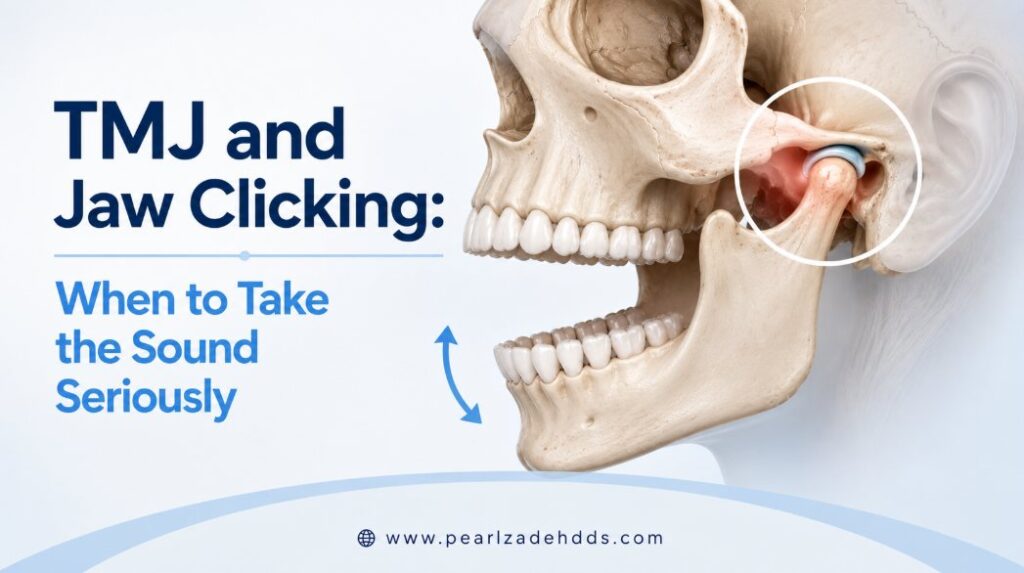
You have one of these joints on each side of your face, right where your lower jaw meets your skull, just in front of your ears. They let your jaw open, close, slide forward, and move side to side. That’s really all you need to know to follow the rest of this. The click you’re hearing is coming from right there.
Why Does Your Jaw Click?
Inside each joint sits a small disc, a piece of cartilage that helps your jaw glide smoothly as it opens and closes. When that disc shifts slightly out of its usual position and then slips back as your mouth opens, it can produce a click. The Merck Manual describes this pattern, called disc displacement with reduction, as typically involving clicking, some jaw deviation during opening, and pain with jaw use like chewing, at least in patients who come in specifically because something feels wrong. That’s a different population from everyday people walking around with a click and nothing else bothering them, which is worth keeping in mind. That’s one possible explanation for a click, not the only one. Muscle tension, joint structure, and other factors can all play a role too, which is exactly why the sound by itself doesn’t tell your dentist much. A click doesn’t automatically mean a disc has slipped out of place. Figuring out what’s actually happening takes looking at your symptoms, your jaw movement, and your history together, not just listening to one sound.
Is Jaw Clicking Normal?
For a lot of people, yes, at least in the sense that it doesn’t require treatment. A peer-reviewed review of disc displacement notes that this same clicking pattern shows up in roughly a third of people with no symptoms at all, meaning plenty of joints click without anything being functionally wrong. That said, it wouldn’t be accurate to say clicking is always harmless in every situation.
An occasional click with zero pain is a different situation from clicking that happens constantly, clicking paired with soreness, clicking alongside limited opening, or a jaw that catches or locks after the click. A new sound that showed up right after an injury is its own category too. The sound itself matters less than everything happening around it.
Why Does My Jaw Click but Not Hurt?
Some people simply have joint sounds without any pain or functional trouble to go along with them. That’s a real, fairly common experience, not a red flag on its own. It’s not something to ignore forever, either. If your jaw opens and closes the way it always has and nothing else feels off, it may not need immediate attention. If the click is new, getting louder or more frequent, or shows up alongside anything else changing, having it looked at is a reasonable move.
When Does Jaw Clicking Become a Concern?
A handful of accompanying symptoms shift clicking from background noise to something worth checking. Jaw pain, facial pain, or discomfort near the ear can occur alongside jaw problems, though ear symptoms have plenty of other possible causes too. Pain while chewing, difficulty opening your mouth fully, your jaw catching or locking, a bite that suddenly feels different, or swelling around the joint all may warrant a closer look. Frequent headaches paired with jaw discomfort are worth mentioning as well, though not every headache traces back to your jaw. Symptoms that are increasing in frequency or intensity, or anything that started after an injury, are also reasonable reasons to get evaluated rather than wait it out.
What Does It Mean If Your Jaw Locks?
A click is a sound. Locking is something else entirely, a real difficulty moving your jaw the way you normally would. A jaw that gets stuck open, gets stuck closed, or repeatedly catches partway through opening deserves professional attention rather than being brushed off. If your jaw suddenly locks and you genuinely can’t move it, don’t try forcing it back into place yourself. Get evaluated promptly instead.
Clicking, Popping, and Grinding: What’s the Difference?
Clicking tends to describe a single, sharper sound during opening or closing. Popping often refers to something louder or more pronounced. Grinding usually describes a rougher sound or sensation, sometimes tied to tooth wear or muscle activity rather than the joint itself. These descriptions are useful for explaining what you’re noticing, but they aren’t diagnostic tests. You can’t determine what’s actually happening in your joint just from how the sound is described. That still takes an actual evaluation.
Can Your Bite Affect Jaw Symptoms?
This deserves a careful answer. How your upper and lower teeth meet can be relevant when a dentist evaluates jaw function, but that’s different from saying a specific bite automatically causes TMJ problems. The National Institute of Dental and Craniofacial Research notes that current research doesn’t support the older idea that a bad bite directly causes these disorders. A dentist evaluating jaw clicking typically looks at your bite alongside jaw movement, muscle tenderness, joint tenderness, range of motion, tooth wear, any history of clenching or grinding, and past injury, since bite is one piece among several rather than a single simple explanation. Our discussion of signs your bite may be causing dental problems goes further into that evaluation if you want more detail.
Can Clenching Make Jaw Clicking Worse?
Clenching and grinding place extra load on your jaw muscles and joints, which can make existing symptoms more noticeable. Stress plays a role for some people too, either by increasing clenching itself or just making you more aware of jaw tension you’d otherwise ignore. None of this means stress is the sole cause behind every case of jaw clicking. Cutting back on unnecessary clenching can genuinely help some patients, but persistent symptoms still deserve an evaluation rather than assuming stress management alone will resolve them. Dental anxiety is one specific source of that tension for some patients, worth mentioning if visiting the dentist itself adds to your stress load.
Can Jaw Clicking Go Away on Its Own?
Some jaw sounds stay stable for years without ever turning into a painful problem. Others change over time, sometimes for the better, sometimes not. There’s no single timeline that applies to everyone here. Someone with painless clicking isn’t necessarily on the same path as someone whose clicking comes with locking or pain that’s getting worse. It wouldn’t be honest to promise every click eventually disappears, because that’s simply not true for everyone.
Should You Stop Chewing or Avoid Opening Your Mouth?
Hearing a click for the first time makes some patients suddenly cautious about yawning, chewing normally, or opening wide at all. Normal jaw movement is generally just part of everyday function and doesn’t need to be avoided out of caution alone. That said, if a specific movement consistently brings on pain, or your jaw keeps catching or locking during it, that’s worth having evaluated rather than repeatedly testing the same motion to see if it happens again. Skip any aggressive jaw stretching or exercise routines you find online without a professional actually guiding you through them first.
What Can a Dentist Check?
An evaluation typically covers where the sound is coming from, whether the joint itself is tender, how far your jaw opens, whether it shifts to one side during opening, how your teeth meet, whether the muscles around your jaw are tender, any signs of clenching or grinding, and whether anything changed recently or followed an injury. Imaging like an X-ray or MRI sometimes comes up depending on what the exam finds, but it isn’t something every patient needs. Most of what a dentist learns comes from the exam itself, not from a scan.
Does Jaw Clicking Always Need Treatment?
No. Whether treatment makes sense depends on your symptoms, how your jaw is functioning, what the exam finds, and what’s actually driving the sound. A painless click with completely normal jaw movement often gets managed differently than painful clicking paired with locking or restricted opening. Our discussion of non-surgical TMJ treatment options covers this in more depth, but the short version is that conservative approaches are generally considered first, not invasive treatment as some kind of default starting point.
What Should You Avoid Doing?
A few habits are worth skipping while you sort out what your clicking actually means:
- Constantly testing your jaw just to hear if it still clicks
- Forcing your mouth open when it feels stuck
- Trying to “pop” your jaw back into place yourself
- Chewing very hard foods if chewing is already painful
- Ignoring persistent pain or locking
- Assuming you need a specific treatment based on the sound alone
None of this is meant to sound alarming. It’s mostly about not accidentally making things harder to sort out.
When Should You See a Dentist?
An evaluation is reasonable when clicking shows up alongside:
- Pain
- Persistent tenderness
- Difficulty opening or closing your mouth
- Jaw locking or catching
- Swelling
- A sudden change in your bite
- Symptoms that are increasing over time
- Symptoms that started after an injury
- Difficulty chewing normally
A painless, occasional click is a different situation from a painful or steadily worsening one. Our broader overview of TMJ disorder and our guide on when jaw symptoms warrant a dental evaluation both go further into that distinction if you want the fuller picture.
Speak With Dr. Pearl Zadeh About Jaw Clicking
A jaw click on its own doesn’t automatically mean something serious is going on. Persistent or painful symptoms deserve a real look rather than guesswork. Dr. Pearl Zadeh, a member of the American Dental Association and California Dental Association, can evaluate your jaw movement, bite, muscles, and joint symptoms as part of a general dental exam and help determine whether further attention makes sense.
Schedule a consultation to talk through what you’re noticing and get a clearer picture of what’s actually going on.
Call (818) 716-6722 or click the button below to schedule a consultation online.
Frequently Asked Questions
Is it normal for my jaw to click when I chew?
It can be, especially if there’s no pain and your jaw opens and closes normally. Clicking without other symptoms is common and doesn’t automatically mean a problem.
Why does my jaw click but not hurt?
Some people have joint sounds without any accompanying pain or dysfunction. If nothing else feels off, it may not need immediate treatment, though a new or worsening sound is worth mentioning to your dentist.
When should I worry about jaw clicking?
When it comes with pain, locking, difficulty opening your mouth, swelling, a bite change, or symptoms that keep getting worse. Those combinations are worth having evaluated.
Can jaw clicking lead to locking?
For some patients, yes, though not for everyone. A jaw that starts catching or getting stuck alongside clicking deserves professional attention.
Does jaw clicking always require treatment?
No. Treatment depends on your symptoms, jaw function, and what an evaluation finds. Painless clicking with normal movement is often managed differently than painful or restricted clicking.
This article is for informational purposes only and is not a substitute for professional dental advice. Please schedule a consultation with Pearl Zadeh DDS to discuss your specific situation.