
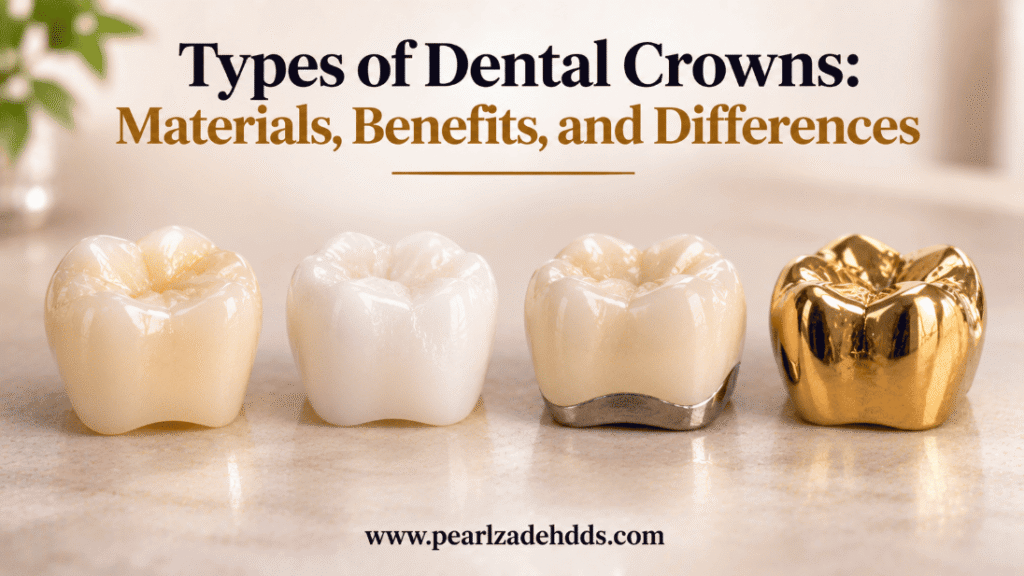
Dental crowns come in several materials, from tooth-colored ceramics to metal alloys. The material affects the crown’s appearance, strength, and suitability for different teeth.
A crown on a front tooth may need to blend closely with neighboring teeth, while a back molar must withstand substantial chewing pressure. The condition of the remaining tooth and the patient’s bite also influence the choice.
Dr. Pearl Zadeh focuses on metal-free ceramic restorations, including all-porcelain crowns. Other materials, such as metal alloys and porcelain-fused-to-metal crowns, are used in dentistry but are not part of her practice’s approach.
What Are Dental Crowns Made Of?
Dental crowns can be made from several materials, including metal, resin, and porcelain, according to Cleveland Clinic. Each has different properties that affect its appearance, strength, and suitability.
All-Porcelain and All-Ceramic Crowns
All-porcelain and all-ceramic crowns contain no metal. Porcelain crowns are one type of ceramic restoration.
Their natural appearance makes them a popular consideration for visible teeth. Cleveland Clinic notes that all-ceramic crowns mimic the appearance of tooth enamel more than other crown types. Their translucency helps create a natural-looking finish.
Strength varies by ceramic material and crown design. Some ceramics are better suited to teeth that experience heavy biting forces than others.
The specific material depends on the tooth’s condition, location, and functional demands.
Zirconia Crowns
Zirconia is a ceramic material made from zirconium dioxide. According to Cleveland Clinic, zirconia crowns are extremely durable, can withstand heavier biting forces than some other ceramic crowns, and are gentle on opposing teeth.
However, zirconia crowns can differ in appearance and physical properties depending on their formulation. Dentists may consider them for teeth that experience substantial chewing pressure.
For a closer comparison, read about zirconia versus porcelain crowns. Patients interested in a particular ceramic material can ask whether it is suitable for their tooth.
Porcelain-Fused-to-Metal Crowns
Porcelain-fused-to-metal (PFM) crowns have a metal base covered by a layer of porcelain. As MedlinePlus explains, the porcelain sits over a metal coping. This construction combines the strength of metal with a tooth-colored outer surface.
However, the porcelain layer can chip over time, exposing the metal underneath. The crown may also wear down the enamel of opposing teeth. In some cases, a thin dark line becomes visible near the gumline.
Because PFM crowns contain metal, they are not part of Dr. Pearl’s metal-free restorative approach.
Gold and Other Metal Crowns
Metal crowns are made from alloys that may contain gold, palladium, nickel, or chromium. They are known for their durability and resistance to chipping and breaking. Their metallic appearance, however, makes them less appealing for visible teeth.
These crowns are generally considered for molars where appearance may be less of a concern. Dr. Pearl’s practice does not offer gold or other metal crowns.
Comparing Different Types of Dental Crowns
This dental crown material comparison is general. No material is best for every tooth or every patient.
| Crown material | Appearance | General characteristics |
| All-porcelain and all-ceramic | Can mimic natural color and translucency | No metal. Strength depends on the ceramic and the crown design. |
| Zirconia | Tooth-colored. Optical qualities vary by formulation. | A strong ceramic. Properties vary by formulation. |
| Porcelain-fused-to-metal | Porcelain surface over a metal base. A dark line can show near the gumline. | Combines metal durability with a porcelain look. The porcelain may chip over time. |
| Gold and other metal | Metallic color | Durable. Rarely chips or breaks. |
How Do Dentists Choose the Right Crown Material?
The choice depends on several factors:
- The tooth’s location.
- Bite pressure and grinding habits.
- How much natural tooth structure remains.
- Appearance and translucency.
- Existing dental restorations.
- The patient’s dental needs and preferences.
A dentist considers these factors together when recommending a crown. A material that works well for one tooth may not be suitable for another.
Why Does Dr. Pearl Focus on Metal-Free Restorations?
Dr. Pearl uses all-porcelain and biocompatible metal-free materials for dental restorations. These materials are selected with consideration for how they interact with the body’s tissues.
For crowns, they can help recreate the natural color and translucency of teeth. Their suitability still depends on the tooth’s condition and functional needs.
The practice also replaces older metal-based and mercury-amalgam restorations with porcelain or composite alternatives when clinically appropriate. Composite is a tooth-colored filling material, not a type of crown.
An existing metal restoration does not automatically need replacement. A dental examination can help determine whether it should remain in place or whether another restoration would be appropriate.
Patients interested in metal-free restorations can discuss their options with Dr. Pearl Zadeh DDS in Woodland Hills.
Call (818) 716-6722 or click the button below to schedule your consultation online.
Frequently Asked Questions
No single material leads in every case. Cleveland Clinic calls zirconia one of the most popular ceramic crown materials. Metal, porcelain-fused-to-metal, and other ceramics remain in use. Dr. Pearl’s practice focuses on metal-free ceramics.
Not exactly. Porcelain is one kind of ceramic. All-ceramic is the broader term, and it also covers materials such as zirconia. Cleveland Clinic groups all-ceramic and porcelain crowns together.
Yes, in the sense that zirconia is a ceramic, not a metal. Cleveland Clinic lists zirconia among ceramic crowns. Formulations differ, so a dentist can explain what a specific product offers.
Cleveland Clinic says all-ceramic crowns mimic tooth enamel more than any other crown type. Results still depend on the specific material, the shade match, and the tooth. A dentist can discuss realistic expectations.
The dentist examines the tooth and weighs its location, bite forces, and remaining structure. Appearance, existing restorations, and patient preferences also count. No material fits every tooth.
The information above is for informational purposes only and is not a substitute for professional dental advice. Please schedule a consultation with Pearl Zadeh DDS to discuss your specific situation.