
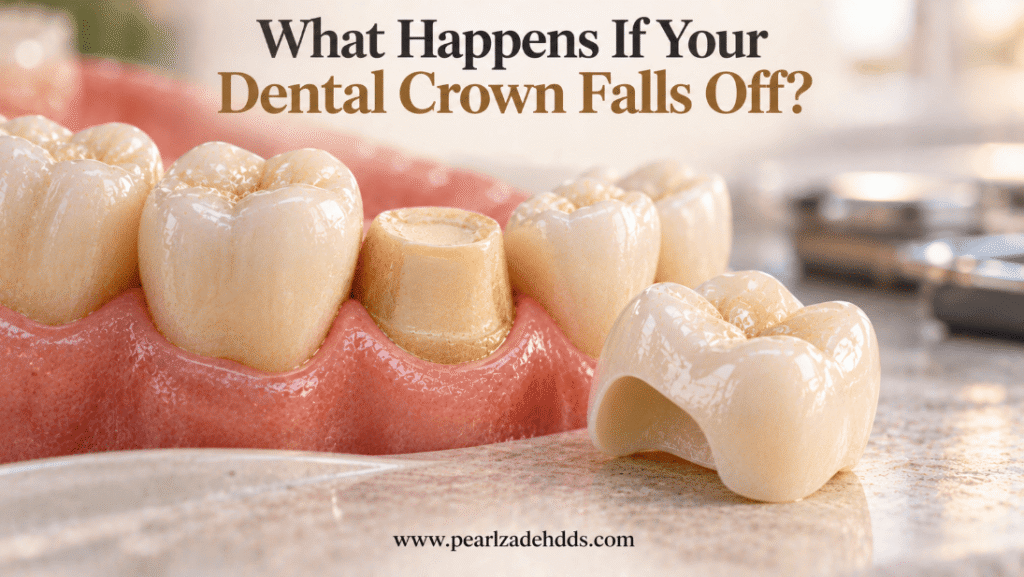
Your crown just came off, and the tooth underneath feels exposed. It may react to air, cold, or chewing. You may also wonder whether this is an emergency.
A crown that comes off leaves the prepared tooth uncovered. The right next step depends on your symptoms and on the condition of the crown and the tooth. Often, the first step is a prompt call to your dentist.
You may notice a sharp edge, a gap, or sensitivity. Those observations help your dentist, but they do not show the cause.
What Should You Do If Your Dental Crown Falls Off?
Follow this sequence:
- Stay calm and look for the crown. Do not swallow it.
- Handle it carefully and store it in a clean container.
- Rinse your mouth gently with water.
- Avoid chewing on the affected side.
- Contact your dentist for instructions and an appointment.
- Protect the exposed tooth from foods and temperatures that trigger discomfort.
These steps protect the tooth and the crown until you are seen. They do not replace an exam.
Write down when the crown came off and what you felt. Note any food or event involved. Those details help your dentist.
A dentist-reviewed Healthline article also advises saving the crown and calling your dentist to ask about special instructions. For a broken crown, Cleveland Clinic advises seeing your dentist as soon as possible and bringing the restoration.
Do not force the crown back into place. If it feels unstable, does not fit easily, or hurts when you position it, leave it out. Call your dentist instead. Do not use household glue or other unapproved adhesives.
A crown that came off intact differs from one that broke. It also differs from one that took part of the tooth with it. Tell the office which one you have.
Is It a Dental Emergency If a Crown Falls Off?
A fallen crown does not always need an emergency-room visit, but do not ignore it. Cleveland Clinic defines a dental emergency as any dental problem that requires immediate attention. Not every detached crown is equally urgent. If you are unsure whether your symptoms are urgent, call and describe the pain, any swelling, and any fever. Check your dentist’s voicemail or website for after-hours instructions if the office is closed.
A crown that came off with mild sensitivity usually calls for prompt contact with your dentist. Some symptoms call for urgent assessment:
- Severe or worsening pain.
- Facial or gum swelling.
- Fever or signs of spreading infection.
- Significant damage to the tooth.
- Difficulty swallowing or breathing.
The American Association of Endodontists notes that gum swelling with constant, severe pain may indicate an abscess. Mayo Clinic advises going to the emergency room for trouble breathing or swallowing. It gives the same advice for facial swelling with fever when you cannot reach your dentist.
Difficulty breathing or swallowing, or rapidly spreading facial or neck swelling, needs emergency medical attention. An emergency room can treat pain and swelling. Cleveland Clinic notes that ER staff do not perform restorative treatments such as crowns. You will still need your dentist afterward.
Why Did My Dental Crown Fall Off?
Several explanations are possible, and symptoms alone cannot show which one applies:
- Weakening or loss of the cement holding the crown.
- Decay affecting the underlying tooth.
- Damage to the crown or the supporting tooth.
- Heavy biting forces, clenching, or grinding.
- Changes in the tooth or restoration over time.
- Problems with the fit or retention of the restoration.
The Healthline article lists similar causes, including decay under the crown and too little cement. One retrospective study of 1,037 tooth-supported single crowns found loss of retention and recurrent caries the most common complications. Loss of retention occurred in 9.9% of crowns over a mean follow-up of about 11 years. The authors also found that bruxism significantly influenced crown survival.
That study describes one group of patients. It cannot predict what happened with your crown. A crown that loosened gradually may feel different from one that came off suddenly while chewing. Neither pattern shows the cause.
A crown coming off does not automatically mean your dentist made an error. It also does not always mean decay. An exam is needed to identify the cause.
What Should You Do With the Crown That Fell Off?
Keep it safe. Place it in a clean container and bring it to your appointment. Do not scrub it aggressively. Never bend any attached parts or try to repair it. Bring any pieces too, since a small fragment can matter.
Tell your dentist if the crown is cracked, broken, or missing part of its structure. That helps them judge whether it can be used again.
If you cannot find the crown, still contact the dental office. Your dentist can evaluate the exposed tooth without the original restoration.
Can You Put a Dental Crown Back On Yourself?
No. Do not force a crown back into place. Also avoid household glue, superglue, and other non-dental adhesives.
Temporary dental repair products are sold over the counter. Contact your dentist before using one. The crown may not fit correctly, and the tooth underneath may need treatment. Reseating a crown over decay or a crack may hide a problem that still needs care.
Your dentist needs to check the fit, the condition of the tooth, and your bite. Only then can they decide whether the crown can be recemented.
What Happens If You Leave the Tooth Without Its Crown?
A prepared tooth may be more vulnerable when left unprotected. Possible problems include sensitivity, discomfort, damage, or further deterioration.
The level of risk depends on the tooth’s condition and how much natural tooth structure remains. Damage is not inevitable. Not every exposed tooth develops decay. Waiting still adds uncertainty, and your dentist can judge the risk for your tooth.
Still, do not wait for pain to develop. The Healthline article advises soft foods, chewing on the other side, and gentle brushing until you are seen. Avoid sticky, hard, or chewy foods too. Watch for new sensitivity, a rough edge, a crack, or gum irritation while you wait. Report anything new when you call.
Skip home remedies for pain. MouthHealthy warns against placing aspirin on an aching tooth or gums because it may burn the tissue.
What Happens at the Dentist After a Crown Falls Off?
Your visit will likely include several steps:
- Your dentist asks when the crown came off and whether symptoms have changed.
- They examine the crown and the underlying tooth.
- They check for decay, cracks, damage, and other problems.
- They assess the fit and condition of the crown.
- They may use additional testing or X-rays when indicated.
Your dentist may also check your bite, since bite forces can contribute to a crown loosening.
X-rays can reveal damage or disease not visible during an exam, according to MouthHealthy. Not every patient needs every test.
The outcome depends on what the exam finds:
- The existing crown may be suitable for recementation if it and the tooth remain in good condition.
- The tooth may need treatment before a crown can be replaced.
- A new crown may be necessary if the original is damaged, no longer fits, or cannot be used safely.
The original crown cannot always be reused. Your dentist will explain what applies to your tooth. Ask what the exam found and what each option involves.
What If a Temporary Crown Falls Off?
Temporary crowns are generally less securely retained than permanent ones. The Healthline article describes a temporary crown as a placeholder held with temporary cement. It may come loose before final placement.
Contact your dental office for instructions. Avoid chewing on the affected side. A dentist-reviewed WebMD article advises avoiding hard, sticky, very hot, or very cold foods with a temporary crown.
A temporary crown that falls off still deserves attention, even if it causes little or no pain. Your dentist can advise how to protect the tooth until your next appointment. Bring the temporary crown to your visit if you have it. Do not try to reseat it yourself.
How Can You Reduce the Risk of Losing a Crown Again?
No routine guarantees a crown will stay in place. These habits help:
- Follow your dentist’s instructions after crown placement.
- Brush and clean between your teeth consistently.
- Attend recommended dental examinations.
- Avoid chewing ice or using your teeth to open packaging.
- Tell your dentist if you clench or grind regularly.
- Seek an assessment if a crown begins to feel loose or changes when you bite.
Early attention matters. A crown that feels loose may be easier to address before it comes off.
MouthHealthy warns that chewing ice and using teeth as tools can crack teeth. It also says a dentist may recommend a night guard for grinding. Good hygiene alone cannot prevent every crown from loosening. Our article on caring for a new dental crown covers daily habits.
Save the Crown, Skip the Glue, and Call Your Dentist
If a crown comes off, save it if possible and avoid do-it-yourself repairs. Protect the exposed tooth and contact your dentist for instructions. Your dentist will decide whether the original crown can be reused or whether another treatment is needed. If you have trouble breathing or swallowing, seek emergency medical care instead. Dr. Pearl Zadeh can evaluate the crown and the tooth and explain your next steps. You can learn more about dental crown treatment at Pearl Zadeh DDS.
Call (818) 716-6722 or click the button below to schedule your consultation online.
Frequently Asked Questions
You can eat carefully. Chew on the other side and choose soft foods. Avoid sticky, hard, very hot, or very cold foods until you are seen.
Call as soon as you can. Your dentist’s office will advise how soon to come in. Severe pain, swelling, or fever needs prompt attention.
Sometimes. It depends on the condition of the crown and the tooth beneath it. If the crown is damaged or no longer fits, a new one may be needed.
Still call your dentist. A painless tooth can still be vulnerable. Your dentist can advise how to protect it until you are seen.
Yes, decay is one possible cause. Worn cement, grinding, and fit problems are others. Only an exam can show which applies.
The information above is for informational purposes only and is not a substitute for professional dental advice. Please schedule a consultation with Pearl Zadeh DDS to discuss your specific situation.