
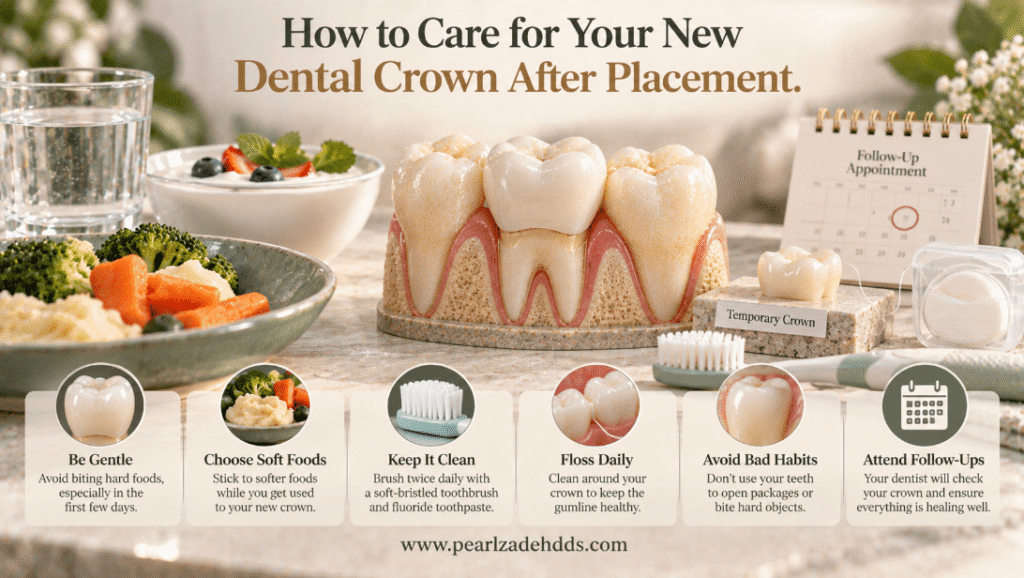
The crown is in, and the numbness is wearing off. Now the questions start. Can you eat normally? Do you brush and floss as usual? Is some sensitivity normal? What if your bite feels different? How careful should you be?
A new crown needs normal oral hygiene, sensible habits, and attention to how the tooth feels. Your dentist’s own instructions come first because crown types and cements differ. Knowing what to expect can help you care for the restoration and recognize when something needs attention.
What Should You Expect After Getting a New Crown?
Experiences vary after crown placement. Some patients notice mild sensitivity, gum tenderness, or an unfamiliar feeling around the tooth. You may also notice the crown when you chew at first.
These sensations do not automatically mean something is wrong. Pay attention to how severe they are and whether they improve over time. Mild symptoms that gradually settle are different from pain or discomfort that becomes stronger or persists.
The type of crown also matters. A temporary crown protects the prepared tooth while the permanent restoration is being made. It is usually held with temporary cement and may need extra care to prevent it from loosening. A permanent crown is cemented or bonded for longer-term use.
Your dentist’s instructions should take priority because aftercare can vary depending on the restoration, cement or bonding material, and condition of the tooth.
Can You Eat Normally After a Crown Is Placed?
Eating instructions depend on the type of crown and the materials used to secure it. Your dentist may also recommend waiting until the numbness wears off before eating.
Be especially careful while your mouth is numb. You may accidentally bite your cheek, lip, or tongue without feeling it. Your dentist can tell you when it is appropriate to eat and whether you need to avoid certain foods temporarily.
You may also need to be more careful with a temporary crown. Sticky or hard foods can place extra stress on the temporary restoration and may contribute to loosening it. Chewing on the opposite side for a short period may be recommended depending on your situation.
There is no single waiting period that applies to every crown. Follow the instructions you received from your dentist rather than relying on a general time frame found online.
If you are unsure what you can eat after your crown is placed, ask your dental office for specific instructions.
What Should You Eat After Crown Placement?
You do not need a restrictive diet after getting a crown. If the tooth or gums feel tender, softer foods may feel more comfortable at first. Some patients also prefer to chew on the other side temporarily.
Soft options include eggs, yogurt, soups, and cooked vegetables. Cut firmer foods into smaller pieces if chewing feels awkward. If your mouth is still numb, avoid very hot foods and drinks because you may not feel the temperature accurately.
If you have a temporary crown, avoid very sticky foods such as caramel or taffy. Sticky foods can pull on the temporary restoration and may loosen it. Avoid biting extremely hard objects with any crown.
You can return to your normal diet as your comfort and your dentist’s instructions allow. You do not need to avoid hard foods permanently unless your dentist recommends otherwise.
Can You Brush a New Dental Crown?
Yes. A crown needs the same daily oral hygiene as your other teeth. MouthHealthy advises brushing twice a day with a soft-bristled toothbrush and fluoride toothpaste. It also recommends gentle, short strokes along the teeth and gumline.
Clean the natural tooth around the crown as well. The crown itself cannot develop tooth decay, but the natural tooth around and beneath it still can. MouthHealthy explains that bacteria in plaque produce acids that can damage tooth enamel.
Avoid aggressive scrubbing around the crown and gumline. Good plaque control helps protect the tooth and tissues surrounding the restoration.
One other point matters if you are considering whitening. Whitening products do not change the color of crowns or other dental restorations. The ADA explains that whitening products work on natural teeth. Our article on whitening with fillings or crowns explains how this can affect your treatment plan.
Can You Floss Around a New Crown?
Yes. Flossing around a crown is generally safe and helps clean the areas where the crown meets neighboring teeth. Clean between your teeth once a day as part of your normal oral hygiene routine.
MouthHealthy recommends using a gentle rubbing motion and curving the floss into a C shape around each tooth. Do not snap the floss into your gums.
Guide the floss gently through the contact between the crown and the neighboring tooth. Then clean along the gumline on both sides of the crown. Depending on your needs, your dentist may also recommend an interdental brush or water flosser.
If floss repeatedly shreds, catches, or becomes difficult to pass around the crown, let your dentist know. They can check the contact, crown edge, or surrounding area.
Temporary crowns may require a slightly different flossing technique. Your dentist may recommend pulling the floss out from the side rather than lifting it upward. This can help reduce the risk of pulling on the temporary restoration. Follow the instructions your dentist gives you for your specific temporary crown.
What If Your New Crown Feels Sensitive?
Some sensitivity can occur after a crown is placed. Recent tooth preparation can temporarily irritate the tissues inside the tooth. Temperature changes and irritation around the tooth may also contribute. The condition of the underlying tooth matters as well.
A 2019 literature review of 43 articles found that tooth preparation can trigger an inflammatory response inside a living tooth. The response may be temporary or persist. The authors also noted that the evidence about the mechanisms and prevention of this sensitivity was not conclusive.
There is no universal timeline for sensitivity after crown placement. Mild symptoms may settle, but sensitivity is not automatically normal and does not always mean something is wrong. Several dental conditions can cause similar symptoms. MouthHealthy lists decay, fractured teeth, worn fillings, and gum disease among possible causes.
Pay attention to what triggers the sensitivity. Hot, cold, and biting pressure can provide useful information during an examination. Persistent, worsening, severe, or spontaneous pain deserves dental evaluation.
What If Your New Crown Feels Too High?
A new crown may feel different when you bite. If your bite feels noticeably uneven, contact your dentist. The same applies if the crowned tooth seems to touch before the others.
Do not assume that a significantly uneven bite will always settle on its own. Not every change in how your teeth meet resolves without attention. At the same time, a new crown does not automatically need an adjustment.
When you contact your dentist, describe what you notice. Tell them which tooth seems to touch first and when you first noticed the change. Your dentist can evaluate your bite and determine whether an adjustment is appropriate.
What Habits Should You Avoid With a New Crown?
A new crown can withstand normal chewing, but some habits place unnecessary force on teeth and restorations.
Avoid chewing ice or using your teeth to open packages. MouthHealthy explains that teeth are designed for eating, not for cutting or opening objects. Nail biting and chewing hard objects such as pens can also damage teeth.
Normal chewing of food is not the concern. The bigger issue is repeated force from habits that place stress on the restoration.
If you have a temporary crown, ask your dentist about chewing gum and other sticky foods. Your dentist can tell you which foods and habits are most likely to interfere with the temporary restoration.
What If You Grind or Clench Your Teeth?
Bruxism, which includes grinding and clenching, can place additional force on teeth and dental restorations. MouthHealthy notes that grinding can contribute to chipped or cracked teeth. It also explains that a dentist may recommend a night guard in some cases. MouthHealthy’s information on teeth grinding describes a night guard as one possible treatment approach.
Not everyone with a crown needs a night guard. Whether one is appropriate depends on factors such as your grinding pattern, symptoms, teeth, and restorations. Grinding often occurs during sleep, so you may not know that you do it.
Tell your dentist if you grind or clench your teeth, or if you notice signs such as tooth wear, jaw discomfort, or damaged restorations. Your dentist can determine whether you need additional protection.
Our article on zirconia vs porcelain crowns also explains how bite forces and other factors can influence crown material and design.
How Do You Care for the Gumline Around a Crown?
The gumline is where the crown meets the natural tooth and surrounding gum tissue. Plaque that remains around this area can contribute to gum inflammation. Decay can also develop at the edge of a crown because the natural tooth remains vulnerable.
In one retrospective study of 1,037 tooth-supported crowns, recurrent decay was recorded in 8.6% of crowns. That figure comes from one study population and does not represent the risk for every crown.
Brush gently along the crown margin and clean between your teeth every day. Pay attention to changes around the gumline, including persistent redness, swelling, bleeding, or irritation.
A crown does not replace the need for healthy gums. Regular dental examinations allow your dentist to assess the crown margin, natural tooth, and surrounding tissues.
What If You Have a Temporary Crown?
Temporary crown care can differ from permanent crown care. Your dentist’s specific instructions should come first.
Avoid sticky foods if your dentist recommends doing so. Floss carefully and ask your dentist how to remove the floss without pulling on the temporary crown.
Contact your dental office if the temporary crown becomes loose, moves, or falls out. Do not try to recement it with household glue. A loose temporary may need to be cleaned, evaluated, and professionally recemented or replaced depending on its condition.
Until you receive instructions from your dentist, brush gently around the temporary crown. Avoid pulling at it with your tongue or fingers.
What If Your Crown Feels Loose, Chips, or Falls Out?
Contact your dental office if your crown feels loose, moves when you bite, chips, or cracks. You should also contact the office if the crown comes off completely. MouthHealthy recommends contacting your dentist for dental emergencies and explaining what happened.
Do not use household glue to reattach a crown. A loose or displaced crown needs professional evaluation. If the crown comes off, keep it in a safe place and bring it to your appointment. Your dentist can determine whether it can be repaired, recemented, or needs to be replaced.
Until you receive further instructions, keep the area clean and brush gently. Avoid chewing on the affected side if the tooth feels uncomfortable or exposed.
How Long Should You Be Careful With a New Crown?
There is no universal one-week rule for crown aftercare. Once the restoration is functioning normally, care becomes part of your regular oral hygiene and daily habits.
Temporary crowns may require more specific precautions until the permanent restoration is placed. Your dentist may also give you temporary restrictions based on the restoration, cement, or condition of the tooth.
Follow the instructions you receive from your dentist and ask when those precautions no longer apply. Your instructions for a temporary crown may differ from those for the permanent restoration.
When Should You Contact Your Dentist?
Contact your dentist if you develop severe or worsening pain, persistent sensitivity, or pain when you bite. You should also call if the crown feels loose, chips, cracks, or falls out.
A noticeably uneven bite deserves attention as well. Persistent gum swelling, redness, or irritation around the crown should also be evaluated.
These symptoms can have different causes, so the symptoms alone may not show what is happening. Your dentist can examine the crown, tooth, bite, and surrounding tissues to determine what needs attention.
How Does New Crown Care Affect Long-Term Longevity?
Good oral hygiene, healthy gums, sensible eating habits, and regular dental examinations can support the long-term health of a crown and the natural tooth underneath it.
These habits cannot guarantee that a crown will last for a specific number of years. The material, tooth, bite, oral health, and other individual factors also affect longevity.
Our article on how long porcelain crowns last explains the factors that can affect crown lifespan in more detail.
Keep Your New Crown Healthy With Everyday Care
A new crown eventually becomes part of your normal oral-care routine. Temporary crowns may need extra precautions until the permanent restoration is placed. Good brushing, daily cleaning between your teeth, sensible eating habits, and regular dental visits can help protect the crown and the natural tooth underneath it.
Dr. Pearl Zadeh can evaluate your crown, address concerns after placement, and provide individualized restorative care. You can learn more about crowns at Pearl Zadeh DDS.
Call (818) 716-6722 or click the button below to schedule your consultation online.
Frequently Asked Questions
Brush twice a day with fluoride toothpaste and clean between your teeth daily. Avoid biting hard objects. Follow your dentist’s instructions.
Often yes, once feeling returns. Instructions depend on the crown type and cement. Follow your dentist’s guidance.
It varies with the crown, the cement, and your dentist’s instructions. Wait until numbness fades to avoid biting your cheek, lip, or tongue.
Yes. Brush gently, including along the gumline. Avoid aggressive scrubbing.
Avoid very sticky foods around a temporary crown and extremely hard objects with any crown. A permanent restriction on hard foods is not usually needed.
This article is for informational purposes only and is not a substitute for professional dental advice. Please schedule a consultation with Pearl Zadeh DDS to discuss your specific situation.