
You expected clear trays gently nudging your teeth into place. Then your dentist mentions IPR, or says something about enamel reduction, and suddenly you’re picturing a drill near teeth you didn’t expect anyone to touch. It’s an understandable reaction. The name sounds more intimidating than the procedure itself.
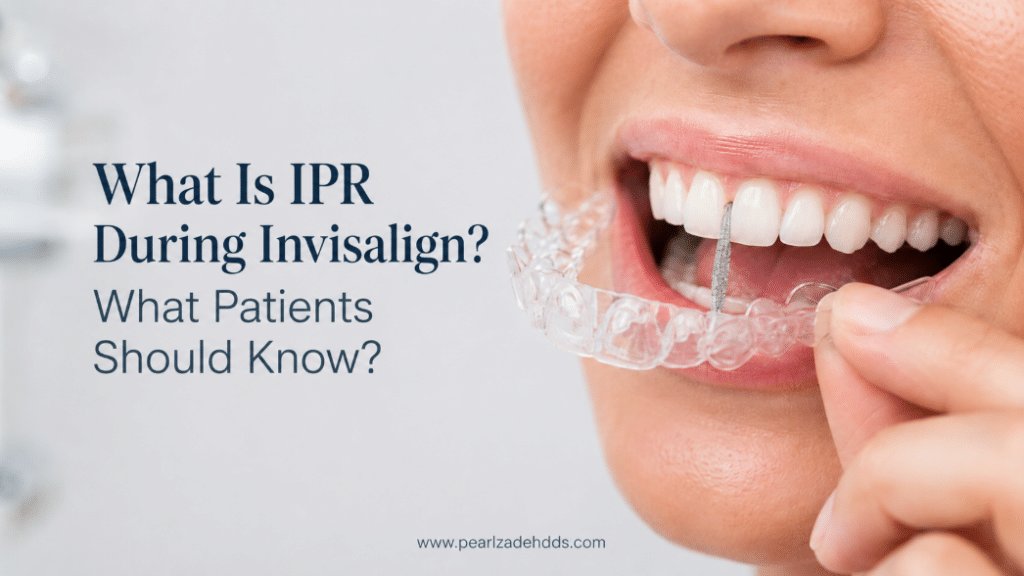
IPR stands for interproximal reduction. During Invisalign treatment, it means removing a very small, carefully measured amount of enamel from between selected teeth. The goal may be to create space for certain tooth movements or help the teeth fit together more effectively. Your dentist plans where and how much reduction is needed before the procedure. IPR isn’t performed on every tooth, and plenty of Invisalign patients never need it at all.
What IPR During Invisalign Actually Means
“Interproximal” means between neighboring teeth, at the contact point where one tooth meets the next. “Reduction” refers to removing a small amount of enamel from that area.
The procedure is planned around your specific treatment needs. Your dentist identifies which teeth need additional space and how much reduction is appropriate. A thin strip, disc, or another specialized instrument may then be used to carefully reduce the enamel between those teeth.
It isn’t random filing, and it doesn’t involve reshaping the entire tooth. Only the selected contact areas are treated, and the amount removed is kept small. Whether you need IPR depends on your teeth, bite, available space, and the movements your Invisalign plan needs to achieve.
Why Would I Need IPR During Invisalign?
Sometimes teeth need more room to move into the positions your treatment plan is aiming for than currently exists in your mouth. When that’s the case, your dentist has more than one way to create that space, depending on your specific situation. IPR is one option. It creates small amounts of space between selected teeth without removing an entire tooth.
It can help with crowding, support planned tooth movement, and improve how neighboring teeth contact each other. In some cases, it may also be part of managing tooth proportions as the overall smile is being planned. None of this means IPR is required for every crowded smile, and it isn’t automatically preferable to other approaches such as extraction. Your treatment plan, based on your specific teeth and bite, determines whether it makes sense for you.
Is This the Same Thing as “Shaving Your Teeth”?
You’ve probably seen that phrase somewhere, and it makes the procedure sound far more aggressive than it actually is. IPR removes a small, carefully planned amount of enamel from between selected teeth. It doesn’t reshape the entire tooth or make your teeth noticeably smaller. The goal is to create space at specific contact points, not change the visible shape of the tooth.
“Shaving” is casual shorthand, but it doesn’t really describe how targeted the procedure is. Your dentist controls where the enamel is reduced and how much is removed based on what your Invisalign treatment needs.
Does It Hurt?
There’s no cutting into your gums, no drilling into the center of the tooth, and nothing intended to come anywhere near the nerve. Most patients describe feeling pressure or a mild vibration during the procedure itself, along with a scraping or rubbing sensation as the instrument passes between the teeth. It’s not painless for absolutely everyone, and it’s fair to say some patients notice mild temporary sensitivity in the treated area afterward, particularly to cold. That typically settles within a day or two. If sensitivity is significant or sticks around longer than that, it’s worth a call to your dentist rather than waiting it out.
How Is IPR Actually Done?
Your dentist identifies which teeth and contact points actually need space, based on your treatment plan, and works out how much reduction each site calls for. The tooth surfaces involved are accessed carefully, and a specialized strip, disc, or similar instrument removes a small amount of enamel from between the selected teeth. Your dentist checks the resulting space and the condition of the tooth surfaces, then finishes and polishes the area so it’s smooth rather than rough. From there, your Invisalign treatment continues on schedule. This is a professional dental procedure performed with specific instruments and training. It isn’t something to attempt yourself under any circumstances.
How Much Enamel Actually Comes Off?
IPR involves a small amount of enamel. A recent peer-reviewed analysis of enamel thickness and IPR planning reports that enamel reduction at a single interproximal site is often planned within a range of about 0.20 to 0.50 millimeters. That range does not mean the same amount will be removed from every tooth or every patient.
The amount depends on which teeth are involved, how much space your treatment plan needs, the thickness and shape of your enamel at that contact point, and the movement your dentist is trying to achieve. Your dentist evaluates those factors before deciding whether IPR is appropriate and how much reduction is needed.
Does Enamel Grow Back After IPR?
No. Enamel doesn’t regenerate once it has been removed, whether through IPR or normal wear over time. That’s why the amount removed during IPR is planned carefully and kept within the limits appropriate for the tooth being treated.
Professional IPR is different from uncontrolled filing because your dentist determines exactly where the enamel needs to be reduced and how much space the treatment requires. The goal is to create the needed space while preserving as much healthy enamel as possible.
Can IPR Damage Your Teeth?
Before recommending IPR, your dentist considers your tooth anatomy, enamel thickness, how much space is actually needed, the health of your teeth and gums, the specific contact points involved, and how IPR fits into the rest of your treatment plan.
A systematic review of the dental and periodontal effects associated with IPR found that IPR appears clinically safe when performed with appropriate case selection, proper technique, and adequate finishing. The review did not find consistent evidence that properly performed IPR increases the risk of cavities, gum problems, or lasting sensitivity.
That doesn’t mean there is zero risk in every situation. Possible concerns include temporary sensitivity, a rough surface if the area isn’t finished and polished properly, excessive enamel removal, or gum irritation depending on the technique used. The purpose of professional IPR is controlled space creation, not removing enamel unnecessarily.
Will I Have Gaps After IPR, or Will My Teeth Look Smaller?
The small amount of space IPR creates is intentional and part of the treatment plan. As your aligners continue moving your teeth, that space is generally used to achieve the planned positions rather than remaining as a visible gap.
What your finished smile looks like depends on the entire treatment plan, not IPR alone. Your dentist considers the amount of space needed, tooth positions, and overall tooth proportions before deciding whether IPR is appropriate.
As for your teeth looking smaller, properly planned IPR shouldn’t noticeably change their visible size. The enamel is removed from the sides where neighboring teeth contact each other, rather than from the front surface you see when you smile.
If tooth proportions are part of your treatment goals, your dentist considers them when planning where IPR is needed and how much enamel should be removed.
Does Everyone Getting Invisalign Need IPR?
No. Plenty of Invisalign cases don’t require IPR at all. For others, it’s one part of a larger treatment plan.
Whether you need it depends on factors such as the amount of crowding, the shape and size of your teeth, the space already available, where your teeth need to move, your bite, and your overall treatment goals. IPR isn’t a standard step that every Invisalign patient automatically goes through.
Other Ways to Create Space: Extraction and Arch Expansion
IPR isn’t the only way to create space when teeth need more room. Extraction involves removing an entire tooth, so it’s a much different approach and may be considered when a case requires more space than IPR can provide. Some orthodontic cases call for extraction, while many can be treated without it.
Another option is arch expansion, which involves gradually widening the dental arch to create additional room. Whether that’s appropriate depends on the patient’s anatomy, tooth positions, and bite.
None of these approaches is automatically better than the others. Your dentist considers how much space the treatment needs and which approach is appropriate for your teeth and bite.
What Happens After IPR?
Your teeth may feel slightly different against your tongue for a little while. Some patients notice a subtly different texture where the enamel was reduced, and mild temporary sensitivity is possible.
The treated contact points may also feel slightly more open at first. Your aligners then continue moving the teeth according to the treatment plan.
Continue your usual brushing and flossing routine after the procedure. If you develop significant pain, swelling, or sensitivity that doesn’t start to settle after a couple of days, contact your dentist rather than waiting it out.
Does IPR Always Happen at the Start of Treatment?
Not necessarily. IPR may be performed before certain aligners are worn, during active treatment, or at another stage when your treatment plan calls for additional space.
Not every patient who needs IPR has it done on the first day. Your dentist may also reassess your teeth as treatment progresses. If the plan changes or additional space appears necessary, they’ll evaluate whether IPR is appropriate before making that decision.
This can sometimes come up alongside refinements, which are additional aligners used to fine-tune tooth movement after the initial series.
IPR and Attachments Are Two Different Tools
It’s easy to mix these up since both can come up during Invisalign planning, but they do very different jobs. Attachments are small tooth-colored shapes bonded to selected teeth. They give the aligner something to grip when certain movements need extra support.
IPR does the opposite. It removes a small amount of enamel between selected teeth to create space or improve how neighboring teeth fit together.
One adds material to the surface of a tooth. The other removes a small amount between two teeth. Your treatment plan may include one, both, or neither, depending on what your teeth need.
How IPR Fits Into Your Overall Treatment Plan
IPR is part of the treatment planning process, not something your dentist adds randomly during an appointment. Your dentist considers your tooth positions, crowding, tooth shape, bite, available space, and where your teeth need to end up.
Our step-by-step look at how Invisalign treatment works covers that planning process in more detail.
This is also why two patients with similar-looking smiles can end up with different treatment plans. The amount of movement needed, the available space, and the way each person’s teeth fit together aren’t always visible just by looking at their smiles.
A more involved case may require IPR, but complexity alone doesn’t automatically mean you’ll need it. The decision comes down to the movements your specific treatment plan needs to achieve.
Does IPR Affect the Cost of Invisalign?
Whether IPR is included in your overall Invisalign fee or handled separately depends on your provider and treatment agreement. There isn’t one pricing rule that applies to every practice.
Our breakdown of what affects Invisalign cost in Woodland Hills covers the factors that can shape your overall treatment fee.
If IPR is part of your plan, ask whether the procedure is included in your quoted treatment fee or carries a separate charge. Getting that answer before treatment starts is better than assuming either way.
Speak With Dr. Pearl Zadeh About Your Invisalign Treatment
Hearing that your Invisalign plan includes IPR isn’t necessarily a reason to worry. It’s a planned technique your dentist may use when certain movements need additional space. Only the areas that need it are treated, and the amount of enamel removed is carefully determined as part of your treatment plan.
As an Invisalign Premier Provider, Dr. Pearl Zadeh can evaluate your teeth, bite, and treatment goals and explain whether IPR makes sense for you and why. Learn more about Invisalign in Woodland Hills.
Call (818) 716-6722 or click the button below to schedule a consultation online.
Schedule a ConsultationFrequently Asked Questions
1. Is IPR safe?When properly planned and performed by a dental professional, IPR is a controlled way to create limited space between selected teeth, with research generally supporting its safety when done with appropriate technique and case selection.
2. Does IPR hurt?Many patients tolerate it well. You may notice pressure, vibration, or a scraping sensation during the procedure, and some temporary sensitivity afterward.
3. Does enamel grow back after IPR?No. Enamel doesn’t regenerate, which is exactly why the amount removed during IPR is planned so carefully and kept small.
4. Will IPR leave gaps between my teeth?The procedure creates small spaces on purpose. Those spaces are part of the treatment plan and generally get used as your aligners continue moving your teeth.
5. Can IPR make my teeth sensitive?Temporary sensitivity is possible, though significant or persistent sensitivity is worth discussing with your dentist.
This article is for informational purposes only and is not a substitute for professional dental advice. Please schedule a consultation with Dr. Pearl Zadeh to discuss your specific situation.