
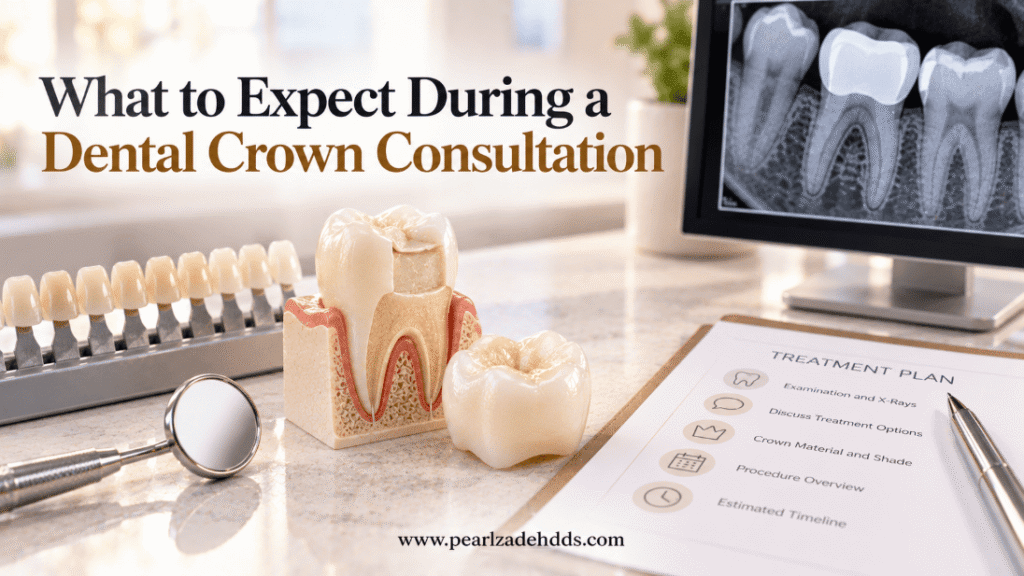
A dental crown consultation usually involves discussing your concerns, examining the tooth, and reviewing X-rays when needed. The dentist then explains whether a crown or another treatment may be suitable.
The visit is an evaluation, not the crown procedure itself. You can ask questions, review your options, and take time to decide how to proceed.
During the consultation, the dentist may explain why a crown is recommended, discuss alternative treatments, and review expected costs and timing. Knowing what to expect can help you prepare questions and make an informed decision.
Why Might You Need a Dental Crown Consultation?
A crown is a tooth-shaped cap that fits over a tooth. Cleveland Clinic says it restores a decayed, broken, weak, or worn-down tooth.
Common reasons for an evaluation include a cracked or weakened tooth, extensive decay, or a large existing filling. MouthHealthy is the American Dental Association’s (ADA) consumer site. It says a crown can strengthen a tooth with a large filling when not enough tooth remains.
A consultation helps the dentist assess the specific problem. It does not commit you to a crown. The dentist may find that another treatment fits better, or that monitoring is reasonable.
What Happens During the Consultation?
The exact process varies with your needs. A typical visit may follow this sequence:
- Discussing your symptoms and dental history.
- Examining the affected tooth and the surrounding gums and tissues.
- Reviewing X-rays or recommending imaging when needed.
- Assessing the tooth’s condition and how much healthy structure remains.
- Discussing the findings and possible treatment options.
Expect questions about when the tooth hurts, what triggers the pain, and any past work on the tooth. Details such as pain with biting or sensitivity to temperature help guide the examination.
The dentist weighs several factors before recommending anything. These include the amount of remaining tooth structure, the location and extent of the damage, and the tooth’s function. The available treatment options also matter.
A consultation is separate from crown placement. If treatment follows, it happens at later visits.
Will You Need an X-Ray?
Possibly. MouthHealthy says X-rays can reveal damage or disease not visible during a dental exam. They can help assess decay, damage, and other concerns that an examination cannot fully show.
You may not need new X-rays at every visit. MouthHealthy says the dentist reviews your history and examines your mouth to decide. It adds that a new dentist may ask for copies of existing X-rays instead of ordering new ones.
X-rays also have limits. Some cracks are difficult to detect on standard images, so the dentist may rely on other findings as well.
Will You Always Need a Crown?
No. A crown is one possible treatment, not an automatic recommendation. Depending on the findings, a filling, bonding, an onlay, or another approach may be appropriate.
A filling may repair a smaller area of decay. Bonding may address limited damage. Cleveland Clinic says an onlay covers at least one cusp, while a crown fits over the entire tooth. An onlay may suit a tooth too damaged for a filling but healthy enough to avoid a crown.
These options are not interchangeable. The right choice depends on the tooth’s condition. Our article on cracked tooth treatment with bonding, an onlay, or a crown compares the options in more detail.
What Will the Dentist Discuss With You?
Topics vary with the tooth and the proposed plan. They may include:
- The purpose of the proposed treatment and why it is recommended.
- Crown material options.
- Expected benefits and limitations.
- Possible risks.
- Expected longevity.
- Costs and insurance questions.
- The likely appointment schedule.
You can ask for clarification at any point before deciding.
Cleveland Clinic explains that dental crowns can be made from resin, metal, porcelain, and other materials. Our article on zirconia versus porcelain crowns compares two common ceramic options.
On longevity, Cleveland Clinic says crowns last between five and 15 years with proper care. Individual results vary, and no dentist can promise a specific lifespan. A separate article covers how long porcelain crowns last with proper care.
Cleveland Clinic notes that crowns may be expensive. Ask for a written estimate and check your plan’s coverage, because insurance rules vary.
Ask how many appointments to expect and how long each lasts. Cleveland Clinic says crown placement usually requires two appointments. A temporary crown stays in place while the final one is made.
How Should You Prepare for Your Appointment?
A little preparation makes the visit more useful. Consider bringing:
- A list of your symptoms and when they occur.
- Relevant dental records or recent X-rays, if available.
- A list of your current medications.
- Your insurance details.
- Questions about treatment and cost.
Specific notes help most. Write down whether pain happens while chewing, with cold drinks, or at night. Good questions include what problem the treatment addresses, which alternatives exist, and what each option involves.
What Happens After the Consultation?
The dentist may recommend further assessment, a crown, another treatment, or monitoring. You may receive a proposed treatment plan and time to review it.
Ask questions before scheduling anything. The consultation does not mean you must proceed with a crown. Treatment does not always need to begin right away, unless the clinical situation calls for prompt care.
If you proceed with a crown, our article on caring for a new dental crown after placement explains how to care for it.
Do not wait for a scheduled visit if symptoms turn severe. Severe or worsening tooth pain, facial swelling, or fever with dental symptoms may require prompt care. Mayo Clinic’s guidance on tooth abscess says to go to the emergency room for trouble breathing or swallowing. It also advises the emergency room for fever with facial swelling when you cannot reach your dentist.
Before deciding how to proceed, talk with Dr. Pearl Zadeh about your concerns and make sure the proposed treatment is clear. You can also read about dental crowns at Pearl Zadeh DDS.
Call (818) 716-6722 or click the button below to schedule your consultation online.
Frequently Asked Questions
The length varies with your needs and the office’s appointment arrangements. A visit that includes imaging and a detailed discussion may take longer than a brief evaluation. Ask the office when you book.
Not necessarily. The dentist decides based on your history and examination. If you have recent X-rays, bring them or ask your previous office to send them.
Often the dentist can discuss initial findings and options at the visit. Some cases need further tests, imaging, or monitoring before a recommendation. Certain cracks are hard to detect.
Yes. Depending on the tooth, alternatives may include a filling, bonding, or an onlay. These are not interchangeable, so ask which options fit your tooth and what limits each one has.
No. A consultation is an evaluation. You can review the proposed plan, ask questions, and decide how to proceed. Prompt care may be advised when symptoms are urgent.
The information above is for informational purposes only and is not a substitute for professional dental advice. Please schedule a consultation with Pearl Zadeh DDS to discuss your specific situation.