
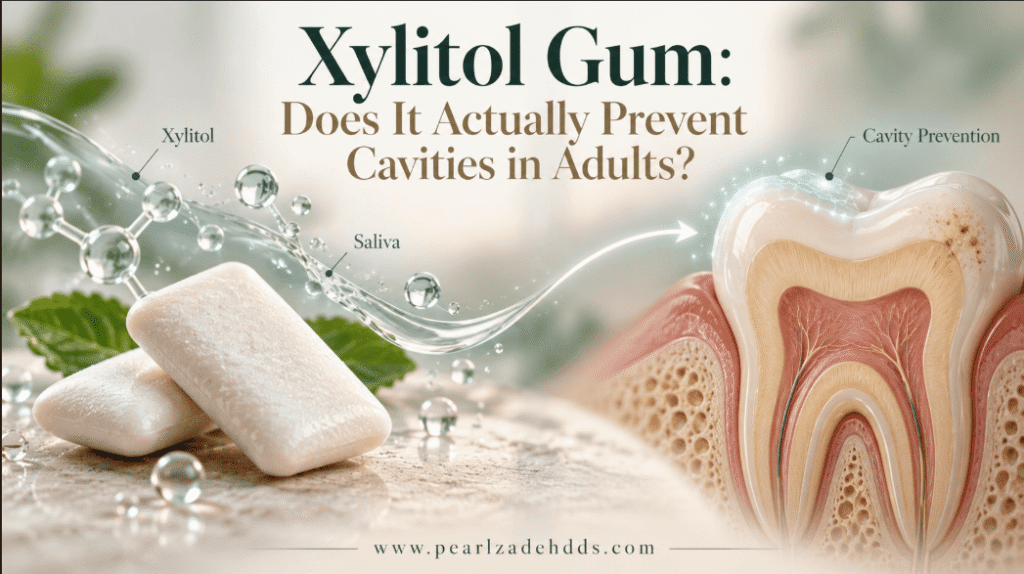
Xylitol gum gets marketed as a cavity fighter, and packaging often implies more than the research supports. If you are deciding whether it deserves a place in your routine, the honest answer sits between the marketing and the skepticism.
Xylitol gum may offer a useful preventive benefit for some adults. Current evidence does not support treating it as a standalone way to prevent cavities. Several different things get bundled together in this conversation, and separating them makes the evidence much easier to read.
What Is Xylitol?
Xylitol is a sugar alcohol, also called a polyol, used as a sweetener in some sugar-free gums, mints, and other products. The American Dental Association notes that sugar-free gums are sweetened with polyols such as xylitol, sorbitol, mannitol or maltitol, which are noncariogenic: they taste sweet but are not a suitable substrate for oral bacteria to use as an energy source.
That is the core difference from sucrose. Plaque bacteria metabolize fermentable sugars and produce acid as a byproduct, and that acid is what demineralizes enamel. Xylitol does not feed that process in the same way.
Two practical points. Xylitol is a food ingredient, not a medication or a dental treatment. And not every sugar-free gum contains it, since several different polyols are used for the same purpose.
How Could Xylitol Gum Help Your Teeth?
Three separate mechanisms get discussed, and they are not equally well established.
Increased saliva
Chewing stimulates salivary flow. The ADA notes that chewing gum after a meal can increase salivary flow by stimulating both mechanical and taste receptors in the mouth. Saliva helps wash away food debris, buffer acids, and deliver calcium and phosphate that support the natural remineralization of enamel.
This benefit comes from chewing, not from xylitol specifically. Any sugar-free gum stimulates saliva. It is probably the single biggest reason sugar-free gum is associated with oral health benefits at all.
Less fermentable sugar exposure
Swapping sugary gum for sugar-free gum removes a source of fermentable sugar from your day. If you chew gum regularly, that change matters on its own, independent of which polyol sweetens the replacement.
Effects on oral bacteria
Research has examined whether xylitol specifically affects Streptococcus mutans and related bacteria associated with cavities. This is where xylitol-specific claims usually originate, and where the evidence needs the most careful reading.
Does Xylitol Actually Prevent Cavities in Adults?
Four different things get treated as interchangeable in marketing: a plausible biological mechanism, a measured change in bacterial levels, a measured change in plaque, and an actual reduction in cavities. Only the last one is what patients care about, and it is the least well supported.
A 2025 systematic review in BMC Oral Health examined exactly this split. The authors reviewed clinical studies comparing xylitol gum against a polyol control gum, which isolates any xylitol-specific effect from the general effect of chewing. Across the included studies, xylitol gum significantly decreased mutans streptococci counts in 12 of 14 studies compared with sorbitol gum. Plaque accumulation decreased in 6 of 10 studies. Caries occurrence decreased in 3 of 5 trials.
Read those three numbers together. The evidence is most consistent for bacterial counts, less consistent for plaque, and thinnest for cavities themselves, where only five trials existed to review. Fewer bacteria is an encouraging intermediate finding. It is not the same as demonstrating that a person will develop fewer cavities.
A separate 2024 systematic review reached a more cautious conclusion. Reviewing nine clinical trials in humans, the authors reported that the preventive effect of xylitol against dental caries cannot be confirmed, and called for further research using standardized protocols. They noted that study groups, evaluation periods, and daily xylitol doses varied considerably between trials, which makes results difficult to compare.
So the accurate summary is not yes or no. Some studies suggest benefit. The effect on bacteria appears real. Whether that translates into meaningfully fewer cavities in adults has not been established.
Is Xylitol Better Than Other Sugar-Free Gum?
The 2025 review is the most relevant evidence here, because its comparison group chewed sorbitol gum rather than no gum. That design asks whether xylitol adds anything beyond chewing itself.
On bacterial counts, it generally did: 12 of 14 studies favored xylitol. On cavities, the picture is thinner, with 3 of 5 trials showing a decrease. A difference in bacterial levels does not automatically establish a clinically meaningful difference in cavity prevention, and five trials is a small base for a confident conclusion.
Sorbitol, mannitol, maltitol, and erythritol are all used in sugar-free gum, and all avoid feeding plaque bacteria the way sucrose does. Xylitol is not universally superior for everyone’s teeth. Choosing sugar-free at all is the larger step; which polyol sweetens it is a smaller question.
How Long Should Adults Chew Xylitol Gum?
There is no universal rule requiring a specific number of minutes or pieces per day.
General guidance for sugar-free gum often suggests chewing for roughly twenty minutes after meals, which is a practical suggestion rather than an established optimal dose. Research protocols have used a wide range of xylitol amounts and schedules, and as the 2024 review noted, that variation is one reason the trials are hard to compare.
More xylitol does not reliably mean more protection. If you want a number that applies to your teeth specifically, that is a question for your dentist rather than a package label.
Can You Chew Xylitol Gum After Meals?
Yes, and after meals is when it makes the most sense. Eating lowers the pH in your mouth, and stimulated saliva helps buffer that acid while clearing food debris from tooth surfaces. Gum can be useful at times when brushing is not practical, such as after lunch at work.
This is a supporting habit, not a requirement. Nobody needs to chew gum after every meal.
Is Xylitol Gum a Substitute for Brushing?
No. The ADA states this directly: while there is some evidence that regular use of sugar-free gum may reduce caries risk, gum is not to be used as a substitute for a regular oral hygiene routine consisting of twice daily brushing with a fluoride toothpaste and daily cleaning between teeth.
Xylitol does not do what fluoride does, and the two should not be treated as interchangeable. Chewing gum also does not replace cleaning between your teeth, limiting frequent sugar exposure, or regular dental examinations. Our article on whether to rinse after brushing covers one small habit that affects how much benefit you get from fluoride toothpaste, which matters considerably more than gum choice.
What About People Who Are at Higher Risk for Cavities?
Cavity risk varies widely between adults. Frequent sugar or carbohydrate exposure, reduced salivary flow, a history of previous or active decay, certain medications, exposed root surfaces, and oral hygiene factors can all raise risk.
Xylitol gum is not sufficient on its own for someone at elevated risk. People in that position generally benefit from an individualized prevention plan, which may include specific fluoride recommendations and a tailored recall schedule. Your own risk level is something a dentist assesses, not something to infer from a single habit.
Can Xylitol Gum Help With Dry Mouth?
Chewing gum stimulates saliva, so some people with dry-mouth symptoms find it helpful for comfort. That is a reasonable use.
It does not treat whatever is causing the dryness. Persistent dry mouth has many possible causes, including medications and medical conditions, and it raises cavity risk in its own right because there is less saliva available to buffer acids and clear debris. If your mouth is persistently dry, that deserves evaluation rather than more gum.
Can Xylitol Gum Cause Any Problems?
For most adults, no. Two things are worth knowing.
Sugar alcohols including xylitol can cause gastrointestinal symptoms such as bloating, gas, or a laxative effect when consumed in larger amounts. Tolerance varies between individuals.
Prolonged or vigorous gum chewing can also be uncomfortable for people with existing jaw pain or joint problems. This does not mean gum causes those conditions. If you have persistent jaw pain, clicking accompanied by pain, or limited jaw movement, discuss gum chewing with your dentist rather than working it out alone. Our overview of early signs of gum disease covers a separate reason that regular dental monitoring matters beyond cavity prevention alone.
What Should You Look for in a Sugar-Free Gum?
Sugar-free is the first thing to check. Beyond that, the ADA Seal of Acceptance is useful information: only sugar-free gums are considered for it, and a company earns it by demonstrating that its product meets requirements for safety and efficacy, which may include indications such as reducing plaque acids, promoting remineralization, reducing cavities, or reducing gingivitis.
The Seal indicates that a specific product met evaluated criteria. It does not mean the product will prevent cavities for every person who chews it. Xylitol appearing in an ingredient list also does not establish that a particular gum prevents cavities, since formulations and the evidence behind them differ.
What Is More Important Than Xylitol Gum?
Brushing twice daily with fluoride toothpaste. Cleaning between your teeth daily. Limiting how often you consume sugary foods and drinks, since frequency matters as much as quantity. Keeping up with regular dental visits. Addressing dry mouth if you have it. And following whatever individualized recommendations your dentist has given you based on your actual risk.
Xylitol gum sits alongside those as a possible extra. It is not a foundation to build on.
So, Should Adults Chew Xylitol Gum?
For many adults, sugar-free gum can be a reasonable addition to an oral-care routine, largely because chewing increases saliva flow. Xylitol may provide additional benefits, particularly on bacterial levels, but current evidence does not establish it as a guaranteed way to prevent cavities.
Whether it is worth adding depends on your cavity risk, your saliva flow, any existing dental conditions, whether your jaw is comfortable chewing gum, your diet, and what the rest of your routine looks like. Not every adult needs to start chewing it.
Speak With Dr. Pearl Zadeh About Cavity Prevention
No single product or habit determines whether you get cavities. What actually helps depends on your own risk factors, your saliva, your diet, and the routine you already have in place. Dr. Pearl Zadeh can assess where your risk actually sits and discuss which preventive measures are worth your attention, whether or not gum turns out to be one of them.
Call (818) 716-6722 or click the button below to schedule your consultation online.
Frequently Asked Questions
Not conclusively. Research consistently shows reductions in cavity-associated bacteria, but evidence for fewer actual cavities is limited. A 2024 systematic review concluded the preventive effect against caries cannot yet be confirmed.
Studies comparing xylitol gum with sorbitol gum generally favor xylitol on bacterial counts. Whether that produces meaningfully fewer cavities is unclear. Choosing sugar-free at all matters more than which polyol sweetens it.
Plaque bacteria cannot use xylitol as an energy source the way they use sugar, so it does not fuel acid production. Chewing also stimulates saliva, which buffers acid and helps remineralize enamel.
There is no established optimal duration. Guidance for sugar-free gum often suggests around twenty minutes after meals as a practical habit. Research protocols have varied widely in dose and schedule.
It is not required. After meals is when gum is most useful, since saliva helps buffer acid and clear debris, but this is a supporting habit rather than an obligation.
This article is for informational purposes only and is not a substitute for professional dental advice. Please schedule a consultation with Pearl Zadeh DDS to discuss your specific situation.