
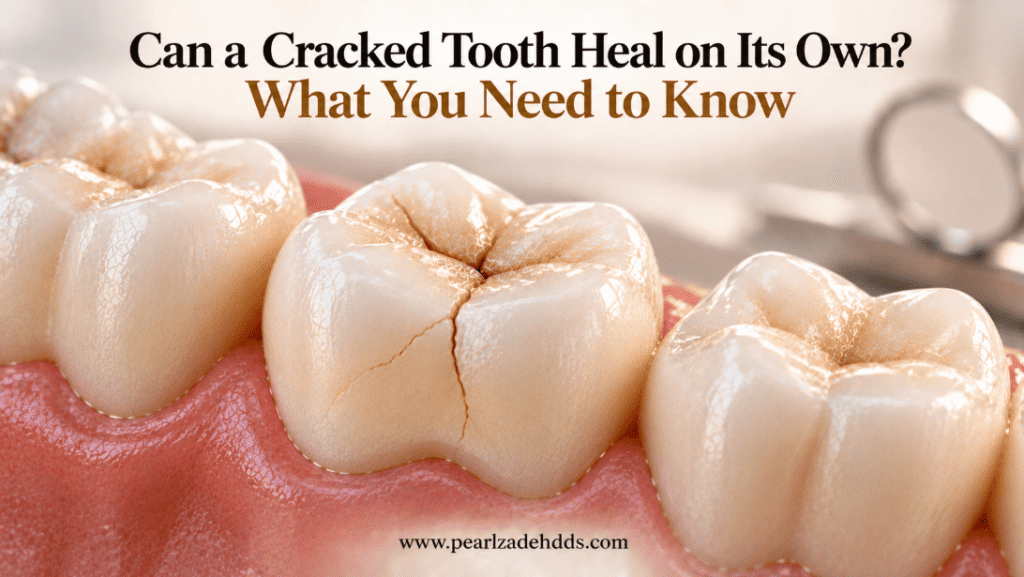
A cracked tooth cannot heal itself. Unlike a broken bone, a tooth cannot grow back together once its structure splits. The pain may fade or come and go, but that does not mean the crack has healed.
Minor enamel changes are different. Early mineral loss at the tooth surface can sometimes be reversed through remineralization. A crack, however, is a physical split in the tooth structure, and remineralization does not close it.
Pain from a cracked tooth may come and go, even when the crack remains. A dentist can assess the crack’s location, depth, and extent to determine the likely outlook and what treatment may help protect the tooth.
Can a Cracked Tooth Repair Itself?
Why a Crack Does Not Heal Like a Bone
The American Association of Endodontists (AAE) says a cracked tooth’s fracture will not heal, unlike a broken bone. Cleveland Clinic gives the same answer: a cracked tooth cannot heal, but treatment might save the tooth.
This means waiting does not close a crack. Time alone does not rejoin the two sides.
Mineral Repair Is Not Crack Repair
Teeth do have some ability to recover mineral. The National Institute of Dental and Craniofacial Research (NIDCR) explains how teeth lose and regain minerals all day long. Saliva supplies minerals, and fluoride helps. In the early stage, marked by a white spot, enamel can repair itself.
That recovery has limits. NIDCR calls a cavity permanent damage that a dentist has to repair. Cleveland Clinic says lost enamel does not grow back. Mineral recovery applies to early surface changes. It does not turn a structural crack back into solid tooth.
Not Every Line on a Tooth Is a Serious Crack
Some lines are superficial. The AAE describes craze lines as tiny cracks that affect only the outer enamel. It says they cause no pain and matter only for appearance. Cleveland Clinic says some hairline cracks may not need treatment. That applies to cracks that cause no pain or infection and do not run deep.
A visible line is not automatically a problem. Some cracks are hard to see. Only a dental exam can say which kind of line a tooth has.
Why Does Cracked-Tooth Pain Come and Go?
The AAE says cracked-tooth pain is often erratic, and it may come and go. Pain can appear with chewing, with the release of biting pressure, or with hot and cold. Chewing can move the cracked pieces, which irritates the pulp inside the tooth.
StatPearls calls sudden sharp pain on biting the most frequently reported symptom. It also lists sensitivity triggered by cold drinks and food.
Several things may affect how a crack feels on a given day. These include chewing pressure, temperature exposure, and the crack’s location and extent. A crack in one spot may rarely bear load. Another may flex with every bite.
Some cracks cause little or no pain. Cleveland Clinic says cracked teeth do not always cause symptoms. The AAE notes that intermittent pain can make the affected tooth hard for a dentist to locate.
Less Pain Does Not Mean the Crack Healed
Pain often fades with time. A three-year National Dental PBRN study followed untreated back teeth with visible cracks. Most biting pain had resolved by a follow-up visit. The authors concluded that few of these pains are constant and most resolve over time.
That finding concerns pain. The study recorded pain only as present or absent. Pain that fades does not show that a crack has healed. It also does not show that the tooth is safe to ignore.
What Happens If a Cracked Tooth Is Left Untreated?
Outcomes vary from tooth to tooth. Some cracks remain relatively stable. Others extend or lead to further damage. Predicting which path a given crack will take is hard.
The AAE explains one way trouble can develop. Over time, the pulp may become damaged beyond its ability to heal. The tooth may then hurt without any trigger.
The AAE says an untreated cracked tooth will progressively worsen. It adds that extensive cracks can lead to infection of the pulp. Cleveland Clinic says cracks sometimes continue to get bigger or split. It adds that an untreated crack may lead to an infection, called a tooth abscess.
Other evidence shows a more varied picture. The PBRN study followed 2,858 teeth with visible cracks. About 80% of those recommended for monitoring stayed on monitoring for three years. Dentists chose patients they expected to keep their teeth. The authors say this likely contributed to the high retention rate.
StatPearls, a clinical reference, calls cracked tooth syndrome occasionally unpredictable. It says patients should be told the condition may result in tooth loss, even with seemingly minor symptoms. That caution does not mean every crack will worsen. It means a dentist’s assessment matters more than how the tooth feels.
Depending on the crack’s location and severity, a tooth may become more painful or develop complications. Not every crack reaches that point.
Can a Dentist Save a Cracked Tooth?
Sometimes. StatPearls says the extent, position, and direction of a crack determine the prognosis. Several details shape the outlook:
- The crack’s depth.
- The crack’s direction.
- The crack’s location in the tooth.
- Whether the crack extends into the root.
- Whether the crack separates parts of the tooth.
The AAE says a split tooth cannot be saved intact, though part of it may sometimes be saved. A crack that extends below the gum line is no longer treatable, it says. Extraction may be needed for a vertical root fracture, it notes.
Other cracks fall short of those situations. The AAE says most treated cracked teeth function comfortably for years. It also says some cracks keep progressing after treatment. A crown does not guarantee success in every case.
The right care depends on the individual tooth. No symptom or visible line can settle the question. StatPearls says early detection plays a crucial role in the prognosis of a cracked tooth.
When Should You Have a Cracked Tooth Checked?
Arrange a dental evaluation if you suspect a cracked tooth, even if the discomfort has improved. A suspected crack can be hard to confirm by sight alone. Dr. Pearl’s article on how a cracked tooth is diagnosed when an X-ray looks normal explains why an exam matters.
Seek prompt assessment for significant pain or a recent injury. Cleveland Clinic says to call your dentist right away if an injury loosened a tooth.
Severe swelling, fever, or difficulty swallowing or breathing needs urgent medical or dental care. Mayo Clinic says to go to the emergency room for trouble breathing or swallowing. It also advises the emergency room for fever with facial swelling if a dentist cannot be reached. For other steps to take before a visit, read Dr. Pearl’s article on what to do if you have a cracked tooth.
Dr. Pearl Zadeh can examine the tooth, explain the findings, and discuss the options that fit.
Call (818) 716-6722 or click the button below to schedule your consultation online.
Frequently Asked Questions
No. Even a small structural crack does not heal on its own, according to the AAE. Superficial craze lines are different, since they affect only the outer enamel. A dentist can tell which kind a tooth has.
Symptoms can shift with chewing pressure, temperature, and the crack’s location. Pain from cracks often fades over time. Stopped pain does not mean the crack closed.
It can. Cleveland Clinic says cracked teeth do not always cause symptoms. The AAE says a vertical root fracture often has minimal symptoms. Not every crack worsens, but pain is not a reliable guide.
Sometimes. The outcome depends on the crack’s depth, direction, and location. It also depends on whether the crack reaches the root or splits the tooth. Some teeth can be preserved, while others have a poor outlook.
Yes. A dentist can check whether a crack is present and how it looks. Some cracks are monitored instead of treated. In the PBRN study, about 80% of teeth recommended for monitoring stayed on monitoring for three years.
The information above is for informational purposes only and is not a substitute for professional dental advice. Please schedule a consultation with Pearl Zadeh DDS to discuss your specific situation.