
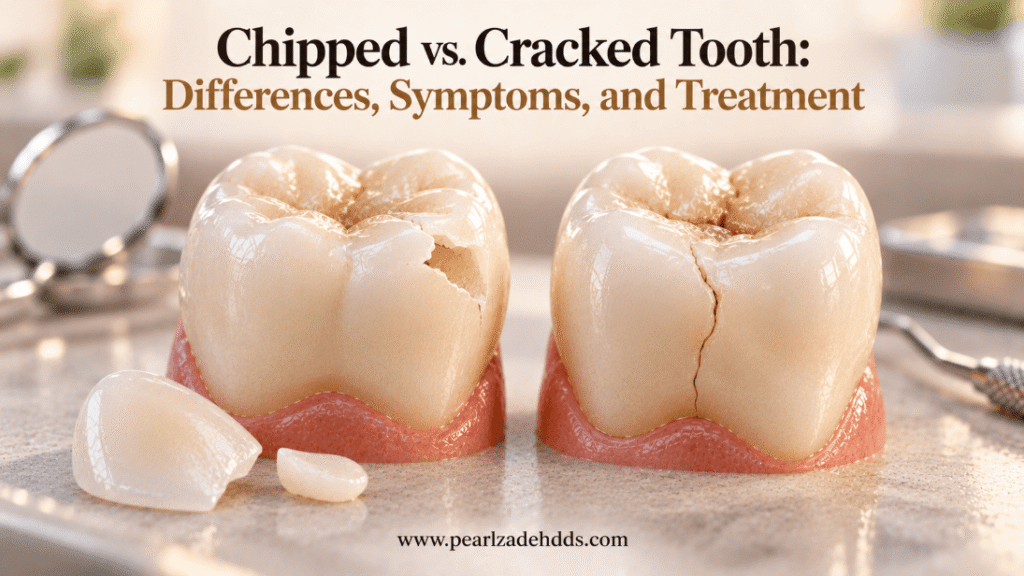
You run your tongue over a back tooth and notice a rough edge. Or you feel a sharp twinge when biting down. You may be wondering whether the tooth is chipped or cracked.
A chip usually means a piece of the tooth has broken away. A crack is a line or split in the tooth structure. The symptoms can overlap, but the damage may differ in depth and severity. A more extensive fracture can reach deeper parts of the tooth and require different treatment.
You cannot always tell how serious the damage is by looking at the tooth. A dental examination can help identify the problem and determine which treatment may be appropriate.
What Is the Difference Between a Chipped, Cracked, and Fractured Tooth?
Dental terms overlap, and different sources use the words differently. The categories below are not always mutually exclusive. Still, plain definitions help.
Chipped tooth. A chip involves a piece of tooth structure breaking away. Small chips may affect only enamel. Larger chips can expose dentin or involve deeper structures. Cleveland Clinic describes a chipped tooth as one in which a fragment of enamel has broken off. Severe chips can expose the tissue beneath the enamel, it adds.
Cracked tooth. A crack is a line or fracture within the tooth. Some cracks are hard to see. They may cause pain when biting or sensitivity, but symptoms vary. The American Association of Endodontists (AAE) describes a cracked tooth as a vertical crack toward the root. That tooth is not yet separated into pieces. It treats craze lines, which are tiny cracks in the outer enamel, as a separate and common finding.
Fractured tooth. Fracture is a broad term for broken tooth structure. A fracture may be minor or extensive. It may involve a cusp, the crown of the tooth, or deeper structures. The AAE’s categories include a fractured cusp, a split tooth with separable segments, and a vertical root fracture. Because the categories overlap, a dentist’s exam matters more than the label you choose at home.
What Do Chipped and Cracked Teeth Look or Feel Like?
Chips and cracks can look and feel different. These signs are not a diagnostic checklist, because they can overlap. Common signs include:
- A rough or uneven edge.
- A visible piece missing from the tooth.
- A fine line on the tooth surface.
- Pain when biting or releasing pressure.
- Sensitivity to hot, cold, or sweet foods.
- Discomfort that comes and goes.
- No obvious symptoms despite a crack.
The AAE lists a variety of symptoms, including erratic pain when chewing, possibly with the release of biting pressure. It also lists pain with temperature extremes and notes that the pain may come and go. StatPearls, a clinical reference, calls sudden sharp pain on biting the most frequently reported symptom.
Small chips may be painless, and cracks may not be visible in a mirror. The AAE adds that your dentist may have difficulty locating which tooth causes the discomfort. These signs also occur with other problems. MouthHealthy lists decay, fractured teeth, worn fillings, and gum disease among causes of tooth sensitivity. Do not diagnose yourself from symptoms alone.
Neither appearance nor symptoms can reliably show how deep the damage goes.
What Can Cause a Tooth to Chip or Crack?
Several factors can contribute, and not every chipped or cracked tooth has the same cause. Common contributors include:
- Biting hard foods or objects.
- Sports injuries, falls, or other trauma.
- Teeth grinding or clenching.
- Large existing fillings or weakened tooth structure.
- Normal wear over time.
The AAE says a tooth can crack from an injury or from general wear and tear. It advises against chewing ice, unpopped popcorn kernels, or pens, and against clenching or grinding. A fractured cusp, it notes, often breaks around a filling. StatPearls says teeth weakened by restorations face a higher fracture risk under biting forces. It also notes that tooth properties can change with age.
MouthHealthy advises wearing a mouthguard for sports and recreation. It also warns that chewing ice, popcorn kernels, and hard candy can crack a tooth.
How Do Dentists Tell Whether a Tooth Is Chipped or Cracked?
A dentist considers your symptoms, dental history, examination findings, and appropriate diagnostic tests. Depending on the case, the dentist may use magnification, check the bite, apply transillumination, or take X-rays. Expect questions about when the pain occurs, what triggers it, and whether it has changed.
StatPearls says a thorough visual exam with magnification and illumination may reveal fracture lines. It calls fiber-optic transillumination particularly valuable and says bite tests help pinpoint the affected tooth and cusp. A 2022 AAE newsletter adds that the naked eye often misses subtle details of cracks.
X-rays have limits. StatPearls says a radiograph may show a thin line when the fracture runs in one direction. A crack running in another direction may not appear. Some cracks do not show on standard X-rays. An X-ray that looks normal does not always rule out a crack. Symptoms alone cannot confirm one either.
Our article on how a cracked tooth is diagnosed when an X-ray looks normal covers the process in detail.
How Is a Chipped Tooth Treated?
Treatment depends on the amount of tooth structure lost and whether deeper structures are affected. The most conservative suitable option may preserve more natural tooth structure. Options include:
- Smoothing or polishing a very small chip.
- Composite bonding for selected minor to moderate chips.
- Veneers for certain front-tooth defects when suitable.
- Crowns for selected cases with more extensive damage or weakened tooth structure.
- Additional treatment if the damage affects the pulp or other internal structures.
Cleveland Clinic says a provider may polish and smooth a small chip so it blends with surrounding teeth. It describes bonding as filling in the chip with composite resin. Veneers suit a minor chip that needs more coverage than bonding provides. Crowns, it says, are caps that protect a weak or heavily damaged tooth. A chip that exposes the nerve may need a root canal, it adds.
The AAE says most chipped teeth can be repaired. For a broken fragment, the NHS advises keeping it in milk or saliva and seeing a dentist. A dentist may be able to glue it back on.
No chip automatically needs a crown or a veneer. Lost tooth structure does not grow back, though. A chip that needs no treatment is still worth showing your dentist.
How Is a Cracked or Fractured Tooth Treated?
Treatment depends on the crack’s location, depth, extent, and restorability. The AAE says treatment and outcome depend on the type, location, and extent of the crack. It also says that, unlike a broken bone, the fracture in a cracked tooth will not heal. Options include:
- Monitoring selected superficial craze lines when no treatment is indicated.
- Restorations for certain fractures involving a cusp or weakened portion of the tooth.
- Crowns for selected cracks when additional coverage and protection are appropriate.
- Root canal treatment when the crack reaches the pulp and the tooth can still be restored.
- Extraction when a tooth cannot be restored, as with some split teeth or deep fractures.
Craze lines cause no pain and are of no concern beyond appearances, according to the AAE. For a fractured cusp, it says a dentist can place a new filling or crown. If a crack reaches the pulp, it says a root canal and crown can keep it from spreading.
The AAE also says a split tooth cannot be saved intact, though endodontic treatment may sometimes save a portion. It says a cracked tooth whose crack extends below the gum line cannot be saved. For a vertical root fracture, treatment may involve extraction. Which option fits depends on the whole picture, not on one finding.
StatPearls describes a suitable restoration for cracked teeth without pulp symptoms. It also says cuspal coverage with a crown or onlay may work well as an external splint. Monitoring has a role too. In a National Dental PBRN observational study, 2,858 patients each had a visible crack in a back tooth. About 80% of teeth recommended for monitoring stayed on monitoring for three years.
A crown cannot repair every crack or guarantee that a crack will not progress. The AAE says a crown provides maximum protection but does not guarantee success in all cases. If your dentist discusses a crown, you can read about dental crown treatment at Pearl Zadeh DDS.
When Should You Seek Dental Care?
A visible chip, a suspected crack, or new pain when biting warrants a dental evaluation. The NHS says to see a dentist if you chip, crack, or break a tooth. It describes these injuries as usually not serious. StatPearls says early detection plays a crucial role in the prognosis of a cracked tooth.
Seek prompt care for significant pain, a large break, or sensitivity that persists or worsens. Cleveland Clinic says to call your dentist right away if an injury loosened a tooth.
Facial trauma, uncontrolled bleeding, or difficulty breathing or swallowing calls for urgent emergency care. Cleveland Clinic lists bleeding that will not stop as an emergency room reason. Severe pain that medication does not relieve and a broken jaw are others. Mayo Clinic advises the emergency room for trouble breathing or swallowing.
Our article on what to do if you have a cracked tooth covers immediate steps. Dr. Pearl Zadeh can examine your tooth and explain whether it is chipped, cracked, or fractured. Dr. Pearl can also discuss the options that fit.
Call (818) 716-6722 or click the button below to schedule your consultation online.
Frequently Asked Questions
Sometimes. A crack can lead to a missing piece, and a chip can sit near a crack. Appearance alone cannot show the depth of the damage, so a dentist needs to examine the tooth.
No. The AAE says that, unlike a broken bone, the fracture in a cracked tooth will not heal. A crack does not close the way a cut in skin does. Treatment depends on the type of damage and the tooth’s condition.
Not always. A very small chip may need only smoothing. Lost tooth structure does not grow back, and a chip can sit alongside deeper damage. A dentist can tell whether treatment is needed.
Sometimes. It depends on the crack’s location, depth, and extent and on how much healthy tooth remains. A split tooth or a crack that extends below the gum line may not be savable. Your dentist can explain what applies.
Not always. Some cracks do not appear on a standard X-ray, depending on the crack’s direction. Dentists also use symptoms, history, magnification, and other tests. A normal X-ray does not rule out a crack.
The information above is for informational purposes only and is not a substitute for professional dental advice. Please schedule a consultation with Pearl Zadeh DDS to discuss your specific situation.