
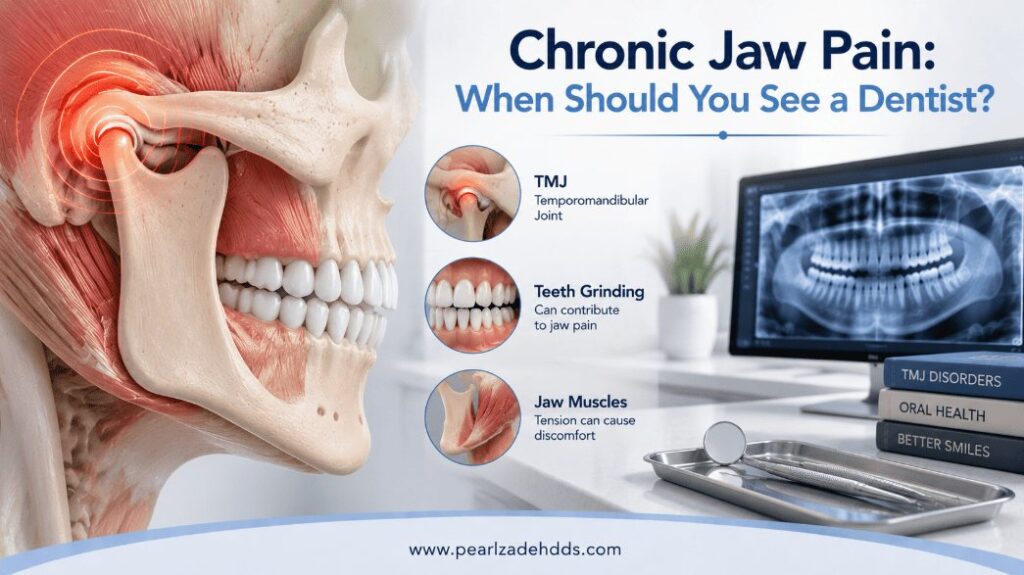
Jaw pain is easy to ignore when it comes and goes. You might notice it while chewing, wake up with a tight jaw, or feel soreness around your temples after a stressful day. Then it settles down, so you move on.
But when the pain keeps returning, becomes more noticeable, or starts affecting how you eat or sleep, waiting it out becomes harder to justify.
So when should you actually see a dentist for jaw pain? The answer depends on how long it has lasted, what triggers it, and what other symptoms you are experiencing.
What Counts as Chronic Jaw Pain?
“Chronic” generally means pain that persists or keeps returning over an extended stretch of time. The National Institutes of Health describes chronic pain broadly as pain lasting longer than three months, or longer than the time your body would normally need to heal. That’s a general medical benchmark, not a strict rule specific to your jaw. The pattern of your pain matters just as much as how long it’s lasted. Temporary soreness after a long day of chewing is different from discomfort that keeps returning every few weeks, which is different again from pain that’s simply been there, on some level, for a while now. Worth paying attention to whether your pain shows up in the morning, during chewing, when you open your mouth wide, after stressful stretches, alongside headaches, with clicking or popping, or together with tooth pain. Those details tell your dentist more than the raw duration alone.
Where Does Jaw Pain Come From?
Jaw pain can come from more places than people expect. The jaw joints themselves, the muscles around them, the teeth, the gums, strain related to your bite, clenching or grinding habits, previous dental work, or an old injury can all be involved. This isn’t a list to diagnose yourself from. It’s exactly why figuring out the actual source is one of the more useful things a dental evaluation can do.
Could Teeth Grinding Be Causing Your Jaw Pain?
It’s a genuine possibility for some patients. Nighttime grinding and daytime clenching place repeated stress on your jaw muscles and teeth, which can show up as morning jaw soreness, general muscle fatigue, tooth wear, or tooth sensitivity. Our discussion of how teeth grinding damages teeth over the years goes further into that connection. Not everyone with jaw pain grinds their teeth, though, so this is one possible piece of the picture rather than an automatic explanation.
Could TMJ Disorder Cause Jaw Pain?
Problems involving the temporomandibular joints or the muscles around them can genuinely cause jaw pain. That can include pain near the joint itself, pain while chewing, clicking or popping, jaw stiffness, limited opening, headaches, or facial muscle soreness. Our broader overview of TMJ disorder covers this territory in more depth. Clicking alone doesn’t automatically mean you’re dealing with a serious TMJ disorder. It’s one detail among several a dentist actually weighs.
Can Jaw Pain Come From a Tooth?
Not all pain you feel around your jaw actually originates in the joint. Tooth decay, a cracked tooth, a dental infection, gum problems, or an issue with an existing restoration can all cause pain that feels broader than one specific tooth. Dental pain has a way of radiating outward, which is part of why patients often can’t pinpoint the true source on their own. None of these possibilities can be confirmed from symptoms alone.
Can Your Bite Contribute to Jaw Pain?
How your upper and lower teeth meet can be relevant for some patients, though it isn’t accurate to say an imperfect bite automatically causes chronic jaw pain. A dentist evaluating this might look at bite contact, tooth wear, existing restorations, signs of clenching, and jaw movement together. Our discussion of signs your bite may be causing dental problems goes further into that evaluation. Bite assessment is one part of a broader picture, not the whole story on its own.
When Should You See a Dentist for Jaw Pain?
A dental evaluation makes sense when jaw pain:
- Keeps returning
- Doesn’t improve
- Makes chewing uncomfortable
- Affects your sleep
- Comes with tooth sensitivity
- Occurs alongside noticeable tooth wear
- Comes with painful clicking or popping
- Makes opening your mouth difficult
- Occurs with headaches or facial muscle soreness
- Follows dental treatment and doesn’t feel normal afterward
Persistent or recurring symptoms deserve attention even when the pain itself isn’t severe. Our guide to when jaw symptoms warrant a dental evaluation goes further into that specific question.
When Is Jaw Pain an Urgent Problem?
A few situations call for prompt attention rather than a routine appointment:
- Significant facial swelling
- Fever along with dental or jaw pain
- Difficulty breathing or swallowing
- Signs of a severe infection
- Major trauma to the jaw
- Jaw locking that prevents normal movement
- Sudden severe pain accompanied by other concerning symptoms
If you’re experiencing difficulty breathing or swallowing, that calls for urgent medical care, not a wait-and-see approach. Most jaw pain doesn’t fall into this category, but these specific situations are worth knowing.
What Happens During a Jaw Pain Evaluation?
Expect questions about:
- When the pain started
- Where it hurts
- What makes it better or worse
- Whether it happens during chewing
- Whether you grind or clench
- Whether you get headaches
- Your previous dental treatment
- Any past jaw injuries
Your dentist may then examine your:
- Teeth
- Gums
- Bite
- Jaw movement
- Jaw muscles
- The TMJ area itself
Imaging sometimes gets recommended depending on what the exam finds, though not every patient needs X-rays or advanced imaging as a matter of routine.
Does Every Jaw Pain Patient Need a Night Guard?
No. A night guard can genuinely help patients who grind or clench, particularly when protecting the teeth is part of the goal. It isn’t automatically the answer for every case of jaw pain, though. What’s actually causing the pain needs to be understood before an appliance gets recommended, not the other way around.
What About TMJ Treatment Without Surgery?
Some TMJ-related symptoms can be managed with conservative approaches, depending on the underlying cause and how severe things are. Our discussion of non-surgical TMJ treatment options covers this in more depth. Not every TMJ condition can be resolved without surgery, but for plenty of patients, conservative care is where things reasonably start.
Can Stress Make Jaw Pain Worse?
For some people, yes. Stress may contribute to jaw clenching and general muscle tension, and patients sometimes notice more discomfort during particularly stressful stretches. This doesn’t mean stress explains every case of chronic jaw pain. It’s one contributing factor among several possible ones.
What Can You Do While Waiting for an Appointment?
A few low-risk, temporary steps can help in the meantime. Choose softer foods if chewing is uncomfortable. Skip chewing gum for now. Avoid opening your mouth unnecessarily wide. Pay attention to whether you’re clenching during the day. Follow any instructions your dentist has already given you. Keep a rough note of when your symptoms show up. None of this is a diagnosis or a cure, and it isn’t a reason to try aggressive jaw exercises or make permanent changes to how you eat. These are just reasonable comfort measures until you’re actually seen.
What If the Pain Comes and Goes?
Intermittent symptoms still deserve attention, even if you feel completely fine for days at a time between episodes. Pay attention to whether certain patterns line up with your flare-ups, stressful periods, mornings specifically, certain foods, chewing, recent dental treatment, clenching, or headaches. Mentioning those patterns during your visit gives your dentist genuinely useful information, more than just describing the pain itself.
What If Your Jaw Pain Started After Dental Work?
Some temporary soreness after certain dental procedures is normal. Persistent, worsening, or unusual symptoms are a different matter and worth a conversation with your dentist. Mention when the pain actually began, what procedure you had done, whether your bite feels different than before, whether chewing feels uncomfortable, and whether things seem to be improving or getting worse. This doesn’t mean the treatment caused a lasting problem. It just means it’s worth having someone take a look.
How Can You Tell If Jaw Pain Is Coming From Your Teeth or Jaw?
Honestly, you often can’t tell on your own. Tooth pain, jaw muscle discomfort, TMJ symptoms, and pain that radiates from somewhere else nearby can all feel remarkably similar. A dental examination is really what helps narrow down where the problem is actually coming from. There isn’t a reliable way to self-diagnose this based on symptoms alone.
Can Chronic Jaw Pain Go Away on Its Own?
Sometimes, yes. Some temporary jaw discomfort settles without any treatment at all. Pain that persists, keeps coming back, gets worse, or starts affecting your eating and daily activities is a different situation and genuinely deserves evaluation. Waiting indefinitely on the assumption it will eventually resolve isn’t a great strategy once a pattern like that shows up.
What Happens If You Ignore Chronic Jaw Pain?
Ignoring persistent symptoms mainly delays figuring out what’s actually causing them. If the underlying issue involves tooth damage, ongoing grinding, an infection, or a jaw function problem, putting off an evaluation just gives that issue more time to continue. This doesn’t mean every case of untreated jaw pain is destined to become severe. It just means there’s little upside to waiting once symptoms are clearly sticking around.
Persistent Jaw Pain Is Worth Checking
Jaw pain can come from the jaw joints, the surrounding muscles, your teeth, your gums, clenching or grinding, previous dental work, or other causes entirely. Occasional mild soreness may well settle on its own. Recurring or persistent pain deserves real attention. A dentist can evaluate your teeth, bite, jaw movement, muscles, and other relevant areas to help figure out what’s actually contributing to what you’re feeling. The goal was never simply to treat the pain. It’s to understand why it’s happening in the first place.
Speak With Dr. Pearl Zadeh About Your Jaw Pain
Persistent jaw pain can have several possible causes, and patients don’t always know where the discomfort is actually coming from. Dr. Pearl Zadeh, a member of the American Dental Association and California Dental Association, can evaluate your teeth, bite, jaw, and related symptoms to help identify what may be contributing to what you’re experiencing.
Call (818) 716-6722 or click the button below to schedule a consultation online.
Frequently Asked Questions
How long does jaw pain need to last before I should see a dentist?
There’s no strict cutoff, but pain that keeps returning, doesn’t improve, or interferes with chewing or sleep is worth having evaluated rather than waiting further.
Does jaw pain always mean I have TMJ disorder?
No. Jaw pain can come from the joint, the surrounding muscles, a tooth, the gums, or your bite. A dental evaluation helps identify the actual source.
Can a tooth problem cause pain that feels like it’s in my jaw?
Yes. Dental pain from decay, a crack, or an infection can radiate outward and feel broader than one specific tooth.
When is jaw pain an emergency?
Significant facial swelling, fever with jaw pain, difficulty breathing or swallowing, major trauma, or jaw locking all call for prompt attention rather than a routine appointment.
Will jaw pain go away on its own?
Sometimes mild, temporary soreness does. Pain that persists, keeps returning, or affects eating and daily activities is worth having evaluated.
This article is for informational purposes only and is not a substitute for professional dental or medical advice. Please schedule a consultation with Pearl Zadeh DDS to discuss your specific situation, and seek prompt medical care for any urgent or severe symptoms.