
You catch your smile in a photo and something looks slightly off compared to a few years ago. The edges of your front teeth look flatter than you remember. Cold water sends a quick zing through one tooth that never used to bother you. Maybe your partner mentioned hearing a grinding sound coming from your side of the bed last night.
Teeth grinding rarely damages teeth all at once. The real issue is repeated pressure and friction, showing up again and again over months and years until the changes finally become visible. Because the wear happens so gradually, plenty of people never notice it happening in real time. They just notice the result one day, seemingly out of nowhere.
It’s also more common than most people realize. One peer-reviewed study puts bruxism at around 31 percent of adults, meaning a noticeable chunk of the people around you deal with some version of this too, even if they’ve never mentioned it.
What Is Teeth Grinding?
Dentists call this bruxism, and it actually covers two related habits. Grinding is when your teeth slide or rub against each other. Clenching is when your jaw muscles tighten forcefully, sometimes without much actual tooth movement. Both can happen while you’re awake or while you’re asleep, and plenty of people have no idea they’re doing either one. You can’t always tell just by paying attention to your own mouth.
Why Grinding Can Damage Teeth
Every time your teeth grind or clench against each other, that repeated contact places real stress on your enamel and the tooth structure underneath. How much that stress actually adds up to varies a lot from person to person. It depends on how often it happens, how much force is behind it, how long the habit has been going on, the condition your teeth were already in, whether you have fillings, crowns, or veneers, and even the specific shape of your bite. The National Institute of Dental and Craniofacial Research notes that mild or occasional bruxism isn’t a health problem on its own, though it’s worth keeping an eye on, since frequent or severe grinding left unaddressed can eventually contribute to real dental problems. Two people who both grind their teeth can end up with very different amounts of actual wear.
The Early Signs of Tooth Wear
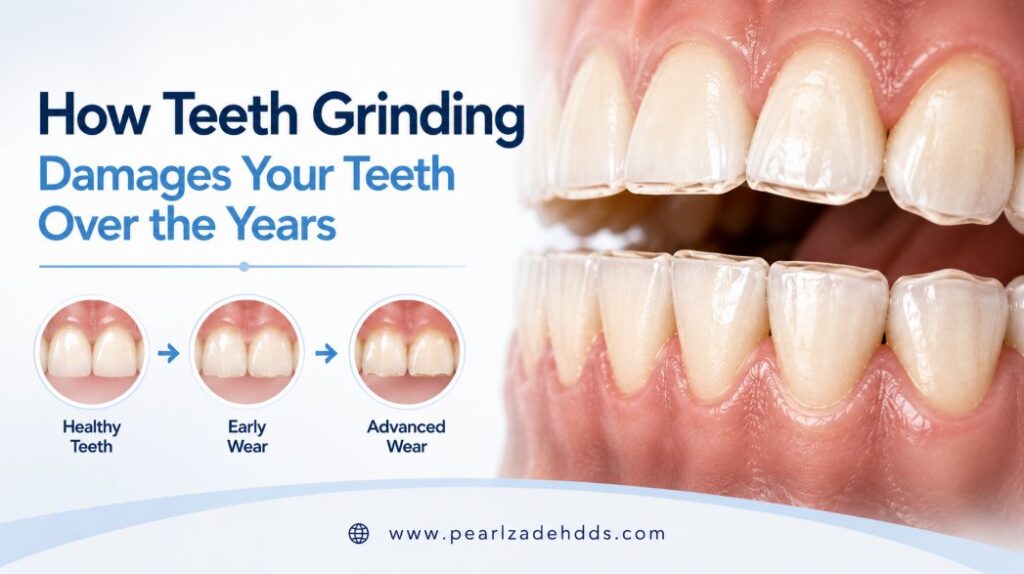
Early changes tend to be subtle. Biting edges that look a little flatter than before. A small chip you don’t remember getting. A tooth shape that’s shifted slightly. New sensitivity to cold or sweet. Rough or sharp spots where a tooth used to feel smooth. Flattened areas on your back teeth. Small cracks that don’t necessarily hurt yet. None of this is usually painful in the early stages, which is part of why it goes unnoticed. A dentist often spots these changes during a routine exam before a patient ever mentions anything.
What Happens to Enamel Over Time?
Enamel is the hard, outer layer covering each tooth, and once it’s genuinely lost, it doesn’t grow back. Repeated grinding can gradually thin that layer down over months and years. This doesn’t mean every clenching episode causes measurable damage. A single stressful night of grinding isn’t the same as months of consistent pressure. There’s a real difference between the slow, normal wear everyone’s teeth experience just from a lifetime of chewing, and the more excessive wear that comes from repeated forceful grinding well beyond what normal use accounts for.
Can Grinding Make Your Teeth Sensitive?
It can, eventually. Significant wear can thin enamel enough to expose dentin, the softer layer underneath that’s naturally more sensitive to temperature and pressure. That said, sensitivity has plenty of other possible causes too, including decay, gum recession, or a cracked tooth. Noticing sensitivity doesn’t automatically mean you grind your teeth. It just means something is worth having looked at.
Can Teeth Become Shorter From Grinding?
Over enough time, yes, repeated wear can gradually flatten or shorten the visible parts of your teeth. Front incisor edges can lose their natural slight curve. Canine tips, normally a bit pointed, can flatten out. Molars can lose the natural contours that once helped them grip food while chewing. There’s no way to predict exactly how much wear any individual will experience. In more severe cases, this kind of change can affect both how your smile looks and how comfortably you chew.
What Happens When Tooth Wear Gets More Advanced?
This isn’t an inevitable progression for everyone, but when wear does advance, it can bring increased sensitivity, chips, small fractures, real loss of tooth structure, changes in how your upper and lower teeth actually meet, discomfort while chewing, and a higher risk of damage to any existing dental work. Once a meaningful amount of tooth structure is gone, restoring it becomes a more involved process than addressing the same issue back when it was still an early, subtle sign.
Can Grinding Damage Fillings, Crowns, or Veneers?
Dental restorations sit under the same repeated stress your natural teeth do, and they aren’t immune to it. Grinding and clenching can chip a restoration, crack one, wear it down faster than expected, or in some cases loosen it. Our porcelain veneers guide touches on durability considerations if you’re weighing cosmetic work alongside a grinding habit. None of this means a filling, crown, or veneer is guaranteed to fail if you grind your teeth. It just means restorations face some of the same forces your natural teeth do.
Can Grinding Cause Cracks in Teeth?
Repeated heavy force can contribute to cracks or fractures in some teeth, though not every cracked tooth traces back to grinding. There’s a real difference between a minor surface crack and a more significant fracture that affects how a tooth functions. Pain when you bite down, pain specifically when you release the bite, new sensitivity that wasn’t there before, a tooth that suddenly feels different than its neighbors, or a visible chip or fracture are all reasonable reasons to get a tooth checked rather than waiting to see if it resolves on its own.
How Can Grinding Affect Your Jaw?
Bruxism doesn’t stop at the teeth. It involves the jaw muscles and often the temporomandibular joints too, the joints connecting your jaw to your skull. Some patients notice jaw soreness, general facial muscle tension, a tired or fatigued jaw first thing in the morning, headaches, or jaw clicking and other joint symptoms. Headaches and jaw pain have plenty of other possible causes beyond grinding, so neither one points to bruxism on its own. Our discussion of TMJ and jaw clicking goes further into what jaw sounds can and can’t tell you, if that’s part of what you’re noticing.
How Do You Know If You Grind at Night?
Plenty of people who grind their teeth in their sleep have no idea they’re doing it, since it happens while they’re unconscious. A few clues can point in that direction: waking up with a sore jaw, morning headaches, tooth sensitivity, teeth that look flatter or chipped, a partner mentioning grinding sounds, or a dentist noticing more wear at a checkup than expected since your last visit. None of these signs prove sleep bruxism on their own. A dentist looks at the overall pattern of wear alongside your symptoms and history to get a clearer picture.
Can You Stop the Damage From Getting Worse?
Catching it early gives your dentist more room to monitor how your teeth are wearing and address whatever’s contributing to it. Depending on your situation, that might mean simply monitoring changes over time, addressing clenching habits directly, reviewing medications or other factors that sometimes play a role, managing jaw symptoms if they’re present, or considering a professionally fitted night guard when it genuinely makes sense for your case. Not everyone who grinds their teeth automatically needs a night guard, and an over-the-counter option isn’t necessarily the right fit for every patient’s bite.
What Does a Dentist Look For?
An exam typically covers:
- Flattened tooth surfaces
- Matching wear patterns between opposing teeth
- Chips or fractures
- Enamel loss
- Cracks
- Sensitivity
- Changes in how your bite comes together
- Damaged restorations
- Tenderness in the jaw muscles
- Other signs that suggest clenching or grinding
Your dentist is looking at the overall pattern across your mouth rather than diagnosing bruxism from one worn tooth in isolation.
Does Teeth Grinding Always Need Treatment?
Not necessarily. Some patients have mild wear that mostly just needs monitoring over time. Others have more active or significant grinding that calls for actual management. What makes sense depends on how much wear is present, what symptoms you’re having, whether things seem to be progressing, what dental work you already have, and your overall situation. There isn’t one solution that fits every patient here.
When Should You See a Dentist?
A handful of signs are worth bringing up rather than waiting to mention:
- New or worsening tooth sensitivity
- Noticeably flattened teeth
- Repeated chips
- A cracked tooth
- Pain when biting down
- Jaw soreness
- Morning headaches tied to jaw tension
- A partner regularly hearing grinding at night
- Dental restorations that keep breaking or wearing
- A noticeable change in how your teeth meet
You don’t need to wait until something actually hurts before mentioning it. Signs that your bite may be part of the picture are worth a look too, since a changing bite relationship sometimes shows up alongside grinding.
Speak With Dr. Pearl Zadeh About Teeth Grinding
Grinding-related damage is easy to overlook because it usually develops so gradually. Dr. Pearl Zadeh, a member of the American Dental Association and California Dental Association, can examine your teeth for signs of wear, sensitivity, cracks, restoration damage, bite changes, and jaw symptoms to help determine whether grinding may be part of what’s going on.
Schedule a consultation to talk through what you’re noticing and get a clearer picture of your teeth and bite.
Call (818) 716-6722 or click the button below to schedule a consultation online.
Frequently Asked Questions
Does everyone who grinds their teeth end up with serious damage?
No. Occasional clenching doesn’t automatically lead to significant wear. Repeated or forceful grinding over months and years is what tends to create noticeable problems.
Can teeth grinding really wear down enamel?
Yes, over time. Enamel doesn’t regenerate once it’s genuinely lost, which is why repeated grinding matters more than a single instance of clenching.
How do I know if I grind my teeth at night?
Common clues include waking with a sore jaw, morning headaches, new sensitivity, flattened or chipped teeth, or a partner mentioning grinding sounds. None of these confirm it alone, which is why an evaluation helps.
Can grinding damage a crown or filling?
It can place stress on restorations the same way it does natural teeth, sometimes leading to chips, cracks, or premature wear, though this doesn’t happen to every restoration.
Do I need a night guard if I grind my teeth?
Not necessarily. Whether a night guard makes sense depends on your specific situation, and a dentist can help determine if one is appropriate for you.
This article is for informational purposes only and is not a substitute for professional dental advice. Please schedule a consultation with Pearl Zadeh DDS to discuss your specific situation.