
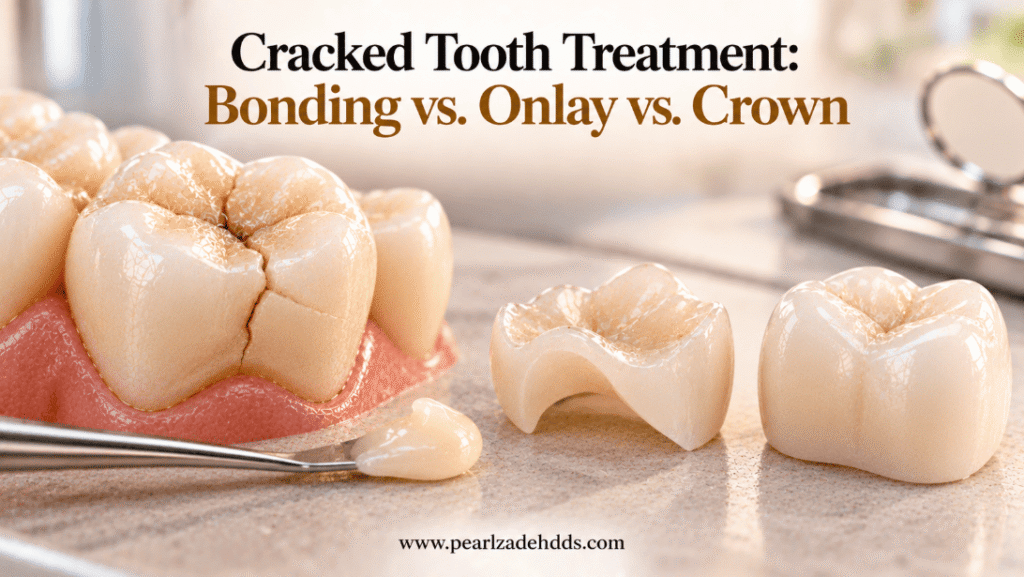
You discover a crack in a back tooth and want to know how it can be repaired. Depending on the damage, a small repair may be enough, while a more extensive crack may need a larger restoration.
Dentists use different treatments for cracked teeth, and each serves a different purpose. Bonding may work for limited damage. An onlay can cover one or more cusps while preserving more of the tooth than a full crown. A crown covers the tooth more extensively when it needs greater protection.
The best option depends on more than the visible crack. Its location and depth, the amount of healthy tooth remaining, whether the pulp is affected, and whether the tooth can be restored all matter. Each treatment has benefits and limitations, which your dentist can explain after examining the tooth.
If you need advice on what to do immediately, read our article on what to do if you have a cracked tooth.
How Does a Dentist Choose the Right Treatment for a Cracked Tooth?
Treatment planning looks at the whole tooth, not only the visible line. A dentist weighs several factors together:
- The crack’s location, depth, and direction.
- How much healthy tooth structure remains.
- Whether the crack affects one or more cusps.
- Whether the dental pulp is involved.
- Existing fillings or previous restorations.
- Bite forces, clenching, or grinding.
- Whether the tooth can be predictably restored.
StatPearls, a clinical reference, says the extent, position, and direction of a crack all affect prognosis. It also says teeth weakened by restorations face a higher fracture risk. Occlusal forces are the leading cause of cracked tooth syndrome, it notes. Extensive restorations and habits such as nighttime grinding can complicate matters.
Symptoms and X-rays may not reveal every detail of a crack. A dentist may combine your history, a clinical examination, and appropriate tests to plan the options. Our article on how a cracked tooth is diagnosed when an X-ray looks normal explains that process.
Some uncertainty can remain even after a thorough exam. StatPearls says a cracked tooth is sometimes unpredictable. It advises clinicians to explain this so patients can set realistic expectations. The AAE adds that early diagnosis can allow more conservative treatment when pulp inflammation is still reversible.
When Can Bonding Help Repair a Cracked Tooth?
Dental bonding uses a tooth-colored composite resin that the dentist shapes directly on the tooth. Cleveland Clinic says the dentist roughens the tooth surface and applies a liquid so the material bonds. The dentist then molds the resin and hardens it with a curing light.
Bonding may be appropriate for selected minor defects or limited damage when enough sound tooth structure remains. A dentist may consider this conservative repair for a small area that does not carry heavy chewing force.
For a crack without pulp symptoms, StatPearls describes removing undermined tissue, then placing a restoration such as flowable composite. It says a direct composite acts as an internal splint that limits flexing under biting load. That description covers selected cases and does not make composite a universal fix.
The main benefit is that bonding can preserve more natural tooth structure. Cleveland Clinic says bonding typically does not require enamel removal. It lists concealing chips or minor cracks among bonding’s uses. Bonding is described there as an option for small cosmetic changes.
The limits matter just as much. Bonding may not provide enough support when a crack crosses a load-bearing area or weakens the tooth. Cleveland Clinic says bonded material can chip over time.
One study offers context. In a National Dental PBRN study, each of 2,858 patients had a visible crack in a back tooth. Treatment failures were associated with intracoronal restorations rather than full or partial coverage. Intracoronal restorations sit within the tooth rather than covering its cusps. The authors note that most of them were bonded composites. Because the patients were not randomly selected, the finding may not apply to every tooth.
So bonding alone may not give enough protection for some cracked teeth. It cannot reliably stabilize every crack. A crack that extends deeply into the tooth calls for a different assessment.
When Is an Onlay a Good Option for a Cracked Tooth?
An onlay is a custom restoration that fits the prepared tooth. It differs from a filling because it can cover part of the chewing surface. Cleveland Clinic says an inlay fills the area between the cusps. An onlay, it adds, also covers at least one cusp. A crown, by contrast, fits over the entire tooth.
In a cracked tooth, a weakened cusp may need more than a filling can offer. StatPearls says cuspal coverage with a crown or onlay may function extremely well as an external splint. Splinting limits flexing of the cracked tooth.
An onlay can restore the tooth’s shape and chewing surface. It can also preserve more of the remaining tooth than some full-crown preparations. That does not hold in every case, so an onlay is not automatically the more conservative or better choice.
The amount of remaining healthy structure matters most. An onlay needs enough sound tooth to hold and support it. If walls or cusps are thin, or the damage is widespread, an onlay may not provide enough coverage.
A dentist judges this after examining the tooth. Sometimes the full picture appears only after the dentist removes an old filling or damaged tissue. Bite forces and the crack’s direction also factor into the decision.
Cleveland Clinic describes onlays for a cavity too big for a filling but too small for a crown. That line addresses cavities, not cracks. For a cracked tooth, the crack’s extent and the tooth’s restorability guide the choice.
When Does a Cracked Tooth Need a Crown?
A crown covers the tooth more fully. Dentists may consider one when extensive damage or weakened structure calls for broader coverage. Cleveland Clinic says dentists use crowns to repair large cavities or restore broken teeth. MouthHealthy, the ADA’s consumer site, says a crown can protect a weak tooth from breaking. It can also restore a broken tooth.
Several situations may point toward a crown. A crack may involve a cusp or a large part of the chewing surface. The tooth may have lost significant structure. An existing filling may take up much of the tooth.
StatPearls says a full-coverage crown allows a more equal distribution of occlusal forces, which helps limit crack propagation. A crown differs from an onlay in extent. An onlay covers part of the tooth, while a crown covers all of it.
A crown also has trade-offs. Cleveland Clinic says the dentist must remove some natural enamel to place one. StatPearls notes that crown preparation is invasive and raises the risk of devitalization. That means the pulp can lose its vitality. If your dentist recommends a crown, you can read about dental crown treatment at Pearl Zadeh DDS.
Not every cracked tooth needs a crown. The AAE says craze lines, which are tiny cracks in the outer enamel, need no treatment beyond appearance concerns. In the PBRN study, about 80% of teeth recommended for monitoring stayed on monitoring for three years.
A crown also cannot guarantee that a crack will stop progressing. The AAE says a crown offers maximum protection but does not guarantee success in every case. It adds that some cracks keep progressing even after treatment. The dentist must first assess the crack’s extent and whether the tooth is restorable.
Bonding vs. Onlay vs. Crown: What Are the Differences?
The table summarizes how the three options generally differ.
| Factor | Bonding | Onlay | Crown |
|---|---|---|---|
| Main purpose | Repairs selected minor defects | Restores damaged areas and may cover one or more cusps | Provides broader coverage for a weakened or extensively damaged tooth |
| Tooth coverage | Limited to the repaired area | Covers part of the tooth, including cusps when needed | Covers most or all of the prepared tooth |
| Tooth preparation | Often minimal | Varies with the damage and design | Usually requires more extensive preparation |
| When it may be considered | Limited damage with adequate remaining structure | Damage requiring cusp coverage while preserving suitable tooth structure | More extensive damage requiring broader coverage |
| Important limitation | May not provide enough support for a weakened tooth | Not suitable for every crack or tooth condition | Cannot make every cracked tooth restorable |
These are general distinctions, not universal rules. A similar crack can call for a different restoration in a different tooth. The dentist must assess the individual tooth before recommending treatment.
What If the Crack Reaches the Nerve or Root?
Restorative treatment depends on how far the crack extends. When a crack reaches the pulp, the tooth may need root canal treatment before or alongside restoration.
The AAE says a root canal removes inflamed or infected pulp from inside the tooth. It lists a crack among the possible triggers. Root canal treatment does not repair the crack itself. It treats the pulp, while a restoration addresses the tooth’s structural needs.
This distinction explains why a restoration often follows. The AAE says the tooth is restored with a crown or filling for protection after a root canal. Cleveland Clinic says people who have root canal therapy also need a crown in most cases.
An AAE Communiqué article cites research on cracked, root canal treated teeth. It reports a higher success rate for teeth with a full-coverage restoration than for those without. The same article says deeper initial periodontal probing depths around a crack were associated with less success. Even so, the right restoration depends on the tooth’s condition.
A crack that extends into the root can make the outlook less favorable. The AAE says a cracked tooth whose crack extends below the gum line is no longer treatable. It adds that a split tooth cannot be saved intact, though part of it sometimes can. A vertical root fracture may require extraction.
StatPearls says clefting of the pulp chamber floor usually means the tooth cannot be restored. When a tooth cannot be restored predictably, extraction may be the appropriate recommendation. Your dentist can explain which situation applies.
How Can You Protect a Tooth After Cracked-Tooth Treatment?
Follow your dentist’s instructions for your specific restoration. Keep up your daily oral hygiene, and attend the follow-up visits your dentist recommends. Those visits let the dentist check the tooth and the restoration.
Grinding and clenching deserve attention. The AAE advises against both. It says to talk to your dentist about a retainer or other mouthguard if you grind during sleep. StatPearls recommends a bite check after a recent restoration. If your bite feels uneven, tell your dentist.
The AAE also notes that some cracks keep progressing even after treatment. That is one reason follow-up matters. If you receive a crown, our article on how long porcelain crowns last with proper care covers upkeep.
No restoration comes with a guarantee, and lifespans vary from tooth to tooth. Dr. Pearl Zadeh can examine your tooth and explain which options fit your situation.
Call (818) 716-6722 or click the button below to schedule your consultation online.
Frequently Asked Questions
Sometimes, for selected minor defects or limited damage with enough sound tooth structure. Bonding may not support a tooth weakened by a deeper crack. Your dentist can tell whether it suits your tooth.
Not automatically. An onlay may preserve more tooth in some cases. A crown may suit a tooth that needs broader coverage. The better choice depends on the crack and the remaining structure.
No. The AAE says craze lines need no treatment beyond appearance concerns. Other cracks may call for bonding, an onlay, a crown, or monitoring. A dentist decides after assessing the tooth.
Yes, in some cases. If a crack reaches the pulp and the tooth is restorable, root canal treatment addresses the pulp. A crown or other restoration then protects the tooth. Neither step repairs the crack itself.
Sometimes. It depends on the crack’s location and extent, pulp involvement, and whether the tooth can be restored. A split tooth or a crack below the gum line may not be savable. Your dentist can explain what applies.
The information above is for informational purposes only and is not a substitute for professional dental advice. Please schedule a consultation with Pearl Zadeh DDS to discuss your specific situation.