
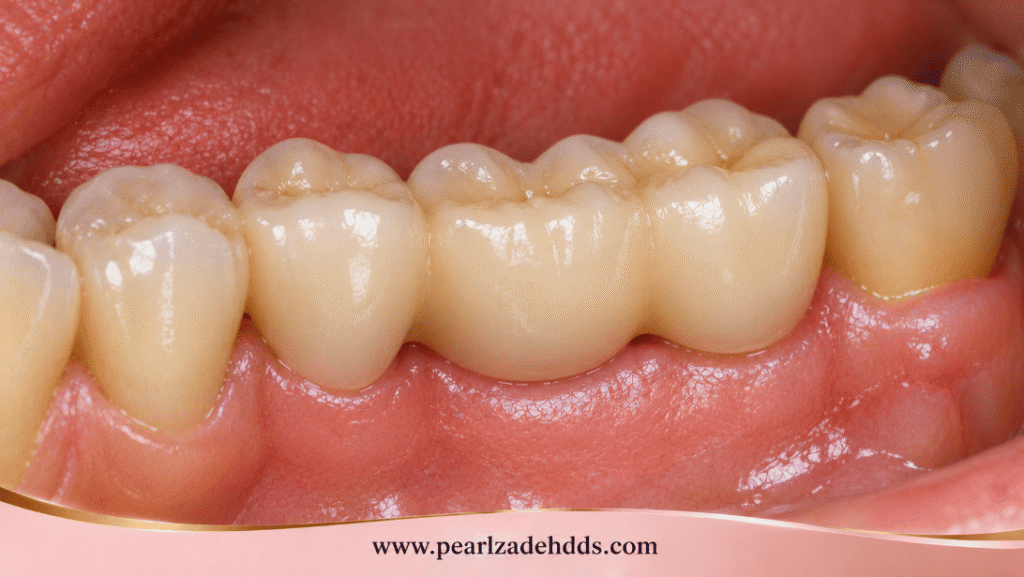
Can one dental bridge replace several missing teeth, or does each missing tooth need its own restoration? Patients often ask this when considering ways to replace missing teeth.
The answer depends on more than the number of missing teeth. The location and length of the gap, the condition of the supporting teeth, and the forces placed on the bridge all affect the design.
How Many Missing Teeth Can a Dental Bridge Replace?
A dental bridge can replace one missing tooth or several adjacent teeth. The number it can replace depends on the support available and the location of the gap.
Cleveland Clinic explains that bridges most commonly replace one to three missing teeth in a row. In some cases, they can replace up to four consecutive teeth.
These figures describe common treatment situations, not a fixed limit for every patient.
Dentists use the term span to describe the space occupied by the replacement teeth. Before choosing a bridge design, the dentist evaluates the supporting teeth, the length of the span, and the biting forces it must withstand.
How Does a Dental Bridge Support Multiple Missing Teeth?
A traditional dental bridge uses natural teeth on either side of a gap for support. Crowns attached to these teeth hold the artificial replacement teeth in place.
Three parts help explain how the design works:
- Abutment teeth: The natural teeth that support the bridge.
- Pontics: The artificial teeth that fill the missing-tooth space.
- Supporting arrangement: The number and position of the abutment teeth help determine which bridge design is suitable.
Not every gap has supporting teeth on both sides. Cleveland Clinic explains that a cantilever bridge can use natural teeth on just one side of the gap. However, this design does not offer the same strength as a traditional bridge in every situation.
Preparing the supporting teeth is another consideration. Traditional and cantilever bridges generally require the dentist to remove some enamel to make room for the crowns. Cleveland Clinic describes this process as irreversible.
What Affects How Many Teeth a Bridge Can Replace?
Several factors influence the design. The dentist considers how they work together rather than relying on the number of missing teeth alone.
The location of the missing teeth. Front and back teeth handle different biting forces. Cleveland Clinic explains that molars are the main chewing teeth. They handle much of the work involved in breaking down food, so bridges replacing back teeth must account for those forces.
The condition of the supporting teeth. Decay, fractures, large restorations, or weakened tooth structure may limit how much support an abutment tooth can provide. Cleveland Clinic warns that teeth without sufficient strength to support a bridge may fracture.
The length of the gap. Longer spans generally place greater demands on the bridge and its supporting teeth. Cleveland Clinic explains that longer bridges usually need additional support.
Bite and chewing forces. The way the teeth meet can affect bridge planning. Grinding and clenching may also place additional pressure on the restoration. Mayo Clinic notes that severe bruxism can damage teeth, crowns, and other dental restorations.
Gum and bone support. The supporting teeth need healthy surrounding tissues. The National Institute of Dental and Craniofacial Research explains that untreated gum disease can spread to the bone supporting teeth, potentially affecting their stability.
These factors help the dentist decide whether the remaining teeth can support the proposed bridge.
Can a Dental Bridge Replace Three or More Missing Teeth?
Some bridge designs can replace three or more adjacent missing teeth. However, a longer bridge needs careful planning because the supporting teeth must withstand the forces placed on the restoration.
The dentist assesses the available support, the length and location of the gap, and the patient’s bite. A design that works for one patient may not be suitable for another.
If the supporting teeth cannot safely carry the load, the dentist may recommend a different restoration.
What If Too Many Teeth Are Missing for One Bridge?
A single bridge may not be suitable when several teeth are missing or the remaining teeth cannot provide enough support. Other options may include separate bridges, partial dentures, or implant-supported restorations.
Multiple Dental Bridges
A dentist may recommend separate bridges when missing teeth occur in different areas of the mouth. Each gap needs its own assessment because the supporting teeth and biting forces may differ.
Partial Dentures
Partial dentures replace several missing teeth in the upper or lower jaw. Unlike a fixed bridge, a removable partial denture can replace multiple teeth without relying on one long span between natural teeth.
Cleveland Clinic explains how partial dentures replace several missing teeth.
Dr. Pearl offers partial dentures. This article on dental bridges vs. dentures explains how these restorations differ.
Implant-Supported Restorations
A dental implant is an artificial tooth root placed in the jawbone. It supports a replacement tooth or a larger restoration.
Cleveland Clinic explains that an implant-supported bridge rests on dental implants rather than natural teeth. This design may replace three or more consecutive missing teeth without using the neighboring natural teeth as bridge supports.
Implant treatment requires an assessment of the gums, jawbone, and overall oral health. The American Academy of Periodontology identifies healthy gums and sufficient bone support as important factors for implant treatment.
Dr. Pearl does not place dental implants. Patients considering this option need an evaluation from a qualified implant provider.
What Are the Limitations of a Longer Dental Bridge?
A longer dental bridge can replace several missing teeth, but it places greater demands on its supporting structures. A few factors need consideration:
- Greater demands on supporting teeth: Longer spans place more load on the teeth holding the bridge. Those teeth must be strong enough to support it.
- More complex cleaning: A longer bridge may create a larger area beneath the replacement teeth that needs daily cleaning. Cleveland Clinic recommends using floss threaders or interdental brushes to clean under a bridge.
- Greater impact if a supporting tooth develops problems: Decay, damage or other problems affecting an abutment tooth can weaken the entire bridge.
- Design limitations: The position of the missing teeth, available support and biting forces may limit which bridge designs are suitable.
A longer bridge is not automatically unsuitable. The dentist must assess the supporting teeth and surrounding tissues before recommending treatment. Regular cleaning and dental checkups also help maintain the restoration.
How Does a Dentist Decide Which Bridge Design You Need?
A dentist examines several factors before recommending a bridge design. The assessment may include:
- Examining the area where teeth are missing.
- Checking the condition of potential supporting teeth.
- Assessing gum health and the surrounding bone.
- Reviewing the bite and chewing contacts.
- Taking dental X-rays when appropriate.
- Discussing other tooth replacement options.
Cleveland Clinic identifies the number of missing teeth, the size of the gap and the condition of neighboring teeth as factors in bridge planning. The dentist uses these findings to decide whether a bridge is suitable and which design can provide adequate support.
Schedule a Consultation With Dr. Pearl
Patients considering a bridge to replace several missing teeth can discuss their options with Dr. Pearl Zadeh DDS.
Dr. Pearl can examine the gap, assess the surrounding teeth and bite, and discuss porcelain bridge options. A partial denture may also be worth considering if it better suits the patient’s needs. Learn more about porcelain bridges and what to know before a visit and the types of porcelain bridges.
Call (818) 716-6722 or click the button below to schedule your consultation online.
Frequently Asked Questions
Sometimes. A bridge may replace four consecutive missing teeth in certain cases, but the supporting teeth must be strong enough to carry the load. A dental examination helps determine whether this option is suitable.
Yes, in some cases. Suitability depends on the supporting teeth, the bite and the length and location of the gap.
It can. Longer bridges generally place greater demands on their supporting teeth. A dentist must assess whether those teeth can handle the additional load.
Yes, in some cases. Molars handle much of the chewing force, so the dentist must assess the available support and biting forces before recommending a bridge.
Neither option is better for everyone. A partial denture is removable and does not depend on one long fixed bridge for support. A dentist can compare both options based on the number of missing teeth and the condition of the remaining teeth.
The information above is for informational purposes only and is not a substitute for professional dental advice. Please schedule a consultation with Pearl Zadeh DDS to discuss your specific situation.