
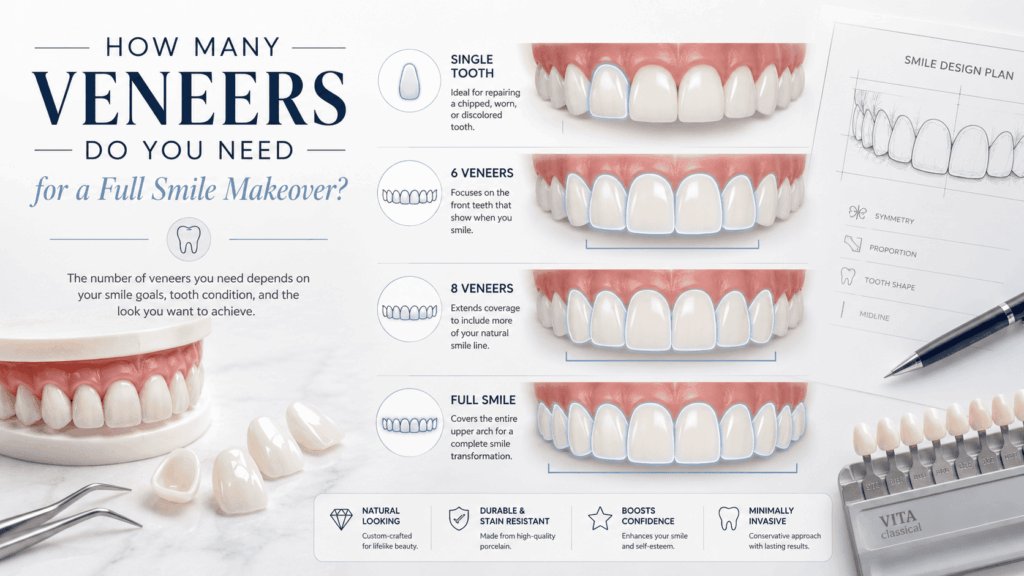
You look up how many veneers a smile makeover typically involves, and you get three different answers: six, eight, and ten upper teeth, often each attached to a hard sales pitch. None of those numbers came from looking at your teeth. They’re generic figures pulled from marketing pages, not a reflection of your smile width, your tooth proportions, or what you’re actually trying to change.
The real answer depends on your smile, not a standard package. Dentists arrive at a specific number through a planning process that considers far more than how many teeth show when you smile for a photo. Understanding that process, covered in more depth in our overview of what a smile makeover includes, makes it easier to have a realistic conversation with your own dentist rather than walking in expecting a fixed number.
Why There’s No Universal Number of Veneers
Two people can have visually similar smiles and still end up with completely different veneer counts. One might need eight teeth treated to achieve a balanced, even look. The other might only need four, because their remaining teeth already match in color and shape. Tooth size, gum position, how much shows when you talk versus when you smile widely, and your specific goals all shift the number in one direction or another.
This is why a dentist quoting a number before ever examining your teeth should be treated with some skepticism. A genuine treatment plan comes after an evaluation, not before one.
How Many Veneers Do Most People Get?
There’s a commonly discussed range for full smile makeovers, generally centered on the teeth that show during a natural smile, which for many people includes the front six to ten upper teeth. This isn’t a rule, though. It reflects what tends to be visible for an average smile, not what’s clinically necessary for every patient.
| Smile Goal | Commonly Discussed Approach |
| Correcting one chip or discoloration | Often addressed with a single veneer, sometimes paired with bonding on an adjacent tooth |
| Improving a few visible teeth | Sometimes treated with two to four veneers to balance a specific area of the smile |
| A broader, more uniform smile change | Frequently involves the teeth that show during a natural smile, often in the six-to-ten range, though this varies by person |
| Full arch transformation including premolars | Occasionally extends further back for patients with a wide smile or significant visibility of posterior teeth |
Some patients need fewer teeth treated than this general pattern suggests, while others need more, particularly if their smile shows further back toward the premolars. The material chosen also plays into the plan; our comparison of porcelain and composite veneers explains how material choice can factor into decisions about scope and coordination across multiple teeth.
Why Some Patients Only Need One or Two Veneers
Not every patient walks in wanting a full transformation. Someone with a single chipped front tooth, or one noticeably discolored tooth that didn’t respond to whitening, may only need that one tooth addressed. In cases like this, a dentist typically focuses on matching the new veneer carefully to the surrounding natural teeth rather than treating teeth that don’t need it. For smaller corrections like this, no-prep veneers sometimes come up as an option, since they’re designed for more conservative, targeted changes rather than broad smile transformations.
| Factor | One Veneer | Several Veneers |
| Typical goal | Fixing an isolated chip, discoloration, or shape issue | Creating a more uniform look across a visible group of teeth |
| Shade matching challenge | Must be matched carefully to surrounding natural teeth | Matched to each other, offering more control over the final shade |
| Planning complexity | Generally simpler, often addressed in a single consultation | Requires more detailed planning to keep proportions balanced |
| Common patient type | Someone with one specific concern and otherwise satisfied teeth | Someone pursuing a broader cosmetic change across their smile |
Treating only what genuinely needs treatment, rather than defaulting to a wider plan, tends to produce a more conservative and often more cost-effective outcome for patients whose concerns are limited to one or two teeth.
What Cosmetic Dentists Evaluate When Planning Veneer Count
Smile design is the process cosmetic dentists use to figure out which teeth need treatment and how many. It goes well beyond counting the teeth visible in a photo. A few specific factors tend to shape the final number.
Smile Width and How Much Shows When You Smile
Some people have a wider smile that reveals teeth further back toward the premolars, sometimes called a broader buccal display. Others show mostly the front four to six teeth, with the back corners of the mouth partially hidden by cheek tissue. A dentist evaluating your smile width determines how far back treatment realistically needs to extend to look natural and complete, rather than stopping arbitrarily at a fixed tooth count.
Smile Line and Lip Position
How your lips move when you smile and speak affects how much of your teeth and gums show at different moments. A dentist looks at your smile at rest, during a natural smile, and while talking, since these positions can reveal different amounts of tooth structure. Treatment planning accounts for all of these, not just a single posed photo.
Tooth Size and Proportion
Cosmetic dentistry often references general proportion guidelines when planning tooth width and length relative to each other, though these are used as a loose reference rather than a strict formula applied to every patient. Your natural tooth size and how your teeth relate to each other in width and length help determine which specific teeth benefit most from a veneer, versus which ones already fit well within a balanced smile.
Tooth Color
If your natural tooth shade varies significantly across your smile, treating only some teeth can leave an uneven color pattern once specific teeth are veneered. Your dentist considers how any untreated teeth will look next to new veneers, which sometimes expands or narrows the number of teeth recommended for treatment.
Existing Restorations
Old crowns, fillings, or bonding on certain teeth can affect how a veneer fits and how well it matches. In some cases, replacing an old restoration alongside new veneers gets folded into the same treatment plan, which can influence the total number of teeth involved.
Bite and Function
How your teeth meet when you bite down matters for planning veneer count and material choice. Patients with grinding or clenching habits sometimes need a different approach than patients with a stable, even bite. Our discussion of veneers for patients who grind their teeth covers how bruxism factors into candidacy and planning in more detail.
Facial Symmetry
Most faces aren’t perfectly symmetrical, and a good smile design plan works with that reality rather than chasing mathematical perfection. A dentist considers your facial midline, the balance between the left and right sides of your smile, and how your teeth relate to your overall facial proportions, rather than treating every tooth identically regardless of your face shape.
Your Own Goals
Two patients with nearly identical starting smiles might want very different outcomes. One may want a dramatic, uniformly bright transformation. The other may prefer a subtler change that still looks recognizably like their own smile. Your stated goals shape the number of veneers as much as any clinical measurement does.
Should Your Bottom Teeth Get Veneers Too?
For many patients, upper teeth alone address the visible parts of their smile, since the lower teeth show less during a typical smile. That said, some patients show more of their lower teeth than average, whether due to how their lips rest or how their bite is structured, which can make lower veneers a more relevant part of the conversation.
| Approach | When It’s Typically Considered |
| Upper teeth only | Common for patients whose smile shows mostly upper teeth, which describes many people’s natural smile pattern |
| Upper and lower teeth | Considered for patients who show more of their lower teeth when smiling or speaking, or who have specific concerns with lower tooth appearance |
| Lower teeth only | Less common, but sometimes appropriate if lower teeth are the primary cosmetic concern and upper teeth are otherwise satisfactory |
Whether lower teeth factor into your plan depends on your specific smile pattern, not a general rule that upper teeth are always sufficient or that lower teeth are always skipped.
Can Veneers Match Your Remaining Natural Teeth?
In many cases, yes, though matching veneers to untreated natural teeth takes careful shade selection and, sometimes, adjusting the treatment plan to include a few additional teeth for better color consistency. Natural teeth aren’t perfectly uniform in color, and neither are veneers meant to be forced into an artificial, flat match. A skilled shade-matching process aims for a result that looks cohesive rather than jarring next to teeth that weren’t treated.
This is one of the reasons dentists sometimes recommend treating slightly more or fewer teeth than a patient initially expected. The goal is a smile that reads as natural and even, not simply the smallest or largest number of veneers possible.
Can Whitening Reduce the Number of Veneers You Need?
Sometimes. If your main concern is overall discoloration rather than shape, size, or chips, whitening treated teeth first can occasionally reduce how many veneers are needed, since brightening the surrounding natural teeth may close the color gap that would otherwise require more veneers for a consistent look.
This isn’t guaranteed to work for every patient, since whitening doesn’t change tooth shape or address structural concerns like chips or unevenness. Your dentist can evaluate whether whitening first makes sense for your specific situation, or whether it wouldn’t meaningfully change the recommended veneer count.
Does Every Visible Tooth Need a Veneer?
No. A tooth that’s already a good color, shape, and size relative to its neighbors generally doesn’t need a veneer just because it’s visible when you smile. Treatment plans typically focus on the teeth that are actually contributing to the cosmetic concern, rather than every tooth within the smile zone by default. If crooked or misaligned teeth are part of what’s bothering you, how veneers relate to crooked teeth explains where cosmetic treatment tends to help and where it doesn’t.
Combining Veneers With Whitening, Bonding, or Orthodontics
A smile makeover doesn’t have to rely on veneers alone. Depending on your specific concerns, your dentist may suggest combining approaches rather than veneering every tooth in the smile zone. Dental bonding compared with veneers explains when a more conservative, lower-cost option might handle part of a plan instead of a veneer.
| Smile Concern | Approaches Sometimes Considered |
| General discoloration across many teeth | Teeth whitening, sometimes on its own or alongside veneers on select teeth |
| A single chip or minor shape issue | Dental bonding or a single veneer, depending on the tooth and desired result |
| Mild rotation or small gaps | Veneers for cosmetic appearance, or orthodontic treatment if the position itself needs to change |
| Multiple concerns across visible teeth | A coordinated veneer plan, sometimes combined with whitening on untreated teeth to help shade match |
Combining treatments this way can sometimes reduce the total number of veneers needed, since not every concern in your smile actually requires one.
How Dentists Decide Which Specific Teeth to Treat
Rather than starting from a target number and working backward, a thorough planning process starts with your specific concerns and works forward. Your dentist typically examines each visible tooth individually, notes which ones contribute to the issue you want addressed, and builds a plan around those teeth specifically. Digital photos, and sometimes a digital smile preview, help visualize how a proposed plan will look before any tooth is touched.
This individualized approach is part of why two patients with seemingly similar smiles can walk out of the same practice with very different treatment plans. The plan follows the smile, not the other way around.
Why Treatment Planning Matters More Than Choosing a Number
Choosing a number first, whether from a marketing page or a friend’s experience, can work against a natural-looking result. A fixed number may not account for your tooth proportions, colouring, or facial features. Letting your dentist create the plan after an evaluation usually helps achieve a smile that fits you rather than a generic template.
How Veneer Count Relates to Treatment Cost
It’s natural to associate a higher veneer count with a higher overall cost, and in general terms, treating more teeth does increase the total investment involved. That said, cost isn’t simply a matter of multiplying a per-tooth price by a number, since material choice, lab work, and case complexity all factor in as well. Our detailed breakdown of what affects porcelain veneer costs goes further into these variables. A consultation is the only reliable way to get a personalized estimate, since every treatment plan, and therefore every cost, is individualized to the patient.
Planning Your Smile Makeover With Dr. Pearl Zadeh in Woodland Hills
Dr. Pearl Zadeh evaluates smile width, tooth proportion, facial symmetry, and your personal goals before recommending a specific number of veneers, rather than starting from a standard package. Her approach to cosmetic treatment planning centers on building a plan around your individual smile rather than applying the same template to every patient. Patients exploring veneers in Woodland Hills can expect that same individualized evaluation, and our broader overview of cosmetic dentistry in Woodland Hills covers the full range of options available if your plan ends up including more than veneers alone.
Once you have a treatment plan in place, our guide to preparing for a veneers appointment and our porcelain veneers guide walk through what to expect as you move forward, along with our composite veneers overview if that material is part of your recommended plan.
Schedule a Consultation With Dr. Pearl Zadeh
The right number of veneers for your smile makeover comes from careful planning, not a standard package. Your tooth proportions, smile width, colour, and goals shape the number differently from another patient’s plan.
Dr. Pearl Zadeh and her Woodland Hills team can evaluate your smile and create a plan based on your goals. They focus on your specific features rather than starting with an arbitrary number.
Call (818) 716-6722 or click the button below to schedule your consultation online.
Schedule a ConsultationFrequently Asked Questions
1. How many veneers do most people get?There’s a commonly discussed pattern centered on the teeth that show during a natural smile, often the front six to ten upper teeth, though this varies significantly based on your specific smile and goals.
2. Is eight veneers enough?For many patients, yes, since eight often covers the visible upper front teeth. Some patients need fewer, and others need more if their smile shows further back or if lower teeth are also part of the plan.
3. Do I need veneers on my bottom teeth?Not necessarily. Many patients only need upper veneers, since lower teeth show less during a typical smile. Patients who display more of their lower teeth, or who have specific concerns there, may benefit from including them.
4. Can I get veneers on only one tooth?Yes, in many cases. A single veneer can address one chipped or discolored tooth, with careful shade matching to the surrounding natural teeth.
5. Will veneers match my natural teeth?Generally, yes, when your dentist matches the shade carefully. Your dentist evaluates your remaining natural teeth to help the new veneers blend in rather than stand out.