
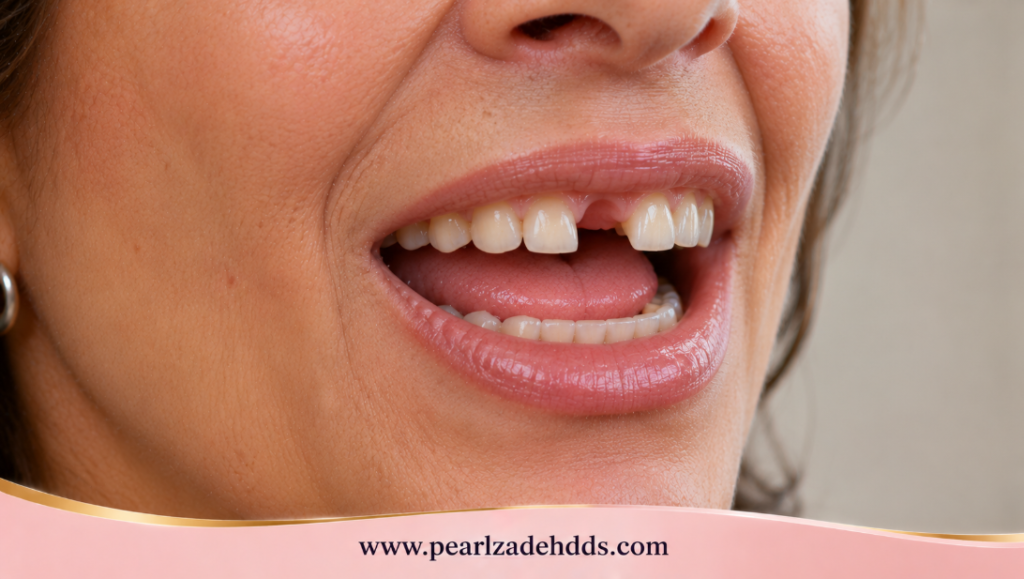
A patient loses a tooth and, within days, notices that certain words sound slightly different. The word “sun” may have a different hiss, or “five” may sound less distinct than before.
Teeth do more than help you chew. They help shape the sounds you make when speaking. The tongue and lips use the teeth as contact points to position themselves and direct airflow.
When a tooth is missing, those contact points can change. The effect depends on which tooth is lost, how many teeth are missing, and how the person normally speaks. Some patients notice a clear difference, while others adapt without any noticeable change.
How Do Teeth Help You Speak Clearly?
Clear speech depends on several parts of the mouth working together. The tongue, lips, teeth, palate and airflow each play a role in forming different sounds.
A 2023 review published in Medicina explains how the tongue makes contact with the teeth, alveolar ridge or hard palate to form consonants. Prosthodontists, dentists who specialize in replacing missing teeth, use this information when planning dental restorations.
The alveolar ridge is the raised area of bone just behind the upper front teeth. The tongue touches or approaches this area when producing sounds such as T, D and N.
Other sounds need different contact points. For F and V, the lower lip meets the edges of the upper front teeth. For P, B and M, the lips come together. S and Z require the tongue to create a narrow channel that directs air past the front teeth.
The tongue also controls how air moves through the mouth. It changes position to narrow the space, briefly block airflow or allow air to pass. The teeth help define the spaces where these movements happen.
Over time, people develop familiar tongue and lip movements for everyday speech. The mouth learns where each contact point sits. Losing or changing a tooth can alter that familiar positioning.
The palate, or roof of the mouth, also affects speech. Its shape helps direct airflow and influences resonance, which describes how sounds are shaped as they travel through the mouth. This matters particularly when a dental appliance changes the surface of the palate. For example, an upper removable denture may cover part of it.
Which Speech Sounds Can Change When Teeth Are Missing?
Different teeth contribute to different speech sounds. Missing front teeth are more likely to affect sounds that depend on contact between the tongue, lips and upper incisors. The following examples explain why.
F and V sounds
These sounds require contact between the lower lip and the upper front teeth. The lower lip rises toward the edges of the upper incisors, leaving a small opening for air to pass through.
Missing upper front teeth remove part of that contact surface. As a result, words such as “five,” “very” and “fine” may sound softer or less distinct. The exact change depends on the size and position of the gap.
S and Z sounds
S and Z depend on a narrow stream of air passing between the tongue and the front teeth. The tongue forms a groove that directs the airflow, producing the familiar hissing sound.
A 2021 simulation published in Scientific Reports describes the groove formed between the tongue tip and the upper incisors. It also shows how changing the position of the incisors can alter airflow during speech.
When a front tooth is missing, air may escape through the gap instead of following its usual path. This can change the sound of words such as “sun,” “zoo” and “miss.” Dentists and speech researchers refer to S and Z as sibilants.
TH sounds
The tongue moves toward the upper front teeth or comes between the teeth when producing TH sounds. The exact movement varies with the speaker and the word.
Missing or misaligned front teeth can change where the tongue makes contact. The 2023 Medicina review discusses how front-tooth misalignment can affect the acoustic quality of TH sounds. Words such as “think,” “three” and “that” may sound different.
Other sounds
Not all speech sounds depend on the teeth in the same way. P, B and M rely mainly on the lips coming together. T, D and N involve the tongue touching the alveolar ridge behind the upper front teeth.
Missing teeth may therefore affect some sounds more than others. The location of the gap and the surrounding oral structures help determine which pronunciations change.
Do Missing Front Teeth Affect Speech More Than Missing Back Teeth?
Front teeth have a direct role in several speech sounds. The lower lip uses the upper front teeth to form F and V, while the tongue relies on the front teeth and nearby surfaces to produce S, Z and TH.
A gap in this area can change the way air passes through the mouth. It can also alter where the tongue and lips make contact. This explains why missing front teeth are more likely to affect pronunciation than missing back teeth.
However, not everyone with a missing front tooth develops a noticeable speech problem. Some people adjust their tongue and lip movements naturally. Others may notice a lisp, a change in certain consonants or difficulty producing familiar sounds.
Patients considering replacement options can learn more about dental bridges for front teeth.
Back teeth play a different role. They are farther from the contact points used for many consonants, so their loss is less likely to affect pronunciation directly. Their main function is chewing, although changes to the bite and available space in the mouth may affect oral movements in some cases.
Losing several teeth can create a larger change in the mouth. Multiple gaps may alter the surfaces the tongue uses for contact, particularly when front teeth are involved. Changes in the bite or the position of remaining teeth may also affect how the tongue and lips move.
The effect is not the same for every patient. The location and number of missing teeth, existing dental alignment and ability to adapt all play a part. Patients can also read about how missing teeth affect your bite over time.
The tongue and speech muscles may gradually adjust to the new restoration. The 2023 review describes a study that recorded patients’ speech before denture insertion and again after one week of adaptation. Some sounds remained difficult to produce with a partial denture, while others improved considerably.
The adjustment period differs between patients. The type of denture, its fit and the sounds affected can all influence how quickly speech improves. If pronunciation difficulties persist, patients should contact their dentist rather than assume the problem will resolve on its own.
The same applies if the denture feels uncomfortable, loose or incorrectly positioned. A dentist can check its fit, identify areas causing difficulty and make adjustments when appropriate.
What If Speech Problems Continue After Replacing Missing Teeth?
Missing teeth are one possible reason for speech changes, but they are not the only cause. A poorly fitting restoration can interfere with articulation. A denture that moves while speaking may also make certain sounds harder to produce.
Other causes may involve the tongue, nerves or muscles. Limited tongue movement, changes in oral sensation and certain medical or neurological conditions can affect speech even when the teeth and gums appear healthy.
A dentist can check whether the missing teeth or dental restoration may be contributing to the problem. If the restoration fits properly and the dentist finds no obvious dental cause, further assessment may be necessary. A speech-language pathologist can evaluate speech difficulties and recommend appropriate treatment.
Sudden speech changes require immediate medical attention. The National Institute of Neurological Disorders and Stroke (NINDS) lists slurred or unusual speech, facial drooping, arm weakness and sudden confusion among the warning signs of a stroke. If these symptoms appear suddenly, call 9-1-1 immediately. Do not assume the change is related to missing teeth or a new dental restoration.
What Should You Discuss With Your Dentist?
A few questions can help you discuss your speech concerns during the appointment:
- Could my missing teeth explain the speech changes I have noticed?
- Which sounds or tongue movements might be affected by this gap?
- Could a dental bridge or partial denture restore the tooth surfaces I use when speaking?
- Might the proposed restoration affect my speech during the adjustment period?
- How will you check the restoration’s fit and position?
- Should I consider an additional assessment with a speech-language pathologist?
The dentist can examine the missing-tooth area, remaining teeth, bite and oral structures. These findings help determine whether a dental restoration may address the problem or whether another type of assessment is appropriate.
Can Dental Bridges and Partial Dentures Improve Speech?
Replacing missing teeth can restore some of the surfaces the tongue and lips use during speech. However, the effect depends on which teeth are missing and whether the restoration suits the patient’s mouth.
Dental Bridges
A dental bridge fills a gap with replacement teeth supported by neighboring teeth. Restoring the shape and position of missing teeth may re-establish contact points used during speech.
Suitability depends on the location and size of the gap and the condition of the supporting teeth. Dr. Pearl offers all-porcelain, metal-free dental bridges. Patients can learn more about porcelain bridges and what to know before a visit.
Partial Dentures
A removable partial denture replaces one or more missing teeth. Its replacement teeth can restore surfaces that the tongue and lips use to form certain sounds.
However, the appliance also takes up space inside the mouth. Its design, fit and position can affect tongue movement and airflow. Some patients need time to adjust to speaking with it.
Dr. Pearl offers partial dentures. Patients can read about the differences between a dental bridge and denture before discussing their options.
Neither restoration guarantees that every speech problem will resolve. The original cause of the difficulty, the teeth being replaced and the fit of the restoration all matter.
Can a New Dental Bridge or Partial Denture Temporarily Affect Speech?
Yes. Speech may feel different when you first receive a dental restoration. Even when it replaces a missing tooth, the new surface can change where the tongue and lips make contact.
Tooth shape and position matter. The 2023 Medicina review explains that changes in tooth length can affect pronunciation. For example, teeth that are too short may cause a V sound to resemble F. Teeth that are too long may cause an F sound to resemble V.
Removable partial dentures can introduce additional changes. Depending on their design, they may cover part of the palate or reduce the space available for the tongue. The Medicina review notes that thicker dentures can reduce oral cavity volume and restrict tongue space.
These changes may make certain sounds harder to produce at first. The tongue and speech muscles may gradually adjust, but the experience varies between patients. If speech remains difficult or the restoration feels uncomfortable, loose or incorrectly positioned, contact the dentist for an assessment. Do not try to adjust the appliance yourself.
Schedule a Consultation With Dr. Pearl
Missing teeth can affect more than chewing and appearance. Their position also influences how the tongue and lips form certain sounds.
Dr. Pearl Zadeh DDS can examine the missing-tooth area and assess the surrounding teeth and bite. Porcelain bridges and partial dentures can be discussed where appropriate. Dental treatment may help when missing teeth contribute to speech changes, but it cannot correct every speech problem.
Call (818) 716-6722 or click the button below to schedule your consultation online.
Frequently Asked Questions
They can contribute to speech changes, especially with s and z sounds, though not every patient is affected. Other causes of a lisp include tongue positioning habits. A dentist can examine the teeth, while a speech-language pathologist can evaluate the speech pattern.
It may. A bridge can restore a missing tooth’s shape and position. That may help recover the contact the tongue or lip expects. Adaptation varies, and no outcome is guaranteed. If difficulty persists, the dentist can check the bridge and consider other causes.
It can at first. A removable appliance changes the surfaces and space the tongue works with. The Medicina review cites a study in which some sounds were harder to produce with a partial denture. Fit and design influence the result, so a dentist can adjust the denture if needed.
No timeline applies to every patient. Adjustment depends on the design, the fit, and the person’s speech habits. One study in the Medicina review assessed speech after a week of adaptation. That was the study’s interval, not a rule. Persistent difficulty deserves a dental visit.
Start with a dentist when speech changed after tooth loss or a new restoration. The dentist can check the missing teeth, the fit, and the bite. If the mouth does not explain the change, a speech-language pathologist can assess it further. Sudden changes with facial weakness or confusion call for emergency care.
The information above is for informational purposes only and is not a substitute for professional dental advice. Please schedule a consultation with Pearl Zadeh DDS to discuss your specific situation.