
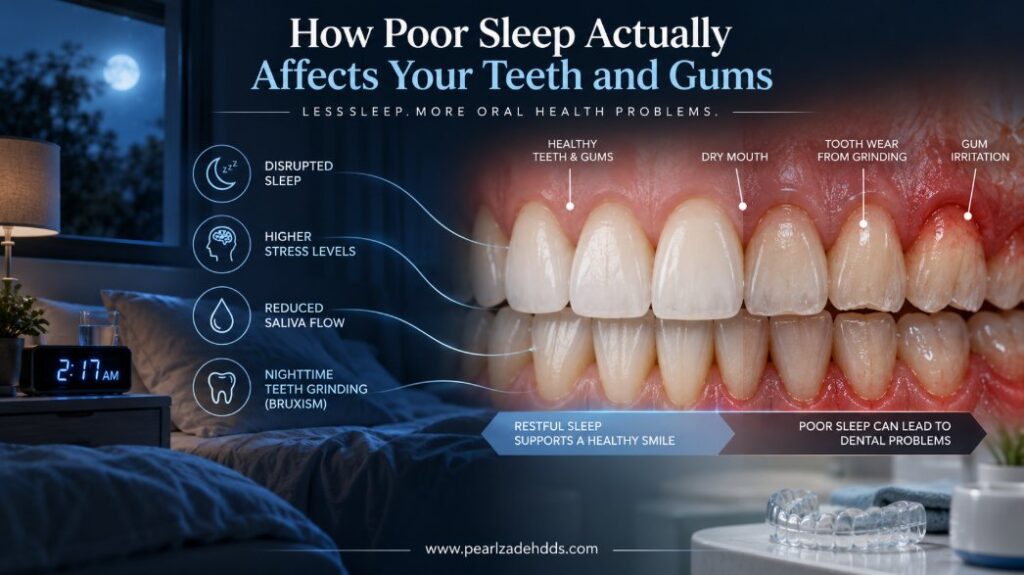
You wake up and your mouth feels dry and sticky. Your jaw aches a little. Maybe a tooth feels sensitive when you drink your coffee, or your gums bleed slightly while you brush. A headache is settling in behind your eyes.
Any of these can have several explanations unrelated to sleep. But sleep quality and the habits that come with a rough night, mouth breathing, clenching, skipping your usual routine, can genuinely play a role in what you’re noticing.
Can Poor Sleep Affect Your Oral Health?
It can, though not through one single mechanism. A systematic review and meta-analysis examining oral health and sleep disorders found a significant association between poor sleep quality and worse oral health outcomes, including dental pain and periodontal issues. An association across a body of research isn’t proof that poor sleep alone damages a specific patient’s teeth. Sleep connects to your mouth through several separate pathways at once: saliva production, mouth breathing, nighttime clenching, and how exhaustion changes daily habits. Most patients only deal with one or two of these, not all of them at once, which is why the sections below treat each one separately.
How Sleep and Your Mouth Are Connected
Saliva production naturally slows during sleep for everyone, leaving less protection overnight than during the day. Mouth breathing, from congestion, anatomy, or habit, dries that reduced saliva out further. Nighttime clenching adds mechanical stress on top. Separately, being tired changes behavior: rushed brushing, skipped flossing, a late-night snack. Sleep-disordered breathing, a category that includes snoring and obstructive sleep apnea, can tie several of these threads together in some patients, though not everyone with disrupted sleep has it. The sections below walk through each pathway individually, since lumping them together doesn’t help you figure out what applies to you.
Poor Sleep and Teeth Grinding
Sleep bruxism, the clinical term for grinding or clenching your teeth during sleep, can happen without you ever being aware of it, since nobody consciously chooses to grind while asleep. Stress and disrupted sleep patterns may contribute to or be associated with this in some patients, though the exact reasons vary and aren’t fully settled in the research. Our discussion of why people grind their teeth at night goes further into the contributing factors involved. Morning signs worth noticing include a tired or sore jaw right when you wake up, unusually sensitive teeth, and a tightness in your face that takes a while to ease off. This doesn’t mean every restless sleeper grinds. Plenty of people sleep poorly without grinding at all, and plenty grind without any obvious sleep problem.
How Grinding Can Damage Your Teeth
When grinding does happen regularly, the physical effects build slowly rather than all at once. Repeated contact between upper and lower teeth can wear down enamel over months and years, showing up as flattened or slightly shortened front teeth. Some patients develop small chips or cracks, particularly on teeth with an existing filling or thin edge. Sensitivity often follows once enough enamel has worn away to expose the layer underneath, and jaw soreness tends to travel with more forceful grinding. In some patients, how the upper and lower teeth contact each other shifts slightly over time. Our overview of signs your bite may be causing dental problems covers that pattern in more depth. How much damage actually shows up varies enormously between people, with no fixed timeline that applies to everyone.
Poor Sleep, Mouth Breathing, and Dry Mouth
Saliva does more work than most people realize. The American Dental Association describes it as providing several protective functions at once: cleansing the mouth, aiding speech and swallowing, protecting oral tissue against physical and microbial harm, and maintaining a neutral pH. Your mouth naturally produces less saliva while you sleep than while awake, which is one reason morning dryness feels more noticeable, even in people with otherwise normal saliva production.
Mouth breathing makes that natural overnight dip more pronounced, since air moving across oral tissue evaporates moisture faster than nasal breathing does. Nasal congestion from allergies or a cold can force temporary mouth breathing, while chronic congestion can turn it into a nightly pattern. A range of medications, including many for blood pressure, allergies, depression, and anxiety, list dry mouth as a side effect, and the ADA specifically names medication use among the recognized causes of xerostomia, the clinical term for chronic dry mouth. Dehydration compounds all of this, since there’s less fluid available to produce saliva in the first place.
Can Dry Mouth Increase Your Risk of Cavities?
It can contribute to that risk, though one dry night won’t cause a cavity on its own. The American Dental Association notes that reduced salivary flow can increase the chance of developing dental caries, demineralization, and sensitivity. Saliva normally neutralizes acids that bacteria produce after eating and carries minerals that repair minor enamel damage. With less saliva doing that work, acid sits longer and repair happens more slowly. This is about persistent dryness, not one rough night.
If you regularly wake up genuinely dry-mouthed, staying hydrated during the day is a reasonable start, along with noticing whether you’re breathing through your mouth at night. This isn’t something to self-treat with a pharmacy product. Persistent dry mouth deserves an actual evaluation, since the cause might not be sleep at all. Medications, an untreated sinus issue, dehydration habits, or another health condition can all present the same way.
Sleep and Your Gum Health: What Does the Research Show?
This connection deserves real caution. Sleep problems and periodontal health have shown up together in research, but the relationship is genuinely complex. An umbrella review examining periodontal disease and sleep-disordered breathing was direct about the limits of that evidence, noting that some individual investigations find no significant association once factors like obesity, smoking, and aging are properly accounted for. Inflammation appears to be one shared thread researchers keep returning to, alongside sleep duration and quality and the same broader health factors that independently affect gum health regardless of how anyone sleeps. Poor sleep shouldn’t be presented as a standalone cause of gum disease. Plaque buildup and the inflammatory response it triggers remain the more established drivers behind gingivitis and periodontitis. Our discussion of early signs of gum disease worth watching for covers what those warning signs look like. Sleep may be one factor woven into a larger picture, which is exactly why regular dental care still matters regardless of how well you’ve been sleeping.
How Poor Sleep Can Affect Your Oral-Care Habits
This part has less to do with biology and more to do with behavior under fatigue. Skipping brushing at night because you’re too exhausted to stand at the sink happens to nearly everyone occasionally. Rushing through the two minutes you do spend, forgetting to floss, reaching for a late-night snack, and leaning more heavily on caffeine or a sugary drink to get through the next day are all realistic patterns when sleep has been consistently poor. This isn’t “poor sleep” damaging your teeth directly. It’s exhaustion quietly eroding the consistency that protects your teeth day to day. An occasional lapse isn’t worth guilt. A pattern that keeps repeating is worth noticing, since accumulation matters more than any single skipped night.
What Your Morning Symptoms May Be Telling You
A handful of symptoms tend to show up together, each pointing toward a slightly different set of possibilities rather than one clear answer.
Dry mouth
Can suggest nighttime mouth breathing, dehydration, a medication side effect, or simply the normal overnight dip in saliva production.
Sore jaw or facial muscles
Often associated with nighttime clenching or grinding, and can overlap with symptoms sometimes linked to TMJ disorder, a broader term covering problems with the jaw joint or surrounding muscles.
Tooth sensitivity
Can come from enamel wear, exposed dentin, gum recession, or other dental issues entirely unrelated to sleep.
Morning headaches
Sometimes occur alongside nighttime clenching, though headaches have plenty of other causes, and it isn’t accurate to automatically attribute one to a dental source.
Bad breath
Can be associated with dry mouth, bacteria that accumulate more easily when saliva flow is reduced, gum disease, or causes unrelated to sleep.
Bleeding gums
Shouldn’t be chalked up to a bad night of sleep. Bleeding often signals gum inflammation that needs evaluation, regardless of what else is going on.
Taken together, these are clues worth noticing, not a self-diagnosis tool. A single symptom rarely tells the whole story on its own.
Could Sleep-Disordered Breathing Be Affecting Your Mouth?
This is worth its own section since it’s genuinely easy to overlook. Sleep-disordered breathing is a broader category that includes snoring and obstructive sleep apnea, where breathing becomes partially blocked or irregular during sleep. A literature review examining oral health implications of obstructive sleep apnea found associations between OSA and heightened risks of bruxism, dry mouth, periodontal disease, and jaw joint disorders, noting that mouth breathing linked to airway obstruction was a particularly significant factor worsening dry mouth. This is a review of associations across research, not a claim that everyone with dry mouth or bruxism has sleep apnea.
If you regularly wake with a genuinely dry mouth, mouth-breathe consistently, snore loudly, or experience disrupted, unrefreshing sleep, that combined pattern is worth mentioning to an appropriate healthcare professional rather than assuming it’s purely a dental issue. This isn’t something to self-diagnose, and a dental visit alone can’t confirm or rule it out. A dentist can look at the oral signs, tooth wear, dry mouth, gum changes, and help you understand whether what’s showing up lines up with a pattern worth discussing with a physician or sleep specialist.
What Can You Do If Sleep Is Affecting Your Oral Health?
A few practical steps connect directly back to what’s covered above, rather than generic wellness advice:
- Keep up consistent brushing and flossing, especially when you’re most tempted to skip it
- Pay attention to persistent nighttime dry mouth rather than assuming it will resolve on its own
- Stay hydrated throughout the day, not just before bed
- Bring up ongoing nasal congestion with a healthcare professional if it’s pushing you toward mouth breathing
- Notice signs of grinding or clenching, like morning jaw soreness, rather than dismissing them
- Avoid letting recurring symptoms go unmentioned simply because they aren’t severe
- Keep up with regular dental exams, since they catch changes you might not notice yourself
- Discuss symptoms that persist despite improved sleep habits directly with your dentist
None of these steps guarantee a specific outcome, and a night guard isn’t automatically the right answer for every patient who grinds. What actually helps depends on what’s driving your specific symptoms.
When Should You See a Dentist?
A few patterns are worth bringing up rather than waiting them out:
- Recurring or worsening jaw soreness
- New or worsening tooth sensitivity
- A cracked or chipped tooth
- Unusual or accelerating tooth wear
- Persistent dry mouth
- Ongoing bad breath
- Bleeding or swollen gums
- Morning symptoms that continue despite genuinely improved sleep habits
A dentist can assess your teeth, gums, bite, and any signs of grinding directly, and help determine whether something beyond sleep might be involved. Not every sleep-related symptom needs an appointment right away, but a repeating or worsening pattern is a reasonable prompt for an actual look.
Speak With Dr. Pearl Zadeh About Your Oral Health
Morning jaw soreness, tooth sensitivity, dry mouth, or gum concerns can have several possible causes, and sleep may be part of that picture for some patients. Dr. Pearl Zadeh, a member of the American Dental Association and California Dental Association, can evaluate your teeth, gums, jaw, and bite to help identify what may actually be contributing to what you’re noticing.
Call (818) 716-6722 or click the button below to schedule a consultation online.
Frequently Asked Questions
Can lack of sleep cause teeth grinding?
Sleep disruption may be linked to nighttime grinding in some patients, though it isn’t the only factor and doesn’t affect everyone who sleeps poorly.
Can poor sleep make dry mouth worse?
Saliva production naturally drops during sleep, and mouth breathing or congestion during a disrupted night can make dryness more noticeable, though poor sleep alone isn’t necessarily the direct cause.
Can sleeping with your mouth open affect your teeth?
Mouth breathing can dry out saliva faster than nasal breathing, which may reduce the mouth’s natural protection against bacteria and acid over time.
Can poor sleep affect your gums?
Research has linked sleep problems with periodontal health, though the evidence is mixed after researchers account for other factors. Plaque and inflammation remain the more established drivers of gum disease.
Why do my teeth or jaw hurt when I wake up?
Morning jaw soreness or tooth sensitivity often comes from nighttime clenching. However, other dental issues can cause these symptoms too, so your dentist should evaluate them.
When should I see a dentist about morning jaw pain or dry mouth?
If either symptom is persistent, worsening, or continues despite improving your sleep habits, that’s a reasonable reason to schedule an evaluation.
This article is for informational purposes only and is not a substitute for professional dental or medical advice. Please schedule a consultation with Pearl Zadeh DDS to discuss your specific situation.