
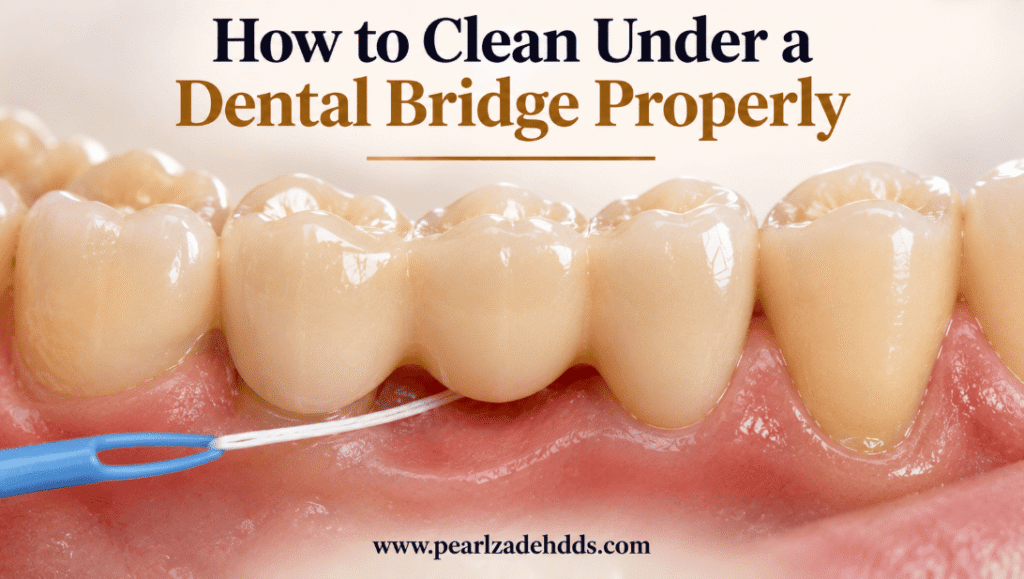
A toothbrush cleans the top and sides of a dental bridge, but it cannot reach the space beneath the replacement tooth. Food particles and plaque can collect in that area even after brushing. Daily cleaning under the bridge helps remove this buildup.
The simplest method is to pass floss under the bridge once a day using a floss threader or super floss. A water flosser may also help, if your dentist recommends one. Remember to brush the supporting teeth with a soft-bristled toothbrush.
Cleaning under the bridge also helps protect your gums and supporting teeth. According to the Cleveland Clinic’s guide to dental bridges, plaque and bacteria can contribute to gum inflammation and cavities if the area around the bridge is not cleaned properly.
Why Does Food and Plaque Collect Under a Dental Bridge?
A dental bridge includes a replacement tooth, called a pontic, that sits over the gap left by a missing tooth. A small space remains between the pontic and the gum tissue, where food particles can collect.
A regular toothbrush cannot reach every surface beneath the pontic. Plaque, a soft film of bacteria, can also build up around the supporting teeth and along the gumline.
That is why brushing alone is not enough. The area beneath the bridge needs daily cleaning to remove trapped food and plaque.
Food collecting under a bridge does not automatically mean it fits poorly. The space is part of the design of many fixed bridges. However, if food keeps getting trapped or becomes difficult to remove, mention it to your dentist.
How to Clean Under a Dental Bridge
The methods below are for fixed dental bridges, which stay in place. Removable partial dentures require different cleaning methods. This comparison of dental bridges and dentures explains how they differ.
Bridge designs also vary, and some are harder to reach than others. The different types of porcelain bridges may have different cleaning requirements. Ask your dentist which tools are suitable for your bridge.
Use a Floss Threader
A floss threader is a small, flexible loop that helps guide regular floss through tight spaces. It works much like a needle and makes it easier to pass floss beneath a fixed bridge. The National Institute of Dental and Craniofacial Research (NIDCR) explains that floss threaders help guide floss around fixed bridges.
Follow these steps:
- Pass a length of floss through the loop of the threader.
- Guide the threader’s tip under the bridge, between the pontic and the gum.
- Pull the threader through until the floss sits beneath the replacement tooth.
- Hold both ends of the floss and move it gently along the underside of the pontic.
- Clean around the sides of the supporting teeth, moving carefully toward the gumline.
- Release one end and pull the floss out. Repeat in each space that needs cleaning.
Use gentle movements rather than snapping the floss against the gums or forcing it through a tight space. The NIDCR also advises handling floss carefully to avoid injuring the gum tissue.
Try Super Floss
Super floss is designed for cleaning around bridges, braces, and other dental work. Each strand has three sections:
- Stiffened end: Helps guide the floss under the bridge without a separate threader.
- Spongy section: Cleans beneath the pontic and around the supporting teeth.
- Regular floss section: Cleans the sides of nearby teeth.
Guide the stiffened end under the bridge, then move the spongy section gently back and forth. Finish by using the regular floss section around the supporting teeth.
Super floss and a regular floss threader both help reach areas that a toothbrush cannot. Check the product instructions, as designs may vary.
Consider a Water Flosser
A water flosser directs a stream of water between the teeth and along the gumline. It may be useful for cleaning around dental work, including bridges. Cleveland Clinic discusses its use for cleaning around bridges and other dental work.
A water flosser can be an extra cleaning aid, but it should not replace brushing or any flossing method your dentist recommends.
Follow the device instructions and use a comfortable pressure setting. If the water stream causes irritation, stop and ask your dentist whether you are using it correctly or need a different approach.
Clean Around the Supporting Teeth
The natural teeth that support a traditional bridge are called abutment teeth. They need regular care because decay or damage to these teeth can affect the bridge.
Use fluoride toothpaste and a soft-bristled toothbrush. Brush gently along the gumline and around the edges where the bridge crowns meet the natural teeth.
Small interdental brushes may also help clean between teeth. Cleveland Clinic lists them as an option for cleaning these spaces. Choose a size that fits without forcing it between the teeth.
If floss or a brush does not fit comfortably, do not push it through. Ask your dentist which cleaning tool is appropriate for the space.
How Often Should You Clean Under a Dental Bridge?
Brush twice a day with fluoride toothpaste and clean between your teeth and beneath the bridge once a day. The National Institute of Dental and Craniofacial Research (NIDCR) recommends brushing twice daily and cleaning between teeth daily.
The right cleaning tools depend on your bridge design and oral health. Your dentist or hygienist can demonstrate how to clean beneath your bridge. Keep up with regular dental checkups and professional cleanings as well.
Common Mistakes to Avoid When Cleaning a Dental Bridge
A few habits can make it harder to keep the area beneath a bridge clean:
- Brushing only the visible surfaces of the bridge.
- Skipping the space beneath the replacement tooth.
- Pulling or snapping floss against the gums.
- Using sharp objects, such as pins or knives, to remove trapped food.
- Relying on mouthwash instead of brushing and cleaning between teeth.
- Ignoring ongoing bleeding, discomfort, or food trapping.
Missing a spot occasionally can happen. Focus on cleaning the bridge and surrounding teeth every day without using excessive force.
When Should You See a Dentist About Your Dental Bridge?
Contact your dentist if you notice any of the following:
- Food repeatedly gets trapped beneath the bridge.
- Your gums continue to bleed or look swollen.
- You experience pain or sensitivity around the supporting teeth.
- The bridge feels loose or shifts when you bite.
- An unpleasant taste or odor persists despite regular cleaning.
Cleveland Clinic also lists a loose or cracked bridge, pain when chewing, and bleeding gums as reasons to contact a dentist. These symptoms do not automatically mean the bridge needs replacement. The dentist can examine the area and determine what is causing the problem. Read more about the signs that a dental bridge may need replacement.
Schedule a Consultation With Dr. Pearl
Dr. Pearl Zadeh DDS in Woodland Hills, California, offers porcelain dental bridges. If you have questions about cleaning your bridge or notice changes around it, Dr. Pearl can examine the area and discuss your concerns.
Call (818) 716-6722 or click the button below to schedule your consultation online.
Frequently Asked Questions
They can be. Front tooth crowns put extra emphasis on natural color, shape, and translucency. Back tooth crowns put extra emphasis on chewing forces and fit. Both need good function and good appearance.
No single type is best for every front tooth. All-porcelain and other metal-free ceramics may be considered because they can mimic natural enamel. The dentist also weighs the bite, the remaining tooth, and the patient’s goals.
Sometimes. Suitability depends on the tooth’s condition, the bite, and grinding habits. Cleveland Clinic notes that dentists use pressed ceramic crowns, one ceramic type, on both front and back teeth.
Back teeth face greater chewing forces, so strength matters. Front teeth still need to withstand biting and tooth contact. Strength is one factor among several, not the only one.
Longevity varies. It depends on the material, fit, oral hygiene, bite forces, and other individual factors. No crown has a guaranteed lifespan. Cleveland Clinic ties crown lifespan to proper care, including a mouth guard for grinding.
The information above is for informational purposes only and is not a substitute for professional dental advice. Please schedule a consultation with Pearl Zadeh DDS to discuss your specific situation.