
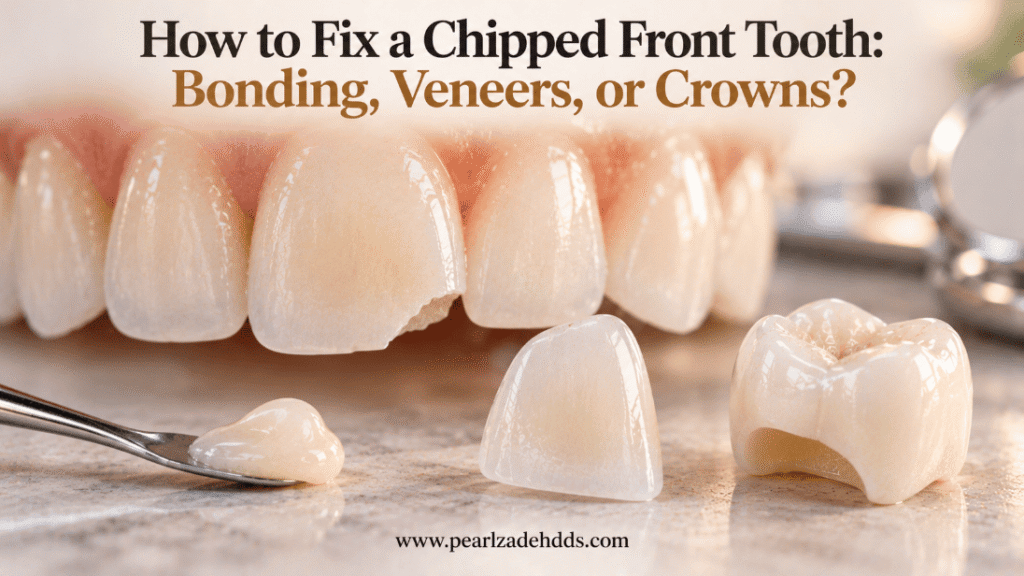
You bite into something hard and notice a rough edge with your tongue. Part of your front tooth has chipped, and the damage is visible when you smile. You want to know how it can be repaired.
The best way to fix a chipped front tooth depends on the size and location of the chip, the condition of the tooth, and the result you want. A small chip may need only smoothing or dental bonding. A larger chip may be better suited to a veneer or crown.
Each option repairs the tooth differently. A dental exam can help determine which treatment is appropriate for your tooth.
What Should You Do If You Chip a Front Tooth?
Have the tooth evaluated, especially if the chip is large, painful, or sensitive. Cleveland Clinic advises scheduling an appointment as soon as possible after you notice a chip. It says an untreated chip can cause other problems if the damage goes beyond the enamel.
Until your dentist assesses the tooth, avoid biting hard foods with it. Choose soft foods and keep the area clean. Cleveland Clinic suggests covering jagged edges with orthodontic wax. Bring any broken piece you can find to your appointment.
A chip that follows an injury needs closer attention. Significant pain, bleeding that does not stop, or other signs of serious injury warrant prompt professional care. Cleveland Clinic says to call your dentist right away if an injury loosened a tooth. It lists bleeding that will not stop as a reason to go to an emergency room. Severe pain that medication does not relieve is another.
How Do Dentists Choose the Right Repair?
Dentists weigh several factors before recommending a repair. No single factor decides the plan. They include:
- The size, depth, and location of the chip.
- Whether the damage involves enamel only or extends into dentin.
- Whether the tooth has a crack or other structural damage.
- How much healthy tooth structure remains.
- The tooth’s color, shape, and position.
- Bite forces and habits such as grinding.
- Your cosmetic goals and expectations.
Cleveland Clinic explains that with a chip, some enamel breaks off, while a crack runs through the tooth. You need a dental provider to know for sure which you have. Slight chips usually cause no major issues. Severe chips that expose the tissue beneath the enamel need dental work to protect the tooth.
Appearance alone cannot determine the best treatment. A small chip may hide a deeper problem. Likewise, a large chip may be simple to restore. Your dentist may need to examine the tooth and assess the surrounding structures, sometimes with X-rays.
Habits matter, too. Grinding, nail biting, and chewing hard objects add stress to a repair. Mayo Clinic says severe grinding may damage fillings, crowns, and other dental repairs. Tell your dentist about any of these habits.
Your goals count as well. Some patients want the least possible tooth removal. Others want a change in shape or color. Share your priorities so your dentist can match the options to them.
Can Dental Bonding Fix a Chipped Front Tooth?
Often, yes. Composite resin bonding can restore a tooth’s shape by adding material to the damaged area. Whether it suits your tooth depends on the chip and the tooth’s condition.
Cleveland Clinic says bonding can improve the appearance of minor chips. The AAE says most chipped teeth can be repaired. Options include reattaching the broken piece of enamel or bonding a tooth-colored filling or crown in place. Bonding may suit smaller chips, especially when enough healthy tooth remains to support the material.
Cleveland Clinic describes the process in several steps. The dentist selects a resin shade, roughens the tooth surface, and applies a liquid. Putty-like resin is then molded, smoothed, and hardened with a curing light. Final adjustments and polishing follow.
Bonding is a conservative approach. Cleveland Clinic says it typically does not require enamel removal, unlike veneers or crowns. That may help preserve more natural tooth structure.
Bonding also has limits. Cleveland Clinic notes that resin does not resist stains as well as porcelain and can chip over time. The ADA lists potential staining and discoloration as disadvantages of composite resin. Color matching varies, too. Your dentist selects a shade to blend with your natural teeth, but no one can promise an exact match.
Bonding may not provide enough support in some cases. A large chip, little remaining structure, or heavy bite forces may call for another restoration. Bonding is also not permanent. It may need polishing, repair, or replacement over time.
When Might a Veneer Be Better for a Chipped Front Tooth?
A veneer covers the front surface of a tooth. Your dentist may consider one when a chip affects appearance and enough healthy structure remains to support it. A veneer is not automatically better than bonding.
Veneers differ from bonding in scope. Bonding rebuilds the damaged area. Cleveland Clinic describes veneers as custom-made shells that fit over the front surfaces of teeth. They can conceal chips and stains. A veneer may help when shape, color, or surface concerns extend beyond the chip. The same page notes that veneers do not necessarily strengthen or repair a tooth.
Your dentist must evaluate the enamel and the tooth’s overall condition first. Cleveland Clinic says veneers are an option only if you are free of extensive cavities and gum disease. MouthHealthy adds that porcelain placement involves removing a small amount of enamel, while composite veneers may require less. It says the treatment is not reversible because enamel is removed.
A veneer is not suitable for every chipped tooth. MouthHealthy says veneers may not be a good choice if you clench, grind, or have a deep overbite. A large chip or limited enamel may also point to another option. Your dentist will explain why a veneer does or does not fit your tooth.
When Does a Chipped Front Tooth Need a Crown?
A crown covers the tooth more fully than a veneer does. Dentists may consider one when damage is extensive or the tooth needs more structural protection. Cleveland Clinic describes crowns as caps that protect a tooth that is weak or has experienced major damage. These situations may lead a dentist toward a crown:
- Larger chips or fractures that leave the tooth weakened.
- Significant loss of tooth structure.
- Existing restorations or other factors that affect strength.
A crown also differs from a veneer in coverage. Cleveland Clinic says a crown covers the entire tooth structure to add strength and protection. Its page on dental crowns says preparation involves removing some natural enamel and placement usually requires two appointments. Your schedule depends on the tooth and your treatment plan.
Before choosing a crown, your dentist must decide whether the tooth can be predictably restored. That depends on the remaining structure, the condition of the inner tooth, and the bite. If a chip reaches the inner tissue, other treatment may be needed first. A crown is not the answer for every chipped front tooth.
If a crown is planned, material is another decision. Our article on how zirconia and porcelain crowns compare explains the options. Front teeth also raise color questions. Our article on why a dental crown can look different from your other teeth covers what affects the match.
Bonding vs. Veneers vs. Crowns: How Do They Compare?
The table below summarizes general differences. Treat it as a guide, not a set of rules. The exact preparation and coverage depend on the clinical situation.
| Factor | Dental bonding | Veneer | Crown |
|---|---|---|---|
| Typical purpose | Repairing smaller chips and reshaping teeth | Improving the front surface’s appearance in selected cases | Restoring and covering a more extensively damaged tooth |
| Tooth coverage | Limited to the repaired area | Primarily the front surface | Covers most or all of the visible tooth, depending on design |
| Tooth preparation | Often minimal | May require enamel removal | Usually requires more extensive preparation |
| Maintenance | May need polishing or repair | Requires ongoing oral care and monitoring | Requires ongoing oral care and monitoring |
| Best choice | Depends on the chip and tooth condition | Depends on the tooth’s structure and cosmetic needs | Depends on the extent of damage and need for protection |
Appearance, durability, and treatment needs differ for each option and vary from tooth to tooth. Your dentist can explain how those trade-offs apply to your chip.
How Long Does a Chipped Front Tooth Repair Last?
Longevity varies. Material, bite forces, oral hygiene, and restoration size all play a role. Habits such as nail biting or chewing hard objects matter, too. No option lasts longest in every case, and no repair carries a guarantee.
Cleveland Clinic says bonding typically lasts three to ten years before it needs a touch-up or replacement. It adds that lifespan depends on habits and the number of teeth treated. The ADA’s direct restorations page says patient behavior is reportedly the most significant factor in composite longevity.
Veneers and crowns need the same daily care and regular exams. Their lifespan also varies with the tooth, the material, and your habits. Regular checkups let your dentist monitor any repair and polish or fix it when needed.
Our article on how long porcelain crowns last with proper care explains what affects crown longevity in more detail.
Can a Chipped Front Tooth Be Whitened Instead of Repaired?
No. Whitening changes tooth color. It does not rebuild missing tooth structure. MouthHealthy says bleaches break stains into smaller pieces, which does nothing for a missing piece of tooth. A chip still needs a suitable restorative approach.
Your dentist may discuss whitening when color is also a concern. MouthHealthy says whitening will not work on caps, veneers, crowns, or fillings. Bonding is made of tooth-colored resin, so ask your dentist how it will respond. Existing and new restorations do not whiten the way natural teeth do. You can read about teeth whitening at Pearl Zadeh DDS to learn more.
A chipped front tooth can often be repaired, but the right option depends on your tooth. Dr. Pearl Zadeh can examine it, explain what the findings mean, and discuss the options that fit. You can learn more about dental crown treatment or explore cosmetic dentistry at Pearl Zadeh DDS.
Call (818) 716-6722 or click the button below to schedule your consultation online.
Frequently Asked Questions
Often, yes. Bonding may suit a small chip when enough healthy tooth remains to support the material. Your dentist confirms that after an exam and may find that smoothing the edge is enough.
Neither is better for every tooth. Bonding is more conservative and may suit a smaller chip. A veneer may help when changes in shape or color extend beyond the chip. Your dentist compares both for your tooth.
A crown may be considered for a large chip, major structure loss, or a tooth that needs protection. Not every chipped tooth needs one. Your dentist must decide whether the tooth can be predictably restored.
Some repairs may be completed in one visit. Cleveland Clinic says bonding usually takes a single office visit. It describes a second visit for veneers and two appointments for crowns. Timing depends on the treatment and the condition of your tooth.
A repair can blend well with neighboring teeth, but no one can promise a perfect result. The material, shade selection, and condition of your natural teeth all affect the outcome. Share your cosmetic goals before treatment.
The information above is for informational purposes only and is not a substitute for professional dental advice. Please schedule a consultation with Pearl Zadeh DDS to discuss your specific situation.