
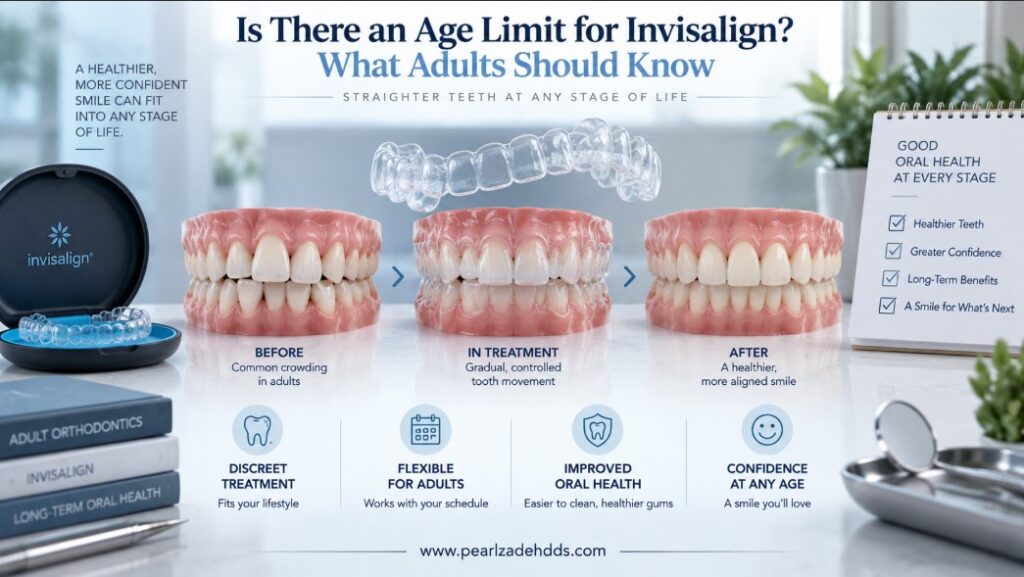
You’ve thought about straightening your teeth for years, and now you wonder if you waited too long. Maybe you’re in your 40s, 50s, or 60s and assume Invisalign suits younger patients with healthy, straightforward mouths. Maybe you had braces decades ago and your teeth have shifted since then. Or perhaps you never addressed crowding that has bothered you throughout adulthood.
There isn’t a simple upper age cutoff for Invisalign. Adults can potentially receive treatment later in life, and age by itself doesn’t determine whether you’re a candidate. What actually matters is your oral health, tooth stability, gum health, bone support, bite concerns, and treatment goals. Those factors, not your birth year, are what a provider actually looks at.
Is There an Age Limit for Invisalign?
Invisalign is used for adults just as often as younger patients, and being older doesn’t automatically rule out treatment. The real question isn’t about a specific birthday. It’s about whether your teeth and the tissues supporting them can safely undergo the kind of movement Invisalign involves. There’s no universal maximum age written into how the treatment works or how providers evaluate candidates.
Teeth remain capable of moving throughout adult life, since the bone surrounding each tooth continuously remodels in response to steady pressure, the same biological process that allows orthodontic movement to work at any age in the first place. What changes over decades isn’t that ability itself. It’s the surrounding conditions: whether gum disease has affected the bone supporting your teeth, whether decades of wear or previous dental work have altered how your teeth actually fit together, and whether any of that needs attention before orthodontic movement makes sense. Those are individual clinical questions, not automatic disqualifiers tied to a particular age.
Can You Get Invisalign in Your 40s, 50s, or 60s?
Often, yes, depending on your specific situation. Adults commonly seek treatment later in life for crowded teeth, spacing that’s opened up over the years, certain bite problems, teeth that have gradually shifted, or relapse after orthodontic treatment they had decades earlier. The reasons tend to shift somewhat by life stage. Patients in their 40s often notice teenage orthodontic work slowly relapsing after years without a retainer. Patients in their 50s and 60s more often bring in decades of gradual shifting, wear, or spacing that developed without any prior treatment at all, sometimes alongside restorations placed years earlier that now factor into planning. Not every bite problem can be corrected with Invisalign, though, and whether it’s the right fit depends entirely on your individual case rather than which decade of life you’re in.
What Matters More Than Your Age?
A handful of clinical factors matter more than how old you are.
Healthy Gums
Active gum disease may need attention before orthodontic treatment starts, since teeth need healthy supporting tissue to move safely and predictably. Our discussion of early signs of gum disease covers what to watch for if you’re unsure where your gum health currently stands.
Stable Teeth and Supporting Bone
Teeth need adequate bone support underneath them to handle the gradual pressure orthodontic movement applies. When that supporting bone has been reduced, whether from past gum disease, bone loss, or other factors, a tooth can become more mobile than it should be, which changes what’s safe to attempt. There’s no specific bone-density number that determines candidacy on its own. This is something your provider evaluates directly, often with imaging that shows the bone level around each tooth, rather than something that can be estimated from age alone.
Cavities and Existing Dental Problems
Untreated decay or other active dental problems generally need to be addressed before starting orthodontic treatment. Moving a tooth that has an unresolved cavity, a crack, or an infection underneath it can complicate both problems at once, and aligners can make certain areas harder to keep clean if decay is already present. Getting a clean bill of dental health first tends to make the orthodontic phase considerably more straightforward.
Your Bite and Treatment Goals
The type and complexity of your bite problem genuinely affects whether Invisalign is the appropriate tool for the job. Our comparison of Invisalign for mild versus more complex cases goes further into how treatment can differ depending on what you’re actually trying to correct.
Does Invisalign Work Differently as You Get Older?
Adult treatment tends to involve considerations that simply aren’t relevant for a teenager. Existing dental restorations, current gum health, previous orthodontic treatment, natural tooth wear, bite changes that have accumulated over years, and other dental work that may need attention all factor into planning for adult patients in a way they typically don’t for younger ones. A teenager’s treatment plan usually starts from healthy, unrestored teeth and gums. An adult’s plan more often starts from a mouth with some combination of fillings, a crown or two, and years of normal wear, all of which the provider needs to account for before deciding how teeth can safely move. This doesn’t mean Invisalign becomes less effective with age, and it doesn’t mean older adults automatically need longer treatment. It means the planning process accounts for a more complete dental history.
Does Invisalign Take Longer for Older Adults?
Treatment time genuinely varies from person to person, and age alone doesn’t determine how long it takes. What actually influences duration includes how complex the required tooth movement is, your starting bite, how consistently you wear your aligners, missed appointments or interruptions along the way, whether refinements become necessary, and whether any oral-health issues need attention during treatment. A peer-reviewed study examining orthodontic patients over 40 found that greater periodontal bone loss was associated with more irregular tooth positioning and higher orthodontic treatment need, which suggests that gum and bone health, not age by itself, can meaningfully affect how complex a case turns out to be. There’s no fixed timeline that applies to every adult patient.
Can You Get Invisalign If You Already Have Crowns, Bridges, or Other Dental Work?
Existing dental work does not automatically rule out treatment, but you should discuss it during your evaluation. Crowns, bridges, fillings, veneers, and previously treated teeth can respond differently to orthodontic pressure than natural teeth. A crown or filling generally moves with the tooth it covers, but the material and bonding method can affect treatment planning. Bridges require more consideration because they connect neighboring teeth. They cannot move independently like a single tooth, which can affect what treatment can achieve in that area.
The American Association of Orthodontists notes that adults often present with restorations, missing teeth, or periodontal concerns that need to be stabilized before tooth movement begins, which is a genuine difference from most younger patients, whose teeth are typically unrestored. Your provider needs to assess the condition, position, and function of each restored tooth before building a treatment plan around it.
What About Invisalign After Previous Braces?
Plenty of adults had braces as teenagers and later noticed their teeth shifting, often after retainer use stopped years ago. Teeth don’t stay locked in place forever after braces come off. Natural forces from chewing, tongue and lip pressure, and simple aging keep exerting a gentle pull toward their original positions over decades, which is exactly why relapse happens even in patients who had genuinely successful orthodontic results the first time.
This kind of relapse is a common reason adults return to orthodontic treatment later in life. What actually makes sense for you depends on where your teeth currently sit and what you’re hoping to accomplish this time around. Our comparison of Invisalign and other clear-aligner options goes further into the differences worth understanding before deciding.
What Should Older Adults Expect During an Invisalign Evaluation?
A thorough evaluation typically covers your dental and oral-health history, your current gum health, the condition of your teeth, any existing restorations, your bite and current alignment, and what you’re actually hoping to achieve. Your provider considers whether Invisalign can realistically address your specific concern, and whether any other dental treatment, such as treating a cavity, addressing gum inflammation, or repairing an aging restoration, should happen first.
This often includes photographs, digital scans or impressions, and sometimes X-rays to see the bone and root structure beneath the gumline. The exact process varies somewhat between providers, so this is a general description rather than a fixed protocol every practice follows identically.
What If You Need Invisalign Refinements?
Refinements are additional aligners sometimes used partway through or near the end of treatment to fine-tune movements that need a bit more adjustment. Our explanation of how Invisalign refinements work covers this in more depth. Needing refinements isn’t something older adults automatically run into more than anyone else. It depends on the specific case, not the patient’s age.
Is Invisalign a Good Option for Older Adults?
For appropriate candidates, yes, Invisalign can be a good fit. Removable aligners are less noticeable than traditional braces. They also make it easier to maintain your normal oral hygiene routine. Your dentist can plan treatment around your specific dental needs rather than using a one-size-fits-all approach. That flexibility can benefit adults who already have dental work or gum health considerations that teenagers typically do not.
That said, Invisalign isn’t automatically the right choice for every adult or bite problem. Some complex bite discrepancies, significant bone loss, or tooth movements may not respond well to aligners. In these cases, another orthodontic approach may work better. Some patients may also need coordinated care between a general dentist and an orthodontic specialist.
An honest evaluation can help determine which option fits your needs. Your dentist should assess your teeth before recommending Invisalign.
When Should You Talk to a Dentist Before Starting Invisalign?
A few situations deserve attention before you pursue orthodontic treatment. These include bleeding or swollen gums, loose teeth, significant tooth sensitivity, untreated cavities, existing dental pain, concerns about previous dental work, or a noticeably changed bite.
None of these automatically rule out Invisalign down the road, but they’re reasons to have your oral health evaluated first rather than starting orthodontic treatment on top of an unresolved issue. Bringing these concerns up early, rather than waiting until an Invisalign consultation, generally makes the whole process more straightforward for everyone involved.
Speak With Dr. Pearl Zadeh About Invisalign
If you’ve been wondering whether you’re too old for Invisalign, age alone does not answer that question. Your gum health, tooth stability, bite, dental history, and treatment goals all play a role in determining whether Invisalign is appropriate for you.
As an Invisalign Premier Provider, Dr. Pearl Zadeh can evaluate your overall oral health and discuss whether Invisalign or another treatment approach fits your needs.
Call (818) 716-6722 or click the button below to schedule your consultation online.
Frequently Asked Questions
Is there really an upper age limit for Invisalign?
No specific age limit exists. Candidacy depends on the health of your teeth, gums, and supporting bone rather than your age alone.
Can you get Invisalign after age 50?
Many adults over 50 can be good candidates, provided a dentist evaluates their gum health, tooth stability, and bite first.
Can you get Invisalign in your 60s?
Many patients can benefit from it, but your dentist still needs to assess factors like gum health, bone support, and existing dental work individually.
Does Invisalign work differently for older adults?
Planning often accounts for more dental history, including existing restorations and gum health, but the treatment itself doesn’t fundamentally change based on age.
Does Invisalign take longer as you get older?
Not automatically. Treatment length depends on the complexity of the case and oral health factors more than age itself.
This article is for informational purposes only and is not a substitute for professional dental advice. Please schedule a consultation with Pearl Zadeh DDS to discuss your specific situation.