
Your dentist just mentioned you clench or grind your teeth and suggested an occlusal splint. That sounds reasonable enough. Then you start wondering what you’re actually supposed to wear. You’ve seen those boil-and-bite guards at the pharmacy for a fraction of the cost. Why not just grab one of those instead?
An occlusal splint is a dental appliance built for a specific purpose, and which one makes sense depends entirely on what your dentist is actually trying to manage. Not every mouth guard does the same job, even when they look similar sitting in a case.
What Is an Occlusal Splint?
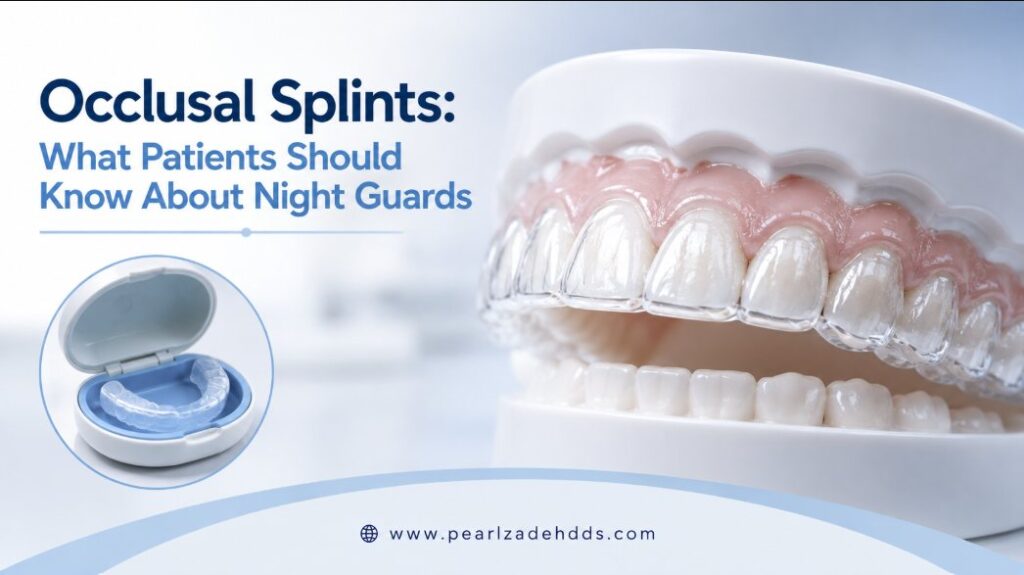
Occlusal refers to how your upper and lower teeth come together when you bite down. Splint refers to an appliance designed to sit between your teeth and influence, or protect, that contact. Put together, an occlusal splint is typically a removable appliance you wear over your teeth, built around your specific bite rather than a generic shape.
Occlusal Splint or Night Guard: Same Thing, or Not?
Patients and even dental offices sometimes use “night guard,” “bite guard,” and “occlusal splint” somewhat interchangeably, and that’s not entirely wrong. What actually varies is the appliance itself. Material, design, fit, thickness, how much of your mouth it covers, what it’s meant to accomplish, and how it interacts with your specific bite can all differ significantly between one “night guard” and another. Not every product sold as a night guard is equivalent to a professionally planned occlusal splint, though that doesn’t mean every store-bought option is automatically unsafe or useless.
A randomized controlled trial comparing over-the-counter and custom bite splints found that patients using the self-fitted, over-the-counter version had a harder time getting the fit to a clinically acceptable standard compared to those using a custom appliance. That’s less about OTC products being inherently bad and more about fit mattering more than people expect, and a dentist being better positioned to get that fit right for your specific teeth.
Why Would Your Dentist Recommend One?
Common reasons include teeth grinding, clenching, forces on your teeth that seem excessive for normal use, visible wear, repeated chipping, certain jaw symptoms, and in some cases protecting existing dental work. When jaw symptoms are part of the picture, an occlusal splint may be one part of managing them, but it isn’t automatically the right treatment for every TMJ problem. Plenty of jaw issues have causes and solutions that have nothing to do with an appliance at all.
How Does an Occlusal Splint Protect Your Teeth?
The appliance creates a controlled surface between your upper and lower teeth, which reduces direct tooth-to-tooth contact and spreads force across the appliance rather than concentrating it on your enamel. What it doesn’t do is prevent every possible form of damage, and it doesn’t stop you from grinding in the first place. There’s a real difference between protecting your teeth from the direct impact of grinding and actually eliminating the underlying habit. A splint generally does the first one, not the second.
Can an Occlusal Splint Stop You From Grinding?
Not necessarily. Wearing one doesn’t automatically make the clenching or grinding stop. You can absolutely still grind while wearing your splint. Its job is usually to protect your teeth and manage the forces involved, not to eliminate the behavior itself. That’s a distinction worth understanding before you start wearing one, so you know what to actually expect.
Who Actually Needs One?
Not every patient who grinds their teeth needs an appliance. Your dentist weighs how much wear is already present, how often and how forcefully you grind, whether you’re experiencing sensitivity, cracks, or chips, any existing restorations you have, jaw symptoms, your bite, your overall dental health, and whether things seem to be getting worse over time. If you have crowns, veneers, bridges, or fillings, that’s one more factor your dentist considers when deciding whether a splint makes sense and what design would actually fit your mouth well. Our porcelain veneers guide touches on some of those durability considerations if cosmetic work is part of your situation. Mild signs sometimes just get monitored over time. Others genuinely benefit from an appliance.
What Happens When Your Dentist Makes One?
The process generally involves examining your teeth and bite, discussing your symptoms and grinding or clenching habits, taking digital scans or impressions, choosing an appliance design suited to your situation, having it fabricated, checking the fit once it arrives, and making adjustments if it doesn’t feel quite right. Not every appliance follows the exact same steps, since the specifics depend on what your dentist is trying to accomplish.
What Should an Occlusal Splint Feel Like?
A brand new appliance usually feels unfamiliar at first. Some patients describe it as slightly bulky, a bit tight, or just different against the tongue or cheeks. Biting down with it in can feel unusual too. Most of this settles as you get used to wearing it. Significant pain, soreness that doesn’t ease up, an inability to bite comfortably, or an appliance that feels unstable in your mouth are all reasons to call your dentist rather than waiting it out.
Can an Occlusal Splint Change Your Bite?
Since the appliance sits directly between your teeth, your bite can feel temporarily different while it’s in place, which is expected. A properly selected appliance, monitored by your dentist, is built around your specific needs. If wearing it causes a significant or persistent change to your bite that doesn’t resolve, that’s worth discussing rather than continuing to wear it and hoping it settles on its own. Not every appliance permanently changes anyone’s bite, but any lasting change deserves a conversation.
How Long Do Occlusal Splints Last?
There’s no single lifespan that applies to every patient. How often you wear it, how forcefully you grind, the material and design of the appliance, and how well you care for it all factor into how long it holds up. Patients who grind heavily tend to wear through their appliance faster than someone with milder clenching. Regular dental visits help your dentist catch when an appliance needs adjusting, repairing, or replacing before it stops doing its job effectively.
Caring for Your Appliance
Rinse it after you take it out, and clean it regularly the way your dentist recommends, often with a soft toothbrush rather than anything abrasive. Let it dry before putting it away, and keep it in its case rather than loose in a drawer or bag. Avoid exposing it to high heat, which can warp the material, and skip harsh cleaning products unless your dentist or the manufacturer specifically says they’re fine to use. Since care instructions can vary by material, it’s worth confirming the specifics for your particular appliance rather than assuming one routine covers every type.
What Happens If You Stop Wearing It?
Your teeth stop getting whatever protection or support the appliance was prescribed to provide. Missing one night here or there isn’t the same as routinely abandoning it altogether. Research on splint use notes that stopping altogether has been linked to a return of symptoms that had settled down, whether related to jaw discomfort or grinding itself. If the appliance is uncomfortable or you’re thinking about stopping altogether, that’s worth bringing up with your dentist rather than just quietly setting it aside.
If Your Splint Suddenly Feels Different
An appliance that no longer fits the way it used to, feels noticeably tighter or looser, has cracked, has a piece missing, has become uncomfortable, or seems to be affecting your bite differently than before are all reasons to reach out to your dentist. Don’t try bending, cutting, heating, or reshaping it yourself. That’s more likely to make things worse than fix the actual problem.
Occlusal Splints and TMJ Symptoms
Some occlusal splints get used as part of managing certain jaw symptoms, but TMJ disorders have multiple possible causes and different treatment approaches depending on what’s actually going on. An appliance isn’t a fix for every clicking jaw, every instance of jaw pain, or every TMJ diagnosis. Our discussion of TMJ and jaw clicking goes further into what jaw symptoms can and can’t tell you on their own, if that’s part of what brought you here.
Occlusal Splints and Teeth Grinding
Patients who already show visible signs of wear tend to have a different conversation about appliance protection than someone with occasional clenching and no signs of damage yet. Our discussion of how teeth grinding damages teeth over the years covers what that wear can actually look like, which helps explain why the same recommendation doesn’t apply to every patient who mentions grinding.
When Should You Talk to Your Dentist?
A handful of situations are worth bringing up rather than waiting on:
- New or worsening tooth wear
- Frequent teeth grinding
- Repeated chips
- A cracked tooth
- Tooth sensitivity
- Morning jaw soreness
- Jaw pain
- An appliance that no longer fits
- A broken appliance
- A noticeable change in your bite
- Persistent discomfort while wearing your appliance
You don’t need to wait until significant damage has already happened before mentioning grinding or clenching to your dentist.
Speak With Dr. Pearl Zadeh About an Occlusal Splint
Not every patient who clenches, grinds, or notices jaw symptoms needs the same type of appliance, or one at all. Dr. Pearl Zadeh, a member of the American Dental Association and California Dental Association, can evaluate your teeth, bite, existing dental work, and grinding or jaw concerns to help determine whether an occlusal splint makes sense for your situation.
Schedule a consultation to talk through what you’re experiencing and get a clearer picture of what might actually help.
Call (818) 716-6722 or click the button below to schedule a consultation online.
Frequently Asked Questions
Is an occlusal splint the same as a night guard?
The terms are often used interchangeably, but appliances themselves can differ quite a bit in material, fit, and purpose. Not every product sold as a night guard matches a professionally planned occlusal splint.
Will an occlusal splint stop me from grinding my teeth?
Not necessarily. It’s designed to protect your teeth and manage the forces involved, not to eliminate the grinding habit itself.
Do I need a custom night guard, or is a store-bought one fine?
It depends on your specific situation. A properly fitted custom appliance tends to offer more reliable protection, but the right choice comes down to what your dentist is trying to manage.
Can wearing an occlusal splint change my bite?
Your bite can feel temporarily different while the appliance is in place. A significant or persistent change is worth discussing with your dentist rather than continuing to wear it as is.
Does everyone who clenches or grinds need an occlusal splint?
No. Whether one makes sense depends on the amount of wear, your symptoms, your dental history, and how things are progressing over time.
This article is for informational purposes only and is not a substitute for professional dental advice. Please schedule a consultation with Pearl Zadeh DDS to discuss your specific situation.