
A damaged molar often leaves one key question. Should the tooth be partially covered or fully protected?
The answer depends less on preference and more on how much healthy structure remains after decay or an old filling is removed.
Dr. Pearl Zadeh’s Woodland Hills practice evaluates each tooth individually and decides between dental onlays and full crowns based on what will best support long-term function.
The difference comes down to how each restoration works and how much of the natural tooth can still be preserved.
The Core Difference Comes Down to Tooth Removal
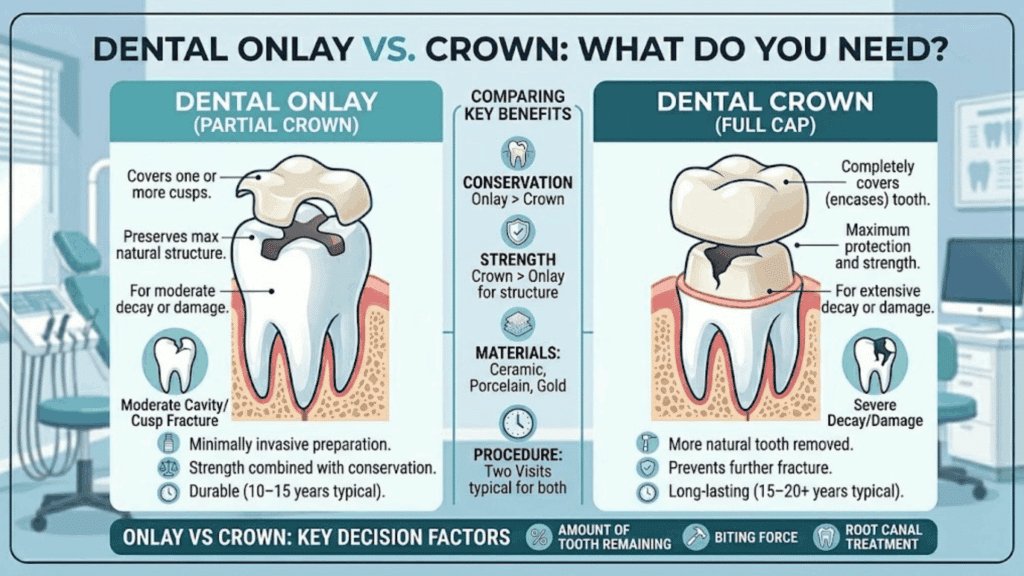
An onlay only covers the damaged part of the tooth, usually one or more cusps, while leaving the rest of the natural surface intact. A crown, on the other hand, covers the entire tooth from top to bottom.
To place a crown, a dentist has to reduce the tooth on all sides. This usually means removing about one to two millimeters of structure, including healthy enamel that cannot grow back.
An onlay takes a more conservative approach. It only replaces the areas affected by decay or damage, while preserving the healthy enamel wherever possible.
The same principle applies when comparing inlays and fillings. The less healthy tooth structure that needs to be removed, the more natural strength the tooth can often retain over time.
Why a Tooth Sometimes Needs a Crown Instead
The need for a crown usually comes down to how much of the tooth is still strong enough to support a restoration. An onlay only works when enough healthy structure remains to bond and reinforce.
When multiple cusps are fractured or badly decayed, there often isn’t enough solid tooth left to support an onlay. The same applies when a vertical crack extends below the gumline, since that area cannot be fully covered or protected by a partial restoration.
Teeth that have had root canal treatment also change the equation. Without a blood supply, the tooth becomes more brittle over time and more likely to fracture under pressure.
Severe wear from grinding can lead to the same issue. When the cusps are flattened, there is often nothing left for an onlay to properly cap.
A crown solves these problems by fully covering the tooth. It acts like a protective shell, helping distribute bite forces evenly and reducing the risk of the tooth splitting during normal chewing.
Why an Onlay Is Often the Better Choice When It’s an Option
Dentists usually try to preserve as much natural tooth structure as possible, as long as the tooth can still function safely.
An onlay supports that goal by covering only the damaged areas instead of reducing the entire tooth. This means less healthy enamel needs to be removed compared to a crown.
Because an onlay bonds directly to the remaining tooth, it helps distribute chewing forces across both the restoration and natural structure. In many cases, this allows the tooth to feel closer to how it functioned before damage occurred.
Treatment time can also be shorter since the preparation is more conservative than a full crown.
This approach is not about doing less. It is about keeping as much of the natural tooth as possible while still restoring strength and function for daily use.
How the Procedures Actually Differ
An onlay procedure focuses on removing only the damaged or decayed part of the tooth while keeping as much healthy structure as possible. Once the tooth is prepared, a scan or impression is taken to capture its exact shape. A temporary restoration is placed to protect the tooth while the final onlay is made. At the next visit, the finished onlay is bonded into place using resin cement and a curing light.
A crown procedure involves more reduction of the tooth. The entire tooth is reshaped to allow space for a full-coverage restoration. After preparation, a scan or impression is taken, and a temporary crown protects the tooth until the final version is ready. The completed crown is then cemented over the entire tooth.
The key difference comes down to how much natural tooth structure is removed. An onlay preserves more of the original tooth, while a crown requires more extensive reshaping that cannot be reversed.
Onlay vs Crown: Key Differences
| Factor | Onlay | Crown |
| Coverage | One or more cusps | Entire visible tooth surface |
| Tooth structure removed | Only damaged areas | Roughly 1 to 2mm on every surface |
| Best for | Localized damage with intact remaining structure | Extensive damage, root canal treated teeth, severe cracks |
| Procedure reversibility | Can sometimes be replaced without major tooth loss | Tooth reduction is permanent once completed |
| Typical longevity | 15 to 30 years with ceramic or gold | 15 to 30 years with porcelain or zirconia |
What Happens If You Choose an Onlay When You Actually Needed a Crown
An onlay depends on having enough healthy tooth structure to distribute chewing forces evenly. When that support is not there, the remaining tooth walls take on more stress than they should.
Over time, those weakened areas can start to flex with every bite. Without proper support, that stress can eventually lead to a crack that extends below the gumline.
At that stage, the tooth may no longer be restorable, and extraction can become the only option. In many cases, this outcome could have been avoided with a crown placed earlier.
This is why a careful evaluation matters before choosing between an onlay and a crown. The right decision depends on the actual strength of the remaining tooth, not just the visible damage.
What Happens If You Choose a Crown When an Onlay Would Have Worked
In this case, the tooth still gets restored, but more healthy structure is removed than necessary.
Once a tooth is reduced for a crown, that natural structure cannot be restored later. If the crown ever needs replacement, treatment usually stays within the crown category rather than shifting to a more conservative option.
Both approaches protect the tooth from decay and fracture, but unnecessary reduction means losing more natural enamel than required for the situation. Careful diagnosis helps avoid that trade-off from the start.
How Your Dentist Actually Makes This Call
During an exam, Dr. Pearl Zadeh looks closely at how much healthy cusp structure is still supporting the tooth. She also checks for hidden cracks and reviews X-rays to understand how deep the decay extends.
In some cases, the final decision only becomes clear once treatment begins. Decay often reaches further than what appears on an X-ray, so a planned onlay may need to change to a crown if more structure is compromised than expected.
This is a normal part of restorative dentistry. X-rays give important information, but they cannot fully show the strength or integrity of the remaining tooth.
Find the Right Restoration for Your Tooth
The choice between an onlay and a crown depends on how much healthy tooth structure is still present. It is less about preference and more about what the tooth can safely support. Many patients share their experiences through our patient testimonials, often highlighting how clear the diagnosis helped them feel confident about their treatment.
Dr. Pearl Zadeh’s Woodland Hills practice evaluates each tooth individually before recommending a restoration. If you are dealing with a damaged tooth, call (818) 716-6722 or click the button below to schedule your consultation online. A thorough evaluation can determine whether an onlay or a crown is the better choice for preserving your tooth.
Schedule a ConsultationFrequently Asked Questions
1. Can an onlay protect a tooth as well as a crown?When enough healthy tooth structure remains, yes. An onlay can strengthen and protect a damaged tooth while preserving more natural enamel than a crown.
2. Will my dentist know in advance which restoration I need?Often, yes. X-rays and a clinical exam provide valuable information. However, the final decision sometimes becomes clear only after all decay is removed.
3. Does a root canal always mean I need a crown?Not always, but crowns are commonly recommended after root canal treatment. These teeth become more brittle over time and often benefit from full coverage.
4. Is it possible to switch from a crown to an onlay later?No. Once a tooth is prepared for a crown, the removed tooth structure cannot be restored. Future treatment typically involves replacing the crown rather than moving to a more conservative restoration.
5. How do I know if my onlay may be failing?New sensitivity, pain when chewing, a visible crack, or changes around the restoration can all be warning signs. A dental exam can determine whether the restoration remains stable and whether additional treatment is needed.