
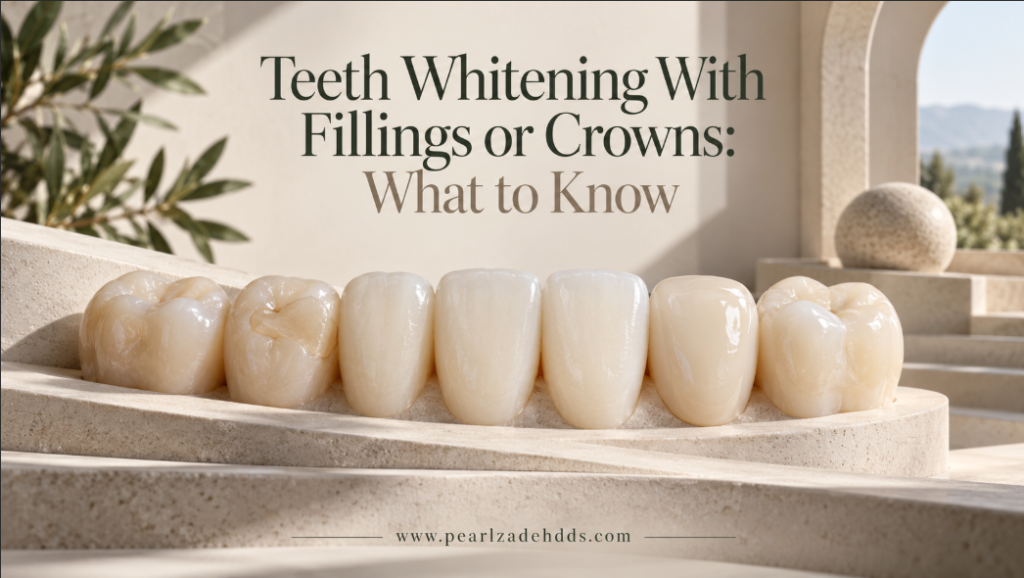
Most people picture whitening as something that lifts the whole smile evenly. If you already have fillings or crowns, that picture needs adjusting. Natural tooth structure and restorative materials do not necessarily change shade in the same way or to the same degree.
Having dental work does not rule out whitening. The useful question is where your restorations sit, how visible they are, and whether a shade difference would bother you afterward.
Can You Whiten Your Teeth If You Have Fillings or Crowns?
Often, yes. Whitening can still be considered, and existing restorations simply become part of the planning rather than a reason to stop.
What matters is telling four things apart: your natural tooth structure, which responds to bleaching; existing fillings; existing crowns; and where each of those sits in your mouth. A composite filling on a back molar raises a very different question than a crown on an upper front tooth. The material and the visibility both count.
Do Crowns Whiten Like Natural Teeth?
No. Whitening agents are designed to act on natural tooth structure, breaking down pigment within enamel and dentin. The American Dental Association states that only natural teeth can be whitened, not tooth-colored restorations. A crown is made from porcelain, ceramic, metal, or a combination, and those materials do not lighten the way enamel does.
The cosmetic consequence is the part patients tend to miss. Suppose a front-tooth crown was carefully shade-matched to your natural teeth when it was placed. It looked right because everything around it was the same color. Whiten those surrounding teeth and the crown can begin to stand out, even though nothing about the crown itself has changed. The mismatch is relative, not a defect in the restoration.
Do Fillings Whiten Like Natural Teeth?
Here the answer is less uniform, and the material matters. Tooth-colored fillings are usually composite resin, which behaves differently from porcelain. An in vitro study comparing restorative materials exposed porcelain, glass ceramics, and a polymer-containing material to two home bleaching agents. The polymer-containing material showed appreciable color change with one agent, and with the other, both that material and one of the glass ceramics showed noticeable change. The authors concluded that restorations should be protected before bleaching, and polymer-containing materials especially, because of the risk of color change.
That study used laboratory specimens rather than restorations in a patient’s mouth, so it indicates a difference between material types rather than predicting your specific filling. The practical takeaway holds, though: bleaching does not lighten a composite filling to match a newly whitened tooth, and different restorative materials do not all respond identically.
Location shapes how much any of this matters. A tooth-colored filling on a front tooth sits in the visible smile zone. The same material on a back tooth rarely shows. Surface staining on a restoration is also a separate issue from the shade the material was made in, and the two get confused often.
Can Whitening Make a Crown or Filling Look Darker?
It can look that way, though what usually changes is the comparison rather than the restoration. The natural teeth become lighter, and the restoration stays where it was, so the contrast between them grows.
A crown matched to teeth at their original shade may be barely noticeable beforehand. After the surrounding teeth lighten by several shades, that same crown can read as noticeably darker. Nothing happened to the crown.
This is not inevitable. How obvious any difference becomes depends on how much your natural teeth actually change, how closely the restoration was matched to begin with, and where it sits in your smile.
Does It Matter Where the Crown or Filling Is?
Front teeth
Restorations in the smile zone carry the most cosmetic weight. A crown or tooth-colored filling on an upper front tooth is visible whenever you talk or smile, so a shade difference there gets noticed. These are the restorations worth discussing in detail before whitening rather than after.
Back teeth
Restorations farther back generally have less visual impact, since they rarely show during normal smiling. That reduces the cosmetic concern, but it does not automatically make whitening appropriate. Your overall oral health, sensitivity, and the condition of your teeth still belong in the decision regardless of where your dental work happens to be.
What If Your Crown Is Already Darker Than Your Natural Teeth?
Temporary tooth sensitivity and gum irritation are the most commonly reported side effects of whitening, according to the ADA. These effects can occur with different whitening methods, and no approach guarantees a sensitivity-free experience. Sensitivity during whitening does not necessarily mean you damaged your enamel. It usually remains temporary and resolves after treatment.
If you already experience sensitivity, consider it before choosing a whitening method. Your dentist can adjust the concentration, contact time, and frequency based on your needs.
What If Your Filling Looks Darker After Whitening?
The same principle applies. The filling probably has not changed much. The tooth around it is lighter, so the filling now reads as darker by comparison.
What to do about it depends on the restoration type, where it sits, its current condition, how visible it is, and how much the appearance actually bothers you. Some patients decide it is not worth further treatment. Others want a visible front-tooth restoration updated to match. Our article on why whitening sometimes doesn’t work covers the related situation where whitening produces less change than expected for other reasons entirely.
Should You Whiten Before Replacing a Crown or Filling?
If a visible restoration is going to be replaced anyway, the sequence matters. A new crown or filling is made in a selected shade, and that shade gets chosen to match your teeth as they are at that moment. Whitening afterward leaves the new restoration behind. Deciding what shade you actually want your natural teeth to be, before the new restoration is fabricated, avoids that. Our article on whitening before veneers or crowns covers that planning sequence in detail, including why dentists often want a whitened shade to stabilize before finalizing a match.
Can You Whiten Around an Existing Crown or Filling?
Yes. Whitening still acts on the natural tooth structure surrounding a restoration, including the parts of a filled tooth that remain natural enamel. Before treatment, a dentist may want to look at where the restoration sits, your current tooth shade, what the restoration is made of, any sensitivity you experience, the condition of the tooth itself, and what result you are hoping for. Our guide to whitening with sensitive teeth and our discussion of whitening and enamel cover two of those factors in more depth.
What If You Have Several Crowns or Fillings?
Shade planning matters more as the amount of visible dental work increases. Someone with one small filling on a back molar has a simpler decision than someone with three crowns across their upper front teeth.
With multiple visible restorations, whitening the natural teeth between and around them can leave a patchwork effect rather than an evenly brighter smile. That does not rule whitening out. It means the conversation should cover the whole smile rather than one tooth, and it may point toward planning whitening and restorative work together rather than separately.
Can Whitening Remove Stains From Crowns or Fillings?
This is where an important distinction lives. Removing surface stains from a restoration is not the same as lightening the material itself. A systematic review of bleaching agents used on discolored composite restorations found that bleaching agents were successful at eliminating stains and returning color close to baseline values, while also noting that the degree of reversal depended on which composite material was involved, and that the included studies were laboratory based.
Read that carefully, because it is easy to over-interpret. Bleaching may lift accumulated staining off a composite restoration and bring it back toward the shade it originally was. That is different from making it lighter than it was built to be. The restoration’s baseline shade is the ceiling.
Professional cleaning or polishing can also address certain surface deposits on restorations. Neither cleaning nor bleaching restores every discolored restoration, and what is achievable depends on the material and what is actually causing the discoloration.
What If Whitening Creates a Shade Mismatch?
Several responses exist, and they are not a ladder to climb. A dentist may suggest leaving the restoration alone, particularly if it is not prominent. Cleaning or polishing may help if surface staining is contributing. Monitoring the shade for a period makes sense in some cases, since whitening results settle. Replacing a visible restoration is reasonable when the mismatch genuinely bothers the patient and the restoration is a candidate for replacement. And future restorative work can be planned around the tooth shade you now have.
Replacement is not a required step after whitening. It is one option, appropriate in some situations and unnecessary in others.
How Can You Plan Whitening When You Have Dental Work?
A few questions are worth thinking through before you start. Which of your teeth have fillings or crowns? Are those restorations visible when you smile? Are any of them already a different shade from the teeth around them? Do you experience sensitivity? Are you planning any new cosmetic restorations in the near future? And how much change do you actually want, as opposed to how much is possible? Professional teeth whitening begins with exactly this kind of assessment.
Does Having Crowns or Fillings Mean You Should Not Whiten?
No. Restorations do not make whitening inappropriate. They change what the result may look like, because some teeth will respond and others will not. Location, material, current shade, and what you want to achieve all factor in. How long your results last is a separate question worth knowing about too, since natural teeth gradually pick up staining again while restorations follow their own course.
Speak With Dr. Pearl Zadeh About Whitening With Existing Dental Work
Whitening remains an option for most people who have fillings or crowns. The real consideration is how your natural teeth and your existing restorations will look alongside each other once treatment is done. Dr. Pearl Zadeh can assess which of your restorations are visible, how closely they currently match, and whether whitening is likely to give you the result you actually want.
Call (818) 716-6722 or click the button below to schedule your consultation online.
Frequently Asked Questions
Yes, whitening still works on your natural teeth. The crowns will not lighten with them, which can create a shade difference if they are visible.
Yes. Whitening acts on natural tooth structure, including the enamel around a filling, though the filling material itself will not lighten to match.
No. Crown materials do not respond to bleaching the way enamel and dentin do, so a crown keeps its existing shade.
They may look darker by comparison once the surrounding tooth lightens, particularly on front teeth. The filling itself typically has not changed.
Not automatically. Replacement is one option among several, and it depends on how visible the restoration is and whether the difference bothers you.
Bleaching may lift surface staining from composite and return it toward its original shade, but it cannot make the material lighter than it was made.
This article is for informational purposes only and is not a substitute for professional dental advice. Please schedule a consultation with Pearl Zadeh DDS to discuss your specific situation.